THE WARM EARTH:
THERMAL REMOTE SENSING
We have already shown several
previews of imagery that depict the thermal state of the Earth's surface. The
Landsat Thematic Mapper band 6 produces images that show the relative differences
in emitted thermal energy from surfaces of varying nature and orientation. On
, we showed this effect in the obviously warmer slopes in the Morro Bay scene
and in Section 2, the surprisingly cool surfaces of the bright, white sandstone
at the Waterpocket Fold. In seeming contradiction, the warmer surfaces associated
with dark shales showed clearly in the Waterpocket Fold image. As we shall show,
these thermal effects also differ, sometimes drastically, in images taken during
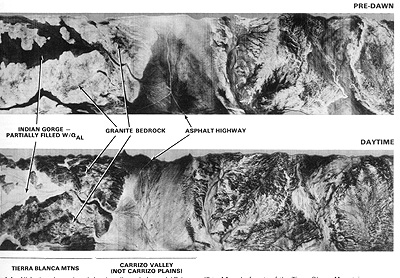
the warmer days and cooler nights. This is clearly the case in this airborne thermal
scanner image of a valley-mountain terrain in southern California, in which the
same features may appear in sharply contrasting tones between the dawn and day
scenes:
One usually obtains considerable
information from thermal imagery, especially that generated as multispectral
images. Some of this information supplements images obtained from reflected
radiation and some stands alone as an information source. In this section review,
we delve rather extensively into the theory and practice of thermal remote sensing
and examine some striking examples obtained from land and water targets. However,
we postpone our discussion of using thermal sensors to obtain temperature profiles
or find other thermal properties in the atmosphere until we consider meteorological
satellites (Section 14).
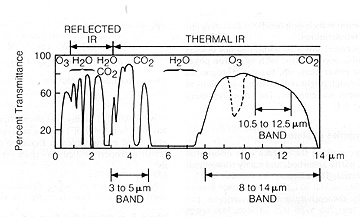
Remote sensing of direct
temperature effects is carried out by sensing radiation emitted from matter
in the thermal infrared region of the spectrum. Most thermal sensing of solids
and liquids occurs in two atmospheric windows, where absorption is a minimum,
as shown in this spectral plot taken from Sabins (Remote Sensing: Principles
and Interpretation, 1987).
The windows normally used
from aircraft platforms are in the 3-5 µm and 8-14 µm wavelength regions. Space
borne sensors commonly use windows between 3 and 4 µm and between 10.5-12.5
µm. None of the windows transmits 100 percent because water vapor and carbon
dioxide absorb some of the energy across the spectrum and ozone absorbs energy
in the 10.5-12.5 µm interval. In addition, solar reflectance contaminates the
3-4 µm window to some degree during daylight hours, so we use it for Earth studies
only when measurements are made at night.
Planck Blackbody Law
Two material properties
determine the amount of thermal radiation emitted by an object: internal temperature
and emissivity. The Planck Blackbody Law gives the rate at which objects radiate
energy:
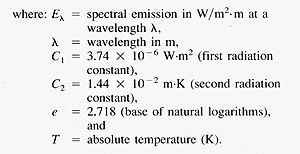
E = C1-5[exp (C2/T) - 1]-1,
A perfect blackbody
is the concept of an ideal material that completely absorbs all incident radiation,
converting it to internal energy. Therefore it does not permit any transmittance
or reflectance but emits the absorbed energy at the maximum possible rate.