|
Ratio, PCA, and Maximum Likelihood Analysis of the
Utah Site
|
Very believable portrayals of the different alteration types at White Mountain were achieved by ratioing, principal components analysis, and maximum likelihood supervised classification, acting on both Landsat TM and Bendix scanner data. Also, a preview of the power of hyperspectral remote sensing is introduced on this page.
The question now becomes: what special processing will accentuate or enhance the alteration types? Using this summer, 1984, Landsat 4 image, we try three types: ratioing, Principal Components Analysis (PCA), and Supervised Classification.
Examine in succession, four ratio images, about which we will briefly comment.
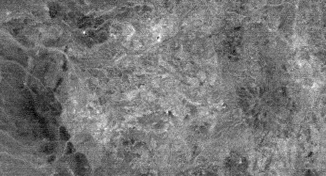
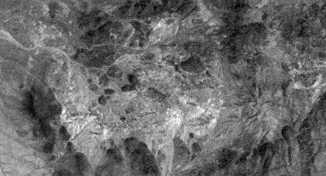
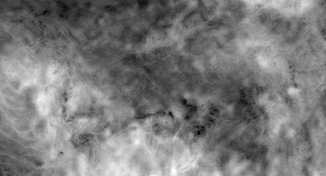
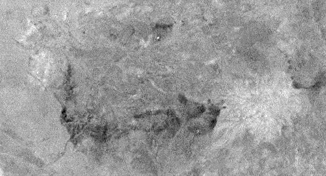
The ratio ofTM Band 3 to Band 1 (3/1) renders most of the area in rather dark grays, but several areas are whitish (brighter). These probably correspond to zones of strong hematitic alteration (very reflective in band 3 but dark in band 1). The ratio 4/2 is similar but the bright areas appear displaced. These may mark local areas of denser vegetation.
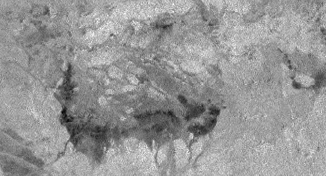
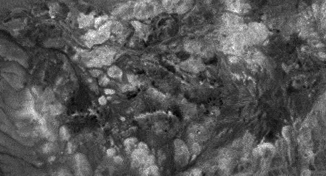
The 7/5 image has a unique pattern, in which a hook-shaped dark area within a scene otherwise light-toned coincides closely to the general altered zone. Band 7 is an excellent detector of hydrous minerals such as the clays, alunite, etc., because these absorb radiation (hence significantly reduce reflectance). Ratio 1/7 shows bright areas that are approximately the same as the basalts and some of the andesites.
5-6: If you had to choose a single ratio image as the one to take with you into the field to check out alteration, which would you pick and why? ANSWER
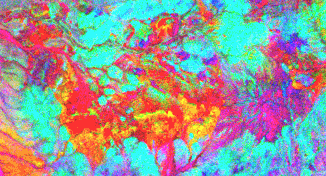
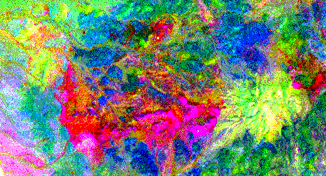
A ratio color composite made up of Blue = 7/5, Green = 1/7, and Red = 3/1 does not separate the two volcanic rock types (both are blue-green) but shows White Mountain as purple and renders some of the k/a (kaolinite/alunite) areas yellow.
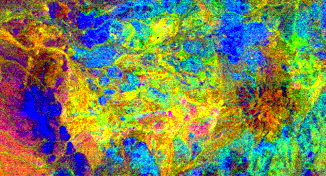
A second ratio composite (second image above), with Blue = 1/7, Green = 4/2, and Red = 3/1, produces a much different result. The deep blue closely expresses the basalt outcrops with the andesites now in a different shade of blue. White Mountain is a distinct orange-brown, but note that the same color appears north of the basalt. The k/a zones are a purplish-red, and quite distinct from a different red for the more iron-rich zones. So, ratio images seem to improve on standard composites in terms of alteration detection.
5-7: Which of the two ratio composites would you take in the field? ANSWER
Let's evaluate the utility of Principal Components Analysis (PCA). The first principal component provides, as we've seen before, a view much like a black and white aerial photo. Lighter tones mark k/a alteration areas. There are several very bright, small spots. These are probably pits dug by prospectors (one pit exposing exceptional quality alunite was visited by the writer but was not entered because about 30 rattlesnakes were slithering about - there are limits to one's ambitions as a remote senser!).
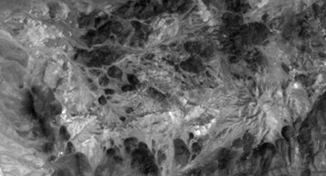
The second principal component
is darker overall, with some alteration especially dark. The image again shows
the bright spots and a bright area west of the basalt hills is part of the area
noted in the regional scene as light-toned alluvium.
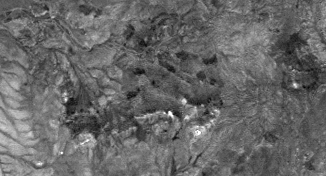
The third principal component
seems meaningless, except that the black spots probably correspond to certain
alteration zones.
A glance at the fourth
principal component shows the same dark hook-like pattern that was observed
in the ratio image 7/5. White Mountain is set apart by its light tones, with
similar tones north of the basalt deposits.
A principal component
color composite, consisting of blue = PC2, green = PC4, and red = PC1 is resplendent
with information. The basalt rocks appear blue-green, whereas the andesites
tend to be dark blues. White Mountain is a distinct yellow, as is the area
above the basalts. This strongly implies that these are outcrops of limestone
similar to those at White Mountain, however, no geologic map to prove that
supposition is available. The k/a zones appear in wine purple color. The hematitic
zones are deep reds and yellows. The areas covered by alluvium tend to be
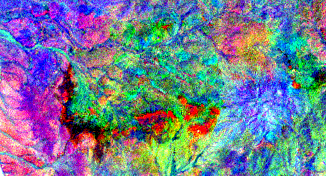
multi-colored, with uncertain boundaries. A second PCA composite
where Blue = PC4, Green = PC5, Red = PC2 is less definitive. Basalts are purple
and andesites may be green and/or yellow. White Mountain is not distinct.
The k/a zones are bright red, but part of these is bounded by a black pattern,
whose nature is puzzling. Nothing like it is evident in the individual PCA
images, but the nebulous PC5 may be contributing. Earlier, a PCA composite
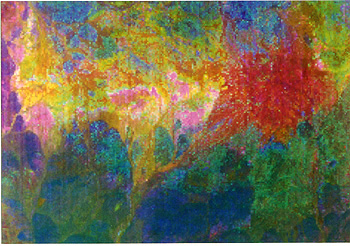
(shown below) was made from a 24-channel Bendix aircraft flight over White Mountain.
For this, they included eight non-thermal channels and combined components 1,
2, and 4 into the composite shown below. Most of the rock units mapped in the
field and identified in the Landsat images seem to show up but in some instances
occupy somewhat different areas and have dissimilar sizes of outcrop. But, we
safely conclude that, using the Bendix image as a standard, the Thematic Mapper
(TM) PCA composites match fairly well. At least, they are good enough to stand
alone as successful guides to the principal rock and alteration types defined
by field work. 5-8:
All three above PCA products each seem to have useful information.
Evaluate them beyond the information already offered in the preceding paragraphs.
What in particular is separated rather well in the two TM images? ANSWER We come now to a highlight
of Section 5, a Supervised Classification of the Landsat TM data made by IDRISI
with training sites based on the maps and on field observations by the author.
Ten classes were established and then identified in training sites used to run
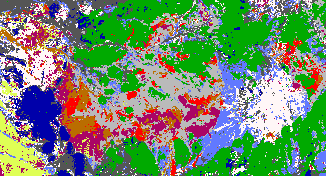
a Maximum Likelihood classifier. Here is the end result (unfortunately, the
legend initially created has been lost from the display program; see descriptions
below). This is a colorful and
a believable product. The classes designated Basalt (dark
blue) and Andesite (green) are largely where they should be in field
terms. White Mountain is well separated but its legend color (whitish) also
is found where additional limestone outcrops are postulated north of the basalts.
The Kaolinite/Alunite zone (purple) coincides well with the map information.
The class designated as Ironrich (brown) is broadly equivalent to the geologic
map unit called Moderately Hematized, whereas the class called Hematite
(red) matches at least some of the map units called Strongly Hematized.
Arbitrarily, four different classes of alluvium were set apart, based on photointerpretative
and geologic reasoning. The class MixAlluv (gray) is partly within the
altered zone and we assume it is a mix of altered rock and volcanic rock debris.
DrkAlluv (dark gray) is a differentiable deposit consisting mostly of
weathered volcanic residue. The class LsAlluv (light blue), we presume
contains considerable contributions from White Mountain and other limestone
sources. BrtAlluv (yellow) refers to alluvium west of the western basalt
hills, which probably received much of its input from the Wah Wah Mountains.
Its brightness (in individual bands and color composites) implies a variety
of light-colored detritus (fragmented debris) and clays. We also classified the
White Mountain data collected by the Bendix scanner, using 7 of its channels.
We consulted the same map to pick training sites, but these sites were not necessarily
the same as we selected for the above Supervised Classification. Plus, we employed
the IDIMS program for the processing algorithm, once again applying the maximum
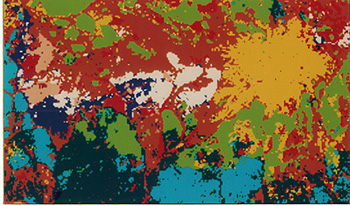
likelihood classifier. In the image above is the resulting classification and
a color code for the selected classes (note that these are not the same as for
the first classification). The major differences between the two classifications
are: 1) we subdivided the volcanic units in part by degree of vegetative cover,
and 2) we treated the unconsolidated cover (alluvium) as a single unit. In general,
the correspondence between the two classification images and between this classification
and the published map is good in both instances. 5-9:
Comparing the two classifications, how does the Bendix classification
differ from the IDRISI one? Account for this. ANSWER This case study with its
accompanying images should convince you that satellite remote sensing has practical
value. We already insinuated this idea in the Overview and the content of the
first four Sections. Besides, remote sensing can lead to possibly sensational
payoffs. We grant that the White Mountain example is almost a sure thing. The
major types of alteration are distinctly different, so much so, that the color
aerial photo is almost sufficient to produce an accurate map (remember, we said
that the images seem superior to the pre-Landsat field map). But, the special
processing products make these differences even more obvious. Imagine that we have a
one-time opportunity to stake several claims anywhere in Utah but must do so
in 30 days. Its a big state! But, with Landsat and other space imagery, properly
processed, we can shrink this huge area to just those small patches that apparently
display abundant gossan. We can visit the most promising of these
patches in brief trips, using rapid reconnaissance to seek signs of minerals.
We can take samples for quick assay to determine grade or concentration (amounts
of useful metals present per unit volume). Favorable results mean that we ought
to file a claim by the deadline. Then, we must drill and map in detail to determine
whether any mineralization we have detected is in enough gross volume to warrant
developing and mining. With any luck, we’ll learn to fully realize the
merits of prospecting from space.
Our chances of finding promising signs of mineralization will improve sharply if we use a spectrometer rather than multiband imagery. This improvement comes from many subtle variations in composition, as well as key information that helps to identify individual mineral species, that are present in detailed spectral curves but may be lost in undersampled multiband spectral data. We can now fly spectrometers on air and space platforms, providing hyperspectral rather than multispectral images and plots.