We concentrate on this page
on the inception, evolution, and demise of individual stars. A helpful Web Site
that supplements the content of this page has been put online by Prof. Nick Strobel of Bakersfield
College. Also recommended are the University of Oregon site cited
in the Preface (especially relevant are Lectures 15-18, and 20) and a site prepared
in outline form by astronomers at University of
Georgia.
Before reading the next two
pages, it may be profitable for you to get an overview of Star formation
by reading a specific page from the above-cited Oregon lectures.
The number of stars in
the Universe must be incredibly huge - a good guess is 100 billion galaxies
each containing 100 billion stars or (1011 times 1011,
which calculates as 1022. Yet on a very clear night in dry air, one
sees without using a telescope or binoculars about 2000 "star" points outside
the Milky Way in the northern hemisphere and a similar number in the southern
hemisphere. Some of these are distant galaxies, so far away that the unaided
eye can discern only an apparent single light source.Man of the brightest stars
are generally those closest to the Sun (around 1 to 100 light years away). Only
when powerful telescopes are used does the astronomer realize by estimate or
extrapolation that billions of galaxies exist; by inference we deduce that these
probably contain stars in numbers similar to those that can be roughly counted
in the Milky Way (in the tens of billions). We begin this concentration
on stars with something that is itself not truly a scientific topic but which
remains useful to astronomers as a convenient "Sky Map". Such maps contain the
Constellations - patterns of certain visible stars (a few were actually
galaxies but this was not known at the time) that the ancients imaginatively
discerned in looking at individual stars within narrow patches of the celestial
hemisphere which seemed to be distinctive and readily recognized. These arrangements
were given fanciful names, of gods, animals, and other descriptors from their
everyday experiences. This began with the Babylonians in Mesopotamia, and the
system was expanded to 88 named constellations by the Greeks and Romans some
2000 years ago. (Psychics and Fortune Tellers have used constellations as "signs"
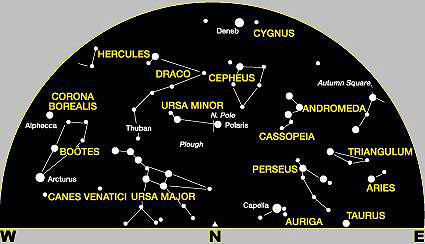
and for horoscopes for several millenia.) This next pair of illustrations (source
StarNames) shows
some of the major constellations in the northern hemisphere, plotted in two
half circle fields:
To the ancients, the stars
were all equidistant on the "celestial sphere" and varied only in brightness.
Modern astronomers now know that individual stars/galaxies in the light points
that make up the constellation pattern are actually located at various distances
from Earth, which together with diifferences in size account for their different
brightnesses. Most of the defining stars in a constellation are located in our
galaxy, the Milky Way. Astronomers often cite
individual constellations as a reference framework in specifying the location
in the celestial sphere of some stellar or galactic feature or phenomenon on
which they are reporting. However, they need to give some specific hemisphere
coordinates, either in terms of azimuth, altitude (along a meridian) and hour
time, or in another system, the declination and right azimuth. The position
of any star as seen on some specific night will vary with the hour, time of
year, and geographic location of the observer. Thus, the movement of the Earth
around its axis causes the stars during a night's observation to follow arcuate
(circles) paths around a part of the sky where the celestial pole is located
(close to the North Star pointed to by two stars in the Big Dipper [Ursa Major]).
The groups of constellations also shift with the seasons and with the place
on Earth where the star-gazer is positioned (different constellations are seen
by those in the Southern Hemisphere of the Earth than those in the Northern
Hemisphere [lookers at the Equator will see some of the constellations visible
in each Hemisphere]). More about the constellations can be found at the Star Charts and Star Map
Internet sites. For the second site, after it appears scroll down until you
see in a sentence an underlined phrase called "northern hemisphere constellations",
an example of the usual format of such maps (this one is valid for December).
This next map, also from StarNames, shows the same look direction (to the North),
as the first map above, but is a Winter view (compare and locate equivalent
constellations; but now several have disappeared and new ones have appeared).
Interesting, but back to Science.
The standard model for a star is, of course, our Sun. The Sun is typical of most
stars; as we shall note shortly, these stellar bodies vary from about 0.1 to 100
times the mass contained in the Sun. Without a telescope, under exceptional viewing
conditions (using binoculars), about 9000 individual stars can be seen in the
wide celestial band that is the central disc of the Milky Way (M.W.) galaxy. Others
elsewhere in the celestial hemisphere make up about 2000 points of stellar light
can be seen (in clear air, away from urban light contamination) by the naked eye.
Some are nearby within our galaxy and are not particularly large, while others
are mostly stars of the Giant/Supergiant types in the halo (see below) around
the Milky Way. Still others are galaxies that lie in intergalactic space beyond
the Milky Way but mostly within a billion light years from Earth. Telescopes can
resolve countless more stars in the M.W., can recognize millions of galaxies,
and can pick out some individual stars in nearby galaxies.
A degree of luminosity of
an object in the sky (galaxy; star; glowing clouds; planet) can be represented
by its apparent magnitude - a measure of how bright it actually
appears as seen by the telescope or other measuring device. This magnitude is
a function of 1) the intrinsic brightness which varies as a function of size,
mass, and spectral type (related to star's surface temperature)and 2) its distance
from Earth. (Magnitude as applied to a galaxy, which seldom shows many individual
stars unless they are close [generally less than a billion years away], is an
integrated value for the unresolved composite of glowing stars and gases within
it.) The brightness of a star can be measured photometrically (at some arbitrary
wavelength range) and assigned a luminosity L (radiant flux). For two stars (a
and b) whose luminosities have been determined, this relationship holds:
from which can be derived:
To establish a numerical
scale, some reference star(s) must be assigned an arbitrary value. Initially,
the star chosen, Polaris, was rated at +2.0 but when it was later found to be
a variable star, others were selected to be the 0 reference value for m. The
magnitude scale ranges from -m (very bright) to +m (increasingly faint) values.
The more positive the number, the fainter is the object (planet; star; galaxy);
very distant galaxies, even though these may be extremely luminous, could have
large positive apparent magnitudes because of the 1/r2 decrease in
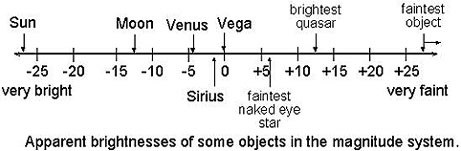
brightness with increasing distance. The Sun has the value - 26.5; the full
Moon is -12.5; Venus is -4.4; the naked eye can see stars brighter than + 7;
Pluto has a magnitude of +15; Earth-based telescopes can pick out stars visually
with magnitudes down to ~+ 20 (faintest) and with CCD integrators to about +28,
and the HST to about +30. Thus, the trend in these values is from decreasing
negativity to increasing positivity as the objects get ever less luminous as
observed through a telescope. Each change in magnitude by 1 unit represents
an increase/decrease in apparent brightness of 2.512; a jump of 3 units towards
decreasing luminosity, say from magnitude +4 to +7, results in a (2.512)3
= 15.87 decrease in brightness (the formula for this is derivable from the above
equations, such that the ratio of luminosities is given by this expression:
10(0.4)(mb - ma). Below is a simple linear
graph that shows various astronomical objects plotted on the apparent magnitude
scale:
Absolute magnitude (M) is
the apparent magnitude (m) a star would have if it were relocated to a standard
distance from Earth. Apparent magnitude can be converted to absolute magnitude
by calculating what the star's or galaxy's luminosity would appear to be if it
were conceived as being moved to a reference distance of 10 parsecs (10 x 3.26
light years) from Earth. The formula for this is:
where r is the actual
distance (in parsecs) of the star from Earth. Both positive and negative values
for M are possible. The procedure envisions all stars of varying intrinsic brightnesses
and at varying distances from Earth throughout the Cosmos as having been arbitrarily
relocated at a single common distance away from the Earth. Both luminosity and magnitude
are related to a star's mass (which is best determined by applying Newton's
Laws of motion to binary stars [a pair; see below for a discussion of binaries]).
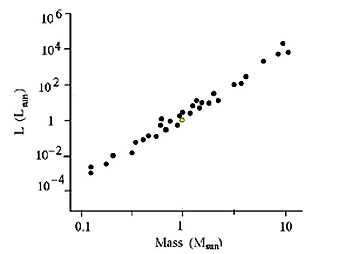
The graph below, made from astrometric data in which mass is determined by gravitational
effects, expresses this relationship; in the plot both mass and luminosity are
referenced to the Sun (note that the numbers are plotted in logarithmic units
on both axes):
There is a relationship
between absolute magnitude (here given by L for luminosity) and mass (given
by the conventional letter M; which accounts for replacing the absolute magnitude
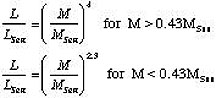
M with L). Here is one expression:
In the above, both L and
M for a given star are ratioed to the values determined for the Sun. Note the
two different power exponents. It seems that some stars obey a fourth power,
others a 3, and a few are just the square of the mass. The most general expression
in use is given as L = M3.5. There are relatively few stars with
mass greater 50 times the Sun. Very rarely, we can find a star approaching 100s
solar mass, but these are so short-lived that nearly all created before the
last million years have exploded, with their mass being highly dispersed, and
thus ceasing to send detectable radiation. If the Sun were envisioned
as displaced outward to a distance of 32.6 l.y., its apparent magnitude as seen
from Earth would be -26.5; its absolute magnitude would be changed to +4.85.
A quasar, which is commonly brighter than a galaxy, has an absolute brightness
of - 27 (note that in the absolute scale increasingly negative values denote
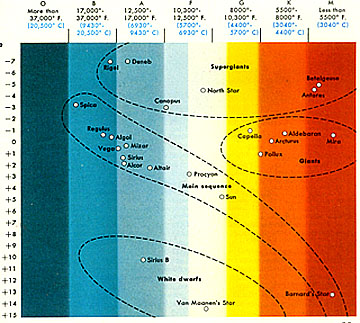
increasing intrinsic brightness). The illustration below gives the absolute
magnitudes (vertical axis) as a function of temperature (horizontal axis) for
a number of stars with popular names; note the similarity of the color bars
(which express the visual colors of the stars as seen through a telescope) to
the brightness range - this is essentially a preview version of the standard
H-D diagram, shown and discussed on this page beginning twelve figures below
this, which serves as a plot of the different types of stars and an inferred
history of a star of given size (mass):
One classification of stars
is that of setting up categories of star types (see below) in a series of decreasing
sizes and luminosities. These are the 7 Luminosity/Type Classes: Ia, Ib: Extreme
Supergiants; II: Supergiants (Betelgeuse); III: Giants (Antares);
IV: Subgiants; V: Dwarfs (Sun): VI: Subdwarfs (metal poor);
VII: White Dwarfs (burned out stars). The oddity in this classification
is the omission of a category of "Normal"; a star is either a Giant or a Dwarf.
Another classification is based on density. Starting with the least dense
and progressing to the most dense (massive), this is the sequence: Supergiant;
Red Giant; Main Sequence; Brown Dwarf; White Dwarf;
Neutron Star; and Black Hole. Each of the above bold-faced types
are described in some detail on this two-part page.
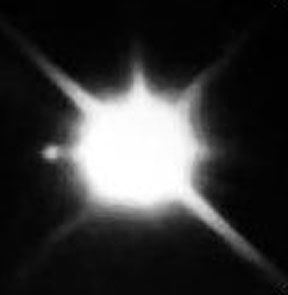
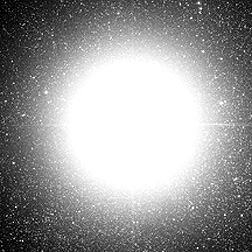
The brightest star in the
northern hemisphere of the sky is Sirius, an A type star (see the H-R plots
below and accompanying paragraphs which explain the letter designation of stars)
of apparent magnitude -1.47 that lies 8.7 light years away. Here is how it appears
through a telescope:
Closest to the Sun is an
M type star (faint), Proxima Centauri, being 4.2 light years away. Just slightly
farther away is Alpha Centauri, a G type star that is the third brightest in
the heavens (visible in southern hemisphere). Here is a telescope view of Alpha
Centauri:
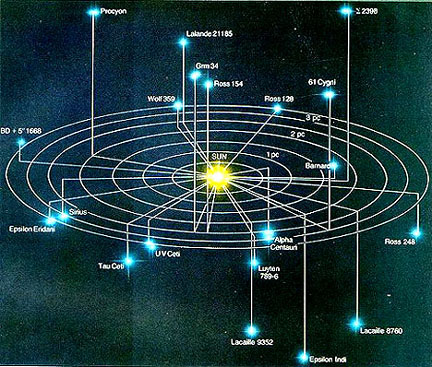
The map below is a plot
of the distances from Earth (circle is 13.1 light years in radius) of the 25
nearest individual or binary stars or local clusters in our region of the Milky
Way Galaxy:
Information Bonus: Just
beyond this limit is the star Vega (27 light years away). It has two claims
to fame: 1) it alternates with Polaris as the North Star used in navigation;
the Earth's precession brings Vega into this position every 11000 years, and
2) It was the nearby star used as the host for an extraterrestrial civiliation
in Carl Sagan's extraordinary science fiction novel "Contact" (later made into
the movie of the same named "starring" Jodie Foster); contact was made with
a planet near Vega as a signal picked up by the Socorro, NM radio telescope
array - as initially interpreted that signal consisted of a string of prime
numbers (those divisible only by themselves and 1).
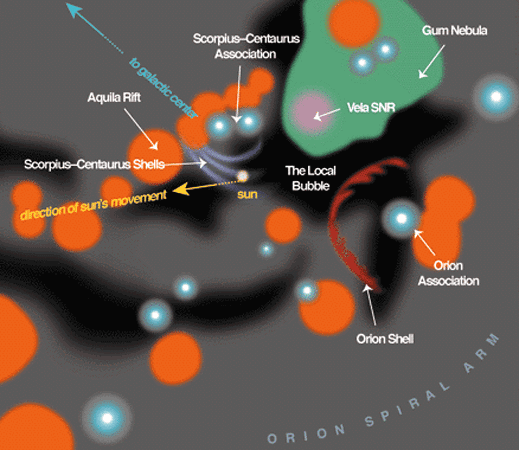
Referring to the above, the
following is extracted verbatim from the caption accompanying this image
that was displayed on the Astronomy Picture of the Day Website for February
17, 2002: What surrounds the Sun in this neck of the Milky Way Galaxy? Our current
best guess is depicted in the above map of the surrounding 1500 light years constructed
from various observations and deductions. Currently, the Sun is passing through
a Local Interstellar Cloud (LIC), shown in violet, which is flowing away from
the Scorpius-Centaurus Association of young stars. The LIC resides in a low-density
hole in the interstellar medium (ISM) called the Local Bubble, shown in black.
Nearby, high-density molecular clouds including the Aquila Rift surround star
forming regions, each shown in orange. The Gum Nebula, shown in green, is a region
of hot ionized hydrogen gas. Inside the Gum Nebula is the Vela Supernova Remnant,
shown in pink, which is expanding to create fragmented shells of material like
the LIC. Future observations should help astronomers discern more about the local
Galactic Neighborhood and how it might have affected Earth's past climate.
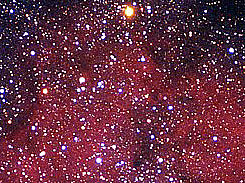
The largest star so far
measured in the Milky Way is Mu Cephi (in the galactic cloud IC1396), seen as
the orange disc (also called Herschel's Garnet star) near top center of this
HST image. Located about 1800 light years from Earth, it is almost 2500 times
the diameter of the Sun.
This is an example of a
rare type of star known as a hypergiant (see next page). Another even bigger
star (2800 times the solar diameter; 2.4 billion miles) is Epsilon Aurigae (in
the constellation Auriga, the Charioteer), but residing in the Milky Way about
3300 light years from Earth. This star, also known as Al Maaz (Arabic for he-goat)
and visible to the naked eye) is considered by many astronomers to be the "strangest"
star in the firmament. Every 27 years this star (magnitude 3.2) undergoes a
diminishing of brightness (about 60000 times greater than the Sun) lasting about
2 years. The last such event was in 1983; the next in 2010. It is thus one of
a class called "eclipsing stars". The cause of this regular pattern of luminosity
change is still uncertain; some astronomers think it is caused by the passage
of a second massive star across Epsilon Aurigae's face but that binary is so
far undetected, leading to the hypothesis that the drop in luminosity occurs
when a cloud of dark material (dust) orbiting the star as a clump obscures Epsilon
Aurigae each time it moves through the line of sight to the Earth. Most stars bigger than
the Sun are not as huge as Mu Cephi or Epsilon Aurigae. The majority are no
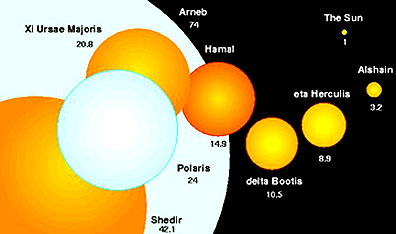
larger than about 100x the diameter of the Sun. This diagram illustrates the
relative size of some common stars (setting the Sun's diameter as 1), which
establishes our star as rather ordinary in the size scheme within the Milky
Way:
More than half of the stars
in a galaxy are also tied locally to a second star as a companion (binary),
such that each of the pair or group orbits around a common center in space determined
by their mass-dependent mutual gravitational attraction. This arrangement is
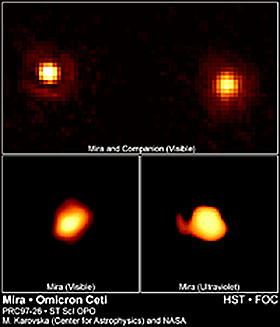
exemplified by the image made by the HST Faint Object Camera (FOC) of the Mira
star (Omicron Ceti) in the Constellation Cetus.
This star is a Red Giant
(see below) which appears to be periodically brightening (it is credited as
the first known variable star, having been discovered in 1546 A.D.). The HST
has resolved it into a binary in which the star on the left has a White Dwarf
(see below) at its core and now receives mass from the Red Giant that accumulates
until the hydrogen burns (see first illustration at the top of page 20-6). An ultraviolet
(UV) image made by HST's FOC actually shows mass being drawn off the Red Giant. Some stars are grouped
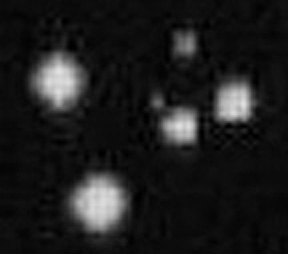
into more than one companion; ternary groupings (three stars orbiting about
a common center of gravity) are fairly common. Here is an image of four stars
orbiting as a unit about a gravity center in the galaxy M73.
Binary star systems are recognized
by three means: 1) visual, through a telescope (as in the above two images); 2)
by periodic drops in brightness caused by passage of one star across another (eclipse;
an uncommon observation condition); and 3) by measuring spectral characteristics
in which both a Doppler shift towards the red and the blue occur as one star moves
away and the other towards Earth (and the reverse) along pathways of their mutual
orbits.
To demonstrate the second
means, examine this diagram which shows the brightness levels (and magnitude
variations) for the binary star Algol:
The larger star (in blue)
is mutually orbiting a smaller star (red) which has a notably smaller output
in its own luminosity. When the latter star passes in front of the larger star,
there is a notable drop in the combined luminosities, as the partial eclipse
cuts out some light from the larger star. Then, when the red star passes behind
the blue star, there is a small drop in luminosity since the smaller, now occulted
star does not send any of its light to the observing telescope. Spectral line shifts are
used to study the motions of binary stars. We will treat stellar spectroscopy
in detail on page 20-7
As a preview, the spectral method can be illustrated by looking at a pair of
spectral strips for two similar stars that are mutually orbiting:
Bright lines for hydrogen
appear in the top and bottom (dark background) strips. This fixes a reference
location for excited hydrogen in the rest state. The two center spectral strips
include the same hydrogen lines, the first strip acquired from one and the second
the other star. Note that the lines in one have moved to the left and the other
to the right of the reference lines position. The spectrum on the bottom center
has been blueshifted (see page
20-9) towards shorter wavelengths; the spectrum at the top center has been
redshifted towards longer wavelengths. This is explained thusly: The bottom
star is in motion towards the observing system on Earth whereas the top star
is moving away from the telescope. This would occur when the two stars are aligned
sideways to the line of sight and are moving in opposite directions around a
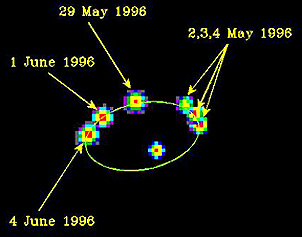
common center of gravity. For some visual binaries,
movements over time can be observed and plotted, such as illustrated here for
the star Mizar (in the Ursa Major constellation), which is resolvable into Mizar
A and Mizar B.
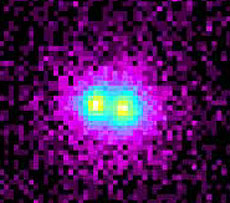
The Chandra X-ray Observatory
has imaged a close binary pair in the M15 Galaxy. Prior to obtaining this image,
the object was thought to be a single star, but at x-ray wavelengths, it is
now resolved into a faint blue star and a nearby companion believed to be a
neutron star giving off high energy radiation. Thus:
Turning now to stellar evolution,
to preview what will be examined in some detail (shown in chart form later on
this page), the pattern of a star's history follows a pathway that, depending
on its total mass, eventually splits into one of two branches (/> or \>),
as it leaves what is known as the Main Sequence. This is: Development of a large
cloud of denser gas made up of predominantly molecular hydrogen (H2)
+ dust --> Protostar --> T-Tauri Phase --> Main Sequence /> (if mass
less than 8 solar masses)--> Red Giant --> Planetary Nebula --> White
Dwarf; OR \> (if mass greater than 8 solar masses) --> Supernova -->
Neutron Star and/or Black Hole (depending on mass [size]). 



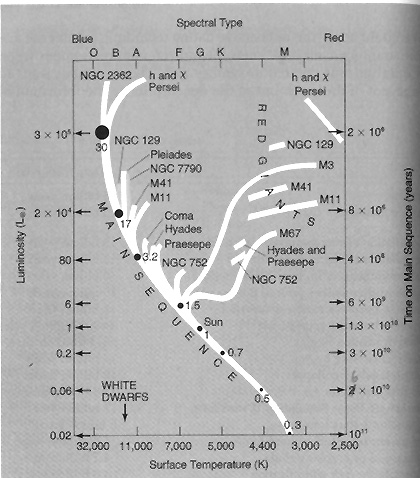
Both star classification and evolution can be summarized in a graphlike chart that consists of a plot of luminosity (vertical axis) versus star surface temperature which is expressed also by (correlated with) the star's visual color (note also the Spectral Type designations at the top). This is known as the Hertzsprung-Russell (H-R) Diagram. Mass densities are shown as numbers on the the central line that defines the Main Sequence (M.S.) of stars. Most known stars lie along this line; they describe a stage in which a star reaches some fixed size and mass and commences burning of most of its hydrogen before changing to some other star type off the sequence. Star types, which are defined on the basis of stellar surface temperatures page 20-7), are shown by the letters (O, B,...etc.) assigned to each group and evolutionary pathways for some are indicated. This particular plot also shows along the right ordinate the total time that Main Sequence stars of different masses spend on that sequence before evolving along the several principal pathways (see below); as far as we now know, stars do not completely vanish, but survive as dwarfs or Black Holes ( but the latter in principle can disappear by evaporation as Hawking radiation).
From J. Silk, The Big Bang,
2nd Ed., © 1989. Reproduced by permission of W.H. Freeman Co., New York
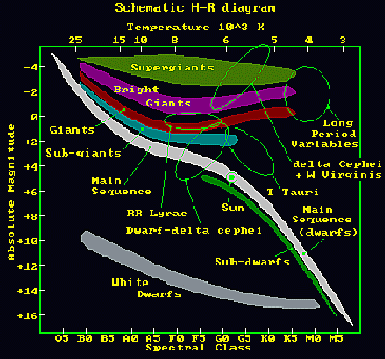
In the version below
of the H-R diagram, the various major star types or states for stars that
are not on the Main Sequence are shown (the spread of those types as a function
of temperature-luminosity variations is plotted). Among the off-M.S. evolved
star groups are four types of Giants (Sub; Red; Bright; Super), T Tauri; and
the two major types of cepheids. These are discussed again on this page or
elsewhere in this Section. Not shown is the recent designation of LT for Brown
Dwarfs. Note that the letters at the bottom include some like B0 and B5 or
K0-K5; this denotes subdivision of each class into temperature subclasses
(0 being hottest and 5 coolest in a class). Temperature ranges (in °K) are:
O class = greater than 30000; B = 11000 - 30000; A = 7500 - 11000; F = 6000
- 7500; G = 5000 - 6000; K = 3500 - 5000; M = less than 2500. Colorwise, the
first three are all "blue-white" stars, F is bluish to white; G is white to
yellow; K is yellow orange; and M is red.
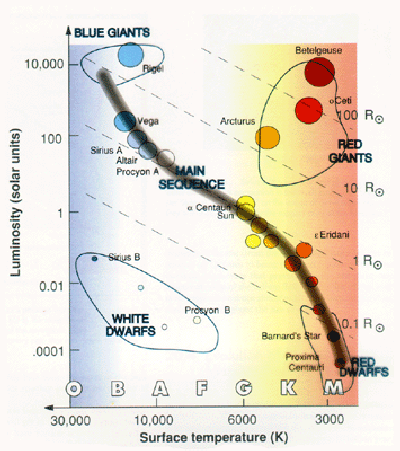
This next diagram is
another H-R variant in which some well-known stars with specific names (visible
to the naked eye or through a telescope) have been plotted. The Red Dwarfs
and Blue Giants are specified in this version. On the right is the size of
a star (in terms of radius) relative to the Sun taken as 1.:
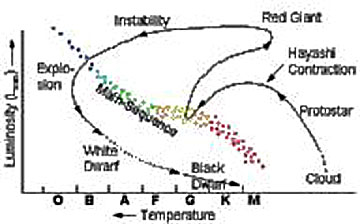
This diagram shows the sequence
star stages from a nebular mass into a protostar, then to the M.S., and on to
a final dwarf state for a sun-size G star.
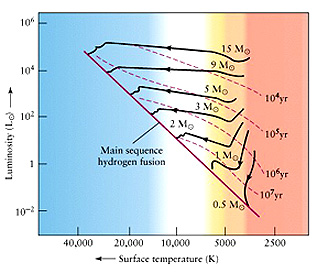
The pathways of protostars
to the Main Sequence, as shown on this modified H-R diagram, depend on their
mass (in multiples of a solar mass) at the stage when they commence proceeding
to the M.S and initiate hydrogen fusion. The times involved in this transition
will vary systematically with mass; thus, a 15 solar mass protostar takes
only about 10000 years to reach the M.S. whereas a 2 solar mass star may require
up to 10,000,000 years for the process to begin fusion:
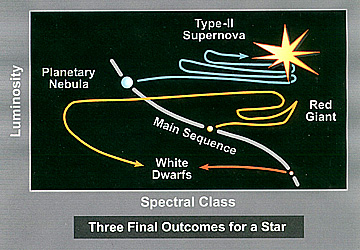
This next diagram shows
the evolutionary history of three stars at the upper, central, and lower ends
of the Main Sequence after they leave the M.S.:
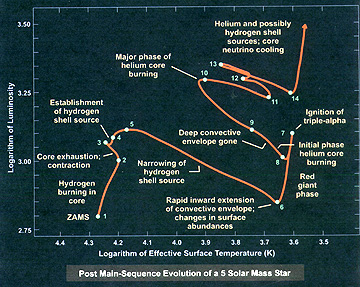
These pathways are somewhat
generalized. When the details are plotted, the path of a star of 5 solar mass
size from the M.S. to a Red Giant can be more complex, as shown in this multi-step
example:
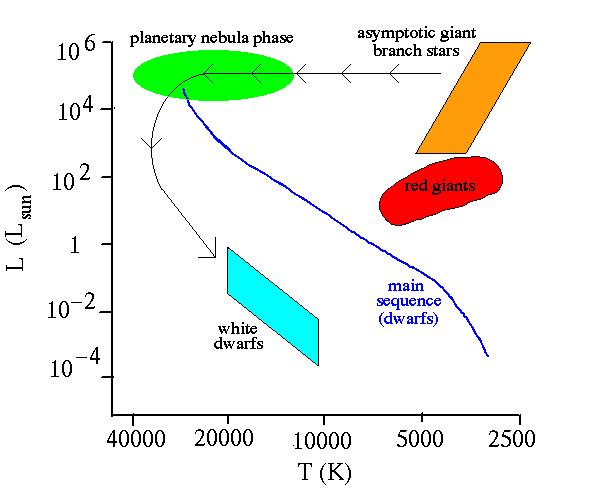
The largest number of
individual stars in galaxies fall between just under 1 solar mass to about
10 solar masses. As these burn their hydrogen fuel into helium, as they begin
to burn the helium they brighten, cast off some of the outer hydrogen, and
become luminous (for stars under a solar mass of 2.3, there is a short-lived
large increase in luminosity known as the helium flash phase). Then, as the
helium burns to carbon (which organizes into a core of degenerate C and some
O; see page 20-7), such stars follow
what is known as the asymptotic giant branch (AGB) pathway which begins with
a second Red Giant state. That is shown in this diagram (as well as the three
previous diagrams):
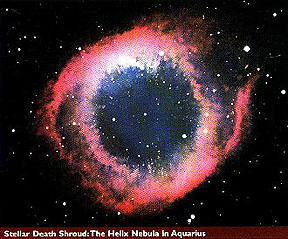
This shedding enroute
to the planetary nebula phase (further described below) can appear in a spectacular
manner, as shown by this HST image of the Helix Nebula, in which the red ring
is excited hydrogen:
A star's precise position
along the Main Sequence depends on the total mass of H fuel that collects during
the formative phase into the gas ball. Some stars (e.g., Type M) have masses
as low as 1/20th of the Sun (1 solar mass is the standard of reference as is
the luminosity of the Sun, also set at 1), whereas others fall within a range
of greater masses that may exceed 50 solar masses (Type O). The high mass stars
on the Main Sequence are brighter and bluer whereas those at the lower end of
the M.S. tend to be yellow to orange. The initial quantity of mass in a star
is the prime determinant of its life expectancy, which also depends on its evolutionary
history and final fate. As a general rule, small stars may take more than 50
billion years to burn out completely, stars in the size range of the Sun live
on the order of 5 to 15 billion years, and much bigger stars carry their cycle
to completion in a billion or less years. Stars whose masses are similar to
the Sun's actually will burn about 90% of their hydrogen during their stay on
the Main Sequence. Stars with greater than 50 solar masses may complete their
M.S. burning in just 20-30 million years.
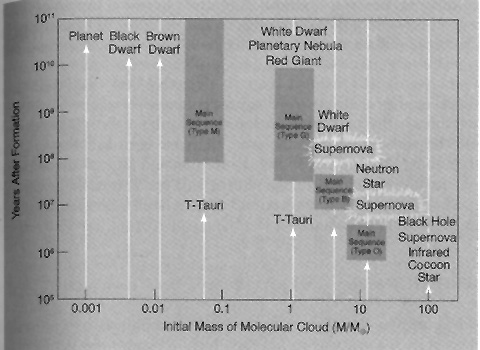
The lifetime spent on
the Main Sequence is approximately proportional to the inverse cube of the
star's mass (this is true for most stars, especially massive ones; stars less
than a solar mass have lifetimes closer to the inverse 4th power). The relation
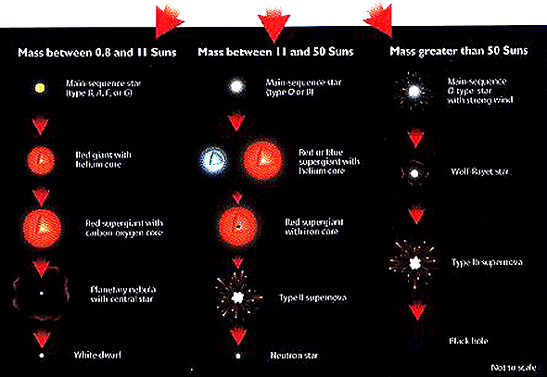
between size (mass) and age is shown in this next diagram: The fate of stars (at
the end of their history) of all sizes (and different masses) can be conveniently
summarized in this Evolution diagram:


A variation of this
diagram (which unfortunately does not produce well when reprocessed after
being taken off the Internet) is included here because of its pictorial
wealth of information:
Now to a more detailed
discussion of the history of stars as expressed in the above diagrams.
Stars develop within galaxies
in nebulae (also called Giant Molecular Clouds [GMC] composed mostly
of H2) by progressive sub-fragmentation, aggregation and contraction
of gas and dust into centers of higher density. These nebulae represent localized
concentration of gases brought about by several processes such as the driving
force of shock waves from supernova explosions and intergalactic magnetic
fields. The clouds turn very slowly but this helps to develop "seed" locations
- internal denser regions that bring the gases toward them because of greater
gravitational attraction. The H-He atoms in these denser local regions assemble
into gas balls and dust clouds by collisions and gravitational forces at initially
low temperatures (100's of ºK) in a turbulent process of condensation, generating
heat (in large part dissipated as thermal radiation). Thus, molecular hydrogen
clouds are the regions of gas where most new stars are born.
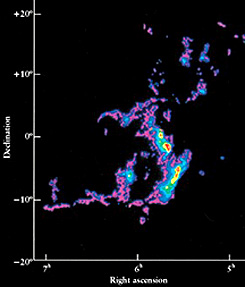
One way to study GMCs
is to plot the distribution of excited carbon monoxide (CO) dispersed within
the molecular hydrogen. In this state CO produces two prominent emission
lines at 1.3 and 2.6 mm in the near radio wave segment of the EM spectrum.
(H2 does not emit strong signals in the radio region.) Here is
the CO pattern that occurs in the Orion Nebula (a GMC which also contains
strong HII (ionized H) regions (see below)
Outside the clouds, H
and He also are dispersed, at much lower densities, as the principal elements
distributed in interstellar space; the density of free H (mostly neutral)
in that space is estimated to be between 3 and 8 atoms per cubic meter. This
atomic hydrogen when excited but not ionized is detectable by its signature
at a 21 cm wavelength as determined through radio telescopy, representing
photon radiation given off when excited hydrogen reverts to its lowest energy
state. But, in spiral galaxies most atomic hydrogen gas has been rearranged
in long streamers between arms of existing stars, as seen in this 21-cm radio
telescope image of the Milky Way.
When GMCs heat up to
temperatures above about 5000° K, the hydrogen can be ionized (see Page 20-7 for a discussion
of the different ionized states of hydrogen and their characteristic spectral
lines). This gives rise to strongly emitting clouds that are referred to
as HII Regions (Atomic hydrogen is denoted by HI;
alternate forms of this symbol are H II or HII). One prominent line used
to image and study HII regions is Hα, whose line lies at
0.656 µm - the N3 --N2 transition in Balmer series. These clouds are photogenic
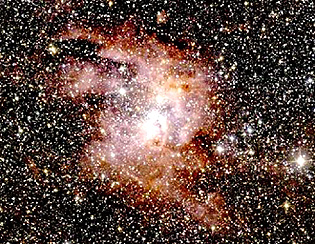
and deserve several examples here. First, an emission nebula as imaged by
a telescope used in the 2Mass project (inventory of stellar objects in the
Visible-Near IR):
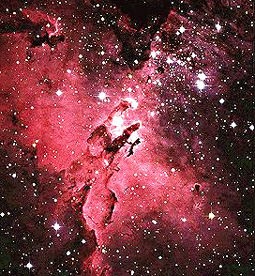
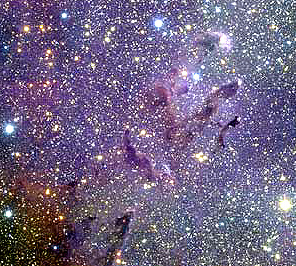
We follow this with
an image of part of M16 (Eagle Nebula) that has heated to the HII
temperature range, with colors chosen to indicate that HII clouds
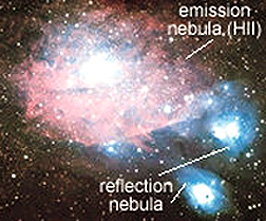
also are bright in the Near-IR: And lastly, an image
which contains an emission cloud (pink) and two smaller reflection clouds
(molecular hydrogen) (blue):
Before organizing into
an galaxy or after a galaxy has formed, the initial nebulae will have irregular
shapes. Some nebulae appear dominated by dark dust, mixed with hydrogen. These
may have elongated shapes, some of which are described as "pillars". Part
of the Eagle nebula contains such dark dust concentrations, as seen here:
A close view of one of
these pillars (said by many as the most fascinating image yet obtained by
the HST) is shown on page
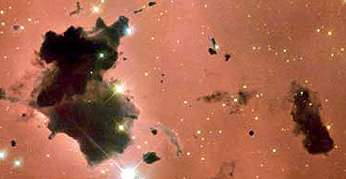
20-11. Another type of dark dust-rich clot, with sharp boundaries, of
star-forming material is called a "Bok Globule" (see several examples on Page 20-4), which commonly
produces a large number of massive O-type stars, the brightest on the Main
Sequence, which have short life times. Here is the IC2914 group:
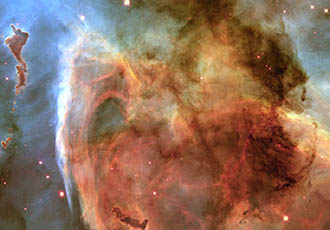
Now look at part of
the Keyhole nebula, some 8000 light years from our own galaxy. Its size
is about 200 l.y. in diameter. It is classed as a dark nebula, but in this
rendition computer processing brings out its rich colors. (Note: the term
nebula, derived from the Latin for "cloud", has multiple meanings.
In the early 20th century, the word was applied to bright objects in the
sky that Hubble and others showed to be galaxies; now, the term is restricted
to any collection of hydrogen gas and dust that may occur outside of a galaxy,
as intragalactic material, or as remnants of exploding stars.) A good review
of the types of nebulae is found at The
Web Nebula.
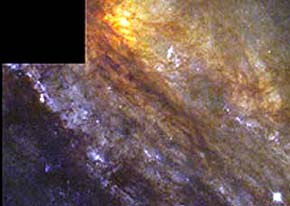
A typical gas and dust
cloud (as shown below, a subsection within a developing spiral nebula, NGC253)
consists of a number of bright, bluish new stars midst swirls of hot hydrogen-rich
gas, and some older stars.
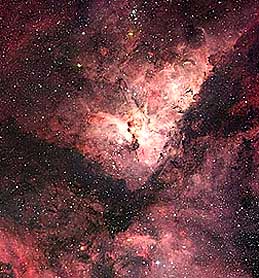
The largest nebula
is the Carinae nebula, seen only from Earth's southern hemisphere. It is
a bright nebula (and contains the supernova Eta Carina star) that lies just
beyond the above Keystone nebula.
The HST Wide Field Camera
has recently imaged a small cluster of stars in an early stage of their organization.
This is in the Small Magellanic Cloud, about 200,000 light years away. This
"cloud" (almost 10 light years wide) consists of glowing hydrogen gas within
which numerous stars are embedded. At least 50 of those that can be resolved
appear to be young, massive stars. As time continues, these stars will enlarge
as gravity pulls in the surrounding nebular material. Because of their large
size, their destiny is to rapidly burn up their hydrogen fuel, and eventually
explode as supernovae (see below), many ending as neutron stars.
As a large number of
stars develop from a nebula, and become luminous as hydrogen-burning ensues,
processes including radiation pressure from starlight will allow the stars
to be seen through the diminishing dust and gas. The nebula may continue
to produce more new stars if it draws more hydrogen from beyond its boundaries,
but generally nebulae tend to use up available H2 and may deactivate.
Stars may then form elsewhere as new clouds develop and reach conditions
favoring stellar generation. Individual stars develop
along fairly well known blueprints. A central clot of mainly gas organizes
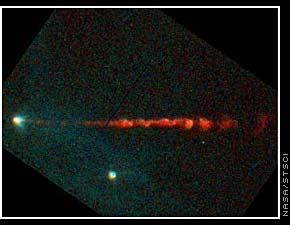
and is surrounded by an envelope usually enriched in dust. As the protostar
heats up, some of its material is ejected by magnetic forces as jets, such
as in these two examples:
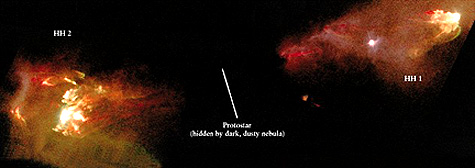
The expulsion of these
high speed gases and charged particles can cause parts of the surrounding
nebular masses to be excited and glow in luminescent patches. This phenomenon
is known as Herbig-Haro (HH) Objects. Here is one example:
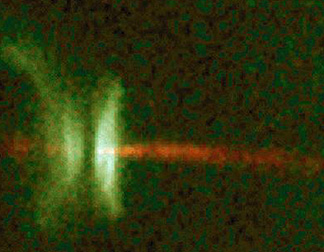
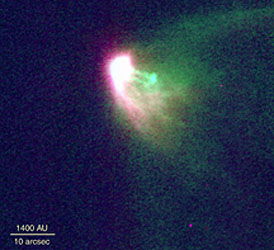
The emergence of these
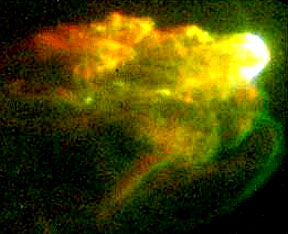
objects at two opposing sides (bipolar) of the protostar is typical. The
next HST view shows this HH effect in a glowing "cloud" which is located
near the end of a jet (bright hemisphere, to the right) passing through
it.
However, the dominant
behavior during the pre-Main Sequence history of a protostar is marked by
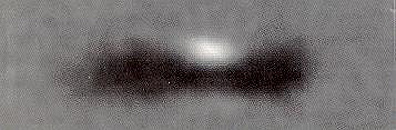
light gases continuing to inflow and build up the star's mass and size.
Much of the dust remains as a thick disk outside the star, such as this
example:
As will be further explained
on page 20-11, disks like this
are the potential conditions that lead to planet formation. Meanwhile, the
star approaches pressure-temperature levels capable of initiating hydrogen
fusion, as described in the next paragraph.
As more matter accrues
within a growing nebula, its internal gravity continues to increase and draw
in still more gases. Gravitationally-driven collapse into forming stars induces
compression and further heat rise. The protostar phase is reached as temperatures
rise to 2000 - 3000° K. At ~10,000° K, the H begins to ionize (electrons stripped
away) and, in the process, loses some heat energy by radiation which tends
to slow or counter the compression. Over time, the cloud eventually reaches
a density that requires it to then undergo local clumping of gases into clots
that grow into still denser concentrations to become stars (these smaller
clots can exist for much of the galaxy's life but are the sites of further
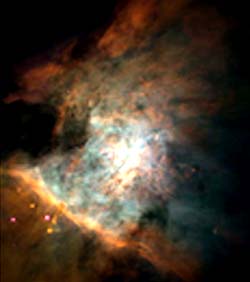
star formation). Here is a Hubble Space Telescope (abbreviated as HST and
described on page 20-3)
view of the Orion nebula, which appears to be in an early stage of organization
into stars (hence, a younger nebula).
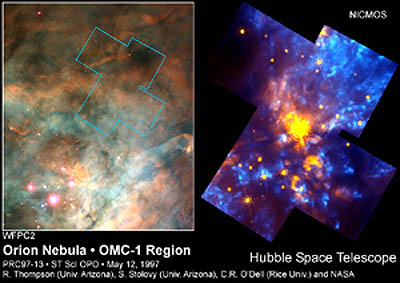
Here is a gas cloud in
the Orion nebula as seen by HST's Wide Camera; but on the right is the same
area imaged in the IR in which a bright small star "shines through" as a protostar.
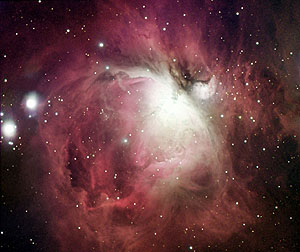
Seen close-up is the
central part of Orion, in which the reds are related to the excitation of
hydrogen gas (using a red filter on the HST image).
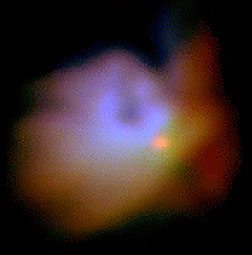
As the early stages of
star formation proceeds, the cloud tends to gather around the star in a more
isolated manner, removed from neighboring gas and dust nebula. It may then
enter the T Tauri phase at which the growing star starts to generate strong
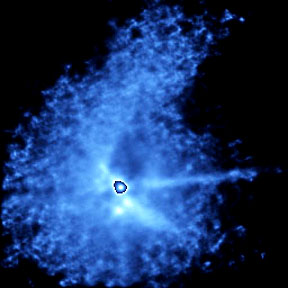
stellar winds. The cloud disk still can exceed 150 A.U. in dimension. This
telescope image shows the glowing cloud (rendered here in blue, but actually
of a different color) around the incipient, still poorly organized central
star (a binary pair).
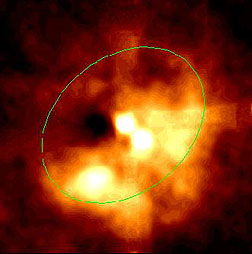
Here are two more T
Tauri stars, the one on the left showing the nebular shield that masks the
bright growing star and the one on the right showing another T Tauri star
as seen in the infrared:
The star now rapidly
contracts as it passes through the Hayashi phase. This relies on
the proton-proton nuclear reaction which releases radiation energy that
causes a notable increase in luminosity. However, hydrostatic equilibrium
(see below) is not yet reached as the growing star continues to experience
disruptive convection. This next view shows
a star after most of its accretionary disk material has been incorporated
into its mass, as it nears the stage where it will be on the Main Sequence.
For stars of masses
near that of the Sun, it takes about 10 million years to work through the
protostar phase and another 20 million years to join the Main Sequence.
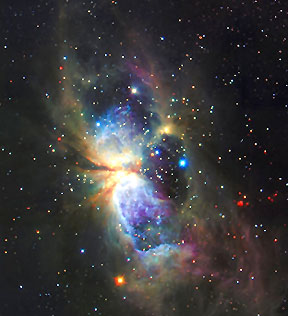
More massive stars reach the Main Sequence more rapidly. Below is a view
taken through the Japanese Suburu Telescope of S106, with mass twenty times
that of the Sun, which began to burn only about 100,000 years ago. This
star, 2000 l.y. from Earth, still is showing dust and gas flowing into the
central body.
An early stage of another
massive star, AFGL2591, 10 times the size of the Sun, has been viewed in
infrared light by the newly operational Gemini North Telescope on Mauna
Kea, Hawaii. Some 3000 l.y away in the Milky Way (located against the backdrop
of the Constellation Cygnus), the central region of the forming star is
still disorganized. Infalling material continues its growth but also sets
off a return outflow of gas and dust.
After a star has moved
onto the Main Sequence, the history of its life cycle there will be a continuous
(somewhat oscillating) "contest" between contractive heating during stages
of gravitational collapse and expansive cooling by thermal radiation outbursts
whenever rising temperatures increase hydrogen ionization. Generally, an evolving
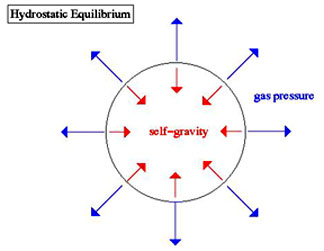
star tends to seek out a balance [hydrostatic equilibrium] between inward
gravitational forces and outward radiation pressure developed from the burning
of the star's nuclear fuel. This is illustrated in this simplistic diagram:
In its early life, the
contraction phase ultimately dominates, so that a star's deep interior temperature
eventually will be raised above 107 K (varies with star size),
at which stage a fundamental nuclear reaction within the hydrogen gas commences.
This involves thermonuclear fusion: p + p => H2 + e+
+ neutrinos (H2 or deuterium is a single proton and a neutron and
e+ is a positron [emitted]). That change of state results in thermal
energy release which contributes to continual rises in temperature. Deep within
the star, an alternate but dominant fusion process involves melding of 4 single
protons into a single helium nucleus consisting of two protons and two neutrons.
As temperatures increase further, some protons, neutrons, deuterium (and minute
amounts of tritium [H3]) combine (in a three step process) into
helium (He4 nuclei [2p, 2n]) which migrate into the star's interior
towards its core. In these reactions, some of the mass is converted to energy
(E = mc2) which radiates outward as the source of the star's luminosity
and which produces the outward pressure that counteracts inward forces owing
to gravitational contraction. Luminosity varies as the fourth power of a star's
mass (thus a star with twice the mass of the Sun shines 16 times brighter).
Helium remains stable
until temperatures approach 100 million° K, at which state it reacts with
more protons and neutrons to transmute into other elements of higher mass
numbers (see below). More massive Main Sequence stars can generate Carbon;
some of this element may be in the star initially if it is formed from previous
gases and particles that contain carbon produced in earlier star generations.
This carbon-enriched star, as its temperature rises and interior pressure
increases, can go through another fuel-burning process known as the CNO. Through
a series of steps as reactions of Carbon with Hydrogen protons take place,
first C12 is converted to isotopes of Nitrogen or O15
but reaction with He4 will lead to C12 again plus energy
released as positrons and neutrinos.
When the H => He process
reaches a steady state, gravitational contraction no longer dominates (attains
a balance called hydrostatic equilibrium)), the star's total radiant
(EM) energy output per second (defined as its luminosity; also referred to
as brightness) becomes constant, and the star reaches a stable state on the
Main Sequence (M.S.), populated by stars that are primarily in the hydrogen-burning
stages. This equilibrium - in which inward directed gravity forces are more
or less countered by outward radiation pressure - is maintained during most
of the star's life on the Main Sequence. These stars spend up to 90% of their
total lives on the Main Sequence.
Because this page
is very long and has so many illustrations that downloading is lengthy,
the second half (remainder) of the page on Stars is continued on page 20-5a,
accessed by the Next button at the bottom here and at the top of this page.