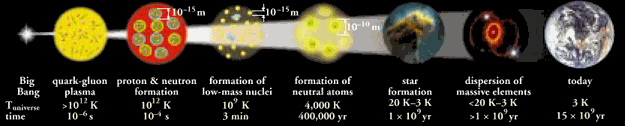
Despite this absence
of summaries, we will attempt to abridge the overall ideas underlying Astronomy
and Cosmology in this summary:
Astronomy deals mainly
with the description of the objects, materials, structure, and distribution
of what appears to exist beyond the Earth itself. Astronomy as an observing
"science" traces its roots to early civilizations such as the pre-Christian
era Babylonians, Egyptians, Greeks, and Chinese and the Mayans and Aztecs in
the New World. Star groupings, the constellations were established and became
involved in myths that suggested deity controls of how the World (i.e., the
Universe) is able to function. Cosmology, which deals with the origin, development,
and future expectations for the Universe, also began in early times, with both
myths and theological explanations for the meaning and cause(s) of the phyical
(natural) World including and beyond the Earth gradually being supplanted by
scientifically-based observations. Key ideas that provide this basis include
the postulates by such Greek philosophers as Pythagoras, Euxodus, and Aristotle,
and the later (ca. 140 BCE) Ptolemaic description of epicyclic "heavenly" motions;
these persisted largely as philosophical musings until the advent of Copernicus
in the 16th Century CE who posited the heliocentric theory for the Solar System
(but suggested by Aristarchus in 280 BCE), followed by important contributions
from Tycho Brahe and Johannes Kepler soon thereafter. Galileo was the first
to use the telecope for astronomical observations. Isaac Newton provided the
foundation for the movements of stars and planets with his Laws of Gravity and
Motion. William Herschel in the late 1700s CE provided the first proof that
the Milky Way in which the Sun is located is an "Island Universe", or galaxy
and surmised that other such galaxies must exist. This lead to the beginning
of the modern era of Cosmology stemming for work by Edwin Hubble in the 1920s.
Before the beginning
of the (this) Universe there was no time nor space, no energy (in the discrete
forms we know) nor matter. What may have existed is some as yet undefined quantum
state in which fluctuations in the "emptiness" led to extremely fleeting "particles"
containing the essence to grow into a Universe. Essentially all such evanescent
moments ended with the disappearance of the ???. But the potential was there for
one such moment to see "creation" of a singularity from when the Universe sprang.
This singularity was
so unstable that it "exploded" into what is known colloquially as the "Big Bang".
That took place some 14 billion or so years ago. The first minute of Universe
time was the critical stage leading to the state of the Universe we observe today.
We can trace theoretically events during the minute back to 10-43 sec(onds),
when the Universe was infinitesimally small. (Experimentally, astrophysicists
can actually reconstruct the sequence and verify the essential physics of the
Universe’s early condition back to 10-12 seconds and to particle
sizes as small as 10-17 meters; better yet, most of the particles and
forces (and fields through which they interact) have now been defined and all
but a few actually found and identified under laboratory conditions.) Initially,
the fundamental forces (strong; weak; electromagnetic; gravity) were unified (as
is being explained through the new theory in physics called "superstrings"). But,
they quickly separated systematically into the individual forces. Although expansion
was rapid, at about 10-35 seconds, there was a one-time only extreme
acceleration of this minute Universe through a process called Inflation.
Thereafter, in this
first minute as expansion continued and the proto-Universe cooled to lower energy
levels, the fermions (matter) , controlled by the appropriate bosons (force),
began to organize into the protons and neutrons (composed of quarks), electrons,
mesons, neutrinos, and others of the myriads of particles continually being
discovered in high energy accelerator experiment in physics labs.
As the first minute
ended, some particles began to associate with others (and probably all the anti-matter
that should have been created was destroyed). In the first few minutes, particles
began to organize into nuclei that were part of a plasma state in which the mix
included electrons, photons, neutrinos and others. In the next 300,000 years or
so, this particle-radiation state witnessed the beginnings of organization into
atoms, mostly of hydrogen and some helium. After that time the Universe became
"transparent" so that communication through photon (light) radiation was possible
between segments of the Universe close enough to exchange information at the speed
of light. The Universe was almost completely homogeneous and isotropic on a grand
scale but locally tiny fluctuations in the state of matter (mostly H and He) led
to gravitational clumping (into nebulas) that grew simply because these slight
increases in density continued to increase the organization through the force
of gravitational attraction. From this eventually, in the first billion years,
stars began to form and to arrange in clusters called galaxies. These adopt specific
shapes, such as spiral, elliptical, or irregular.
Stars burn their hydrogen
at high temperatures, during which (depending on their size) they convert the
fuel to heavier elements. Large stars die out rapidly (a few billion years to
much less); small can persist for times that are comparable to the total life
of the Universe. During their stable lifetimes, the stars hold together by a fine
balance between inward contraction under gravity, involving internal heating up,
and the outward pressure of the radiation produced by nuclear processes. Many
stars can explode as supernovae. Various types of stars evolve over time through
distinct pathways; among these are Red Giants; White Dwarfs; Neutron Stars. Black
Holes are another, perhaps widespread, constituent of space. As a star forms out
of nebular material - gases mainly of some hydrogen and helium, and other elements
in various forms, including particulate dust), some of this material not drawn
into the growing star may collect in clots that would form planetary bodies -
rocks and gas balls - similar to those making up our Solar System.
The fate of the Universe
depends ultimately on how much mass it has. If that number is high the Universe’s
expansion will slow down and eventually reverse (contract) so that all matter
and energy collect again at a singularity which may undergo another Big Bang.
Or the matter/energy is insufficient to slow expansion and the Universe enlarges
forever. The shape of the Universe will depend on the nature of the expansion;
at large scales the Universe is subject to the laws of Relativity. Recent information
favors endless expansion and the possibility that the rate of expansion is now
increasing.
Add to all of this the
theoretical (quantum-driven) possibility that there may be multiple universes,
unable to communicate with one another, with new ones forming at various times
and perhaps old ones dying in some way. The mind boggles at this point.
This is perchance a
gross simplification of the big picture. Read through this Section for more details.
And watch for updates - so much is happening now.
Before beginning this
Section, we urge you to read through this hidden Preface (once there, hit
your BACK button on the browser you use to return to this page). The Preface contains
four major topics: 1) the role of remote sensing in astronomy; 2) some suitable
references for additional information; and basic principles of 3) Relativity,
and 4) Quantum Physics. The Preface contains a list of some very readable books
and a number of Internet links to reviews or tutorials on Astronomy/Cosmology.
Also, most of the illustrations in this Section were made from images and data
acquired by spaceborne Observatories; for a listing of many of these with links
to homepages click on this Internet site produced by astronomers
at the Australian National University.
The Nature and
Origin of Matter; The Early Eras
Cosmologists - those
who study the origin, structure, composition, space-time relations, and evolution
of the astronomical Universe - generally agree that the Universe had a finite
beginning between 12 and 16 Ga (Ga = 1 billion years [b.y.]) ago; the current
best estimate lies close to 14 Ga. This is derived by measuring the time needed
for light to have traveled from the observable outer limit of the Universe to
Earth in terms of light years *, which can be converted
to distances. The physical conditions that guaranteed the present Universe must
have burst into existence almost instantaneously. During the first minute of the
Universe's history, many of the fundamental principles of both Quantum Physics
(or, as applied to this situation, Quantum Cosmology) and Relativity - the two
greatest scientific discoveries of the 20th Century (see Preface, accessed by
link above) - played key roles in setting up the special conditions of this Universe
that have been uncovered and defined in the 20th Century. Quantum processes were
a vital governing factor during the buildup and modifications of the particles
and subparticles that arose in the earliest stages. Likewise, Relativity influenced
the space-time growth of the Cosmos from the very start.
In the most widely accepted
current model of the Universe, there is no starting place or time in the conventional
sense of human experience. Space**, as now defined and
constrained by the outer limits of the observable Universe, did not yet
exist (see below); also, sequential events, embedded in a temporal continuum,
had not begun. The observable Universe is just the visible or detectable part
extending to the outermost reach of the Universe where objects or sources of radiation
have sent signals traveling at the speed of light over an elapsed time not greater
(usually somewhat less) than the time (age) of the start of expansion. Since now
most cosmologists feel some confidence that there is something beyond the observable
Universe (be it the unseen parts of our Universe or some other Universe(s)), that
unobserved part plus the observed part is sometimes spoken of as the Cosmos.
The initiating event,
referred to as the Big Bang, began at a point-like singularity (so small
that the notion of spatial three-dimensions [3-D] has no conceptual meaning),
some sort of quantum state of still-being-defined nature that marks the inception
of space/time (thus, without a preceding "where/when"; philosophically "uncaused"),
from which all that was to become the Universe can be mentally envisioned to have
been concentrated. This singularity is thus described as not quite a point (dimensionless)
condition which has extreme curvature and incredible density and where the laws
of physics (including relativity) break down, i.e., do not apply. The singularity
also ties in to the nearly instantaneous moment in time when the Universe is initiated
after which some things can be said about the earliest behaviour of the Universe
in terms of known or postulated concepts in physics). Just prior to the singularity's
unfolding into the first moments of the Universe, space and time were completely
joined (not distinguishable) but without any meaningful geometric or temporal
value.
At the very beginning
of this (our) Universe, multidimensional space and time came into being and began
to take on physical characteristics. But at the cosmic scale, these two fundamental
properties must, according to Special Relativity, comprise the 4-dimensional spacetime
Universe we now observe (according to some theories discussed below and on page
20-10, additional dimensions are possible). The exact nature (concept) of time
is still not fully understood and is subject to continuing debate (for an excellent
review of time, read About Time: Einstein's Unfinished Revolution by Paul Davies,
1995); also consult his Web site on "What happened before the Big Bang" at this
site (the
host site contains many interesting and provocative articles; click on Albert
Einstein within the page that comes up to get to the parent site). There is, of
course, the conventional time of everyday experience on Earth (years, days, seconds,
etc.), measured fairly precisely by atomic clocks (e.g., the pulsating beat of
a cesium atom, used to define the 'second') and less so by mechanical timepieces
or crystal watches. There are the redefining ideas of time consequent upon Special
Relativity, in which the perception of time units proceeds faster or slower depending
on frames of reference moving at different relative velocities. There is the notion
of "eternity" in which time just is - has no specific beginning or ending.
But, all these measures
and concepts are difficult to extrapolate to that nebulous temporal state (if
real) which was before the singularity of our Universe came into being
(conceivably the singularity could have existed for some finite "time" before
its inevitable instability forced the beginning we describe below as the Big
Bang). But, time had to separate at that instant and become measurable in terms
we have set forth to use its property of steady progression of a temporal nature.
If nothing existed prior to the singularity event, then there is no means to
determine and measure the time involved as a prior state. If ours is not the
only Universe (see the discussion of multiverses on page 20-10), and other Universes
existed before the one we observe, then time in some way can be pushed backward
to their inceptions. One possibility is an infinite number of Universes in time
and space, with no end points for starts and finishes (read Paul Davies' book
for the philosophical as well as physical implications of time, and the still
unresolved dilemmas in specifying the meaning of time). For our purposes in
studying the Cosmology of the one known Universe, we will assume a start to
the time accompanying the moment of its existence and its subsequent progression
as being comprehensible in the units we define for Earth living. Thus, the Universe,
under this proposition, can be dated as to its age in years.
At the very beginning,
the fundamental energy within the singularity may have been (or been related to)
gravitational energy that controlled the nature of the singularity. An alternative
now being investigated is some form of repulsive energy (similar to that once
proposed by Albert Einstein) such as quintessence (see page 20-10) which may prove
to be related to the "dark energy" (page 20-9) that seemingly dominates the present
Universe. At the instant of singularity, the initial energy (some of which was
about to become matter) was compressed into a state of extremely high density
(density = mass or amount of matter [or its energy equivalent] per specific [unit]
volume), estimated to be about 1090 kg/cc (kilograms per cubic centimeter)
and extraordinary temperatures, perhaps in excess of 1032 °K (K = Kelvin
= 273 + °C [C = degrees Centigrade]), both without any counterpart in the presently
observed Universe. As you will see below, certain forms of matter came from the
pure energy released during the first fraction of a second of the Universe's history.
The famed Einstein equation E = mc2 accounts for the fact that under
the right conditions, energy can convert to matter, and vice-versa.
At the instant of creation,
the singularity (which theory holds to have been far less than 10-33
of a centimeter in diameter), proved exceptionally unstable and proceeded to "come
apart" by experiencing something akin to an "explosion", which goes under the
popular name of the "Big Bang" (B.B); implicit in this is the general idea of
expansion (see page 20-1a, accessed through the link below on this page). This
was not an explosion in the conventional sense, such as produces an incandescent
gaseous fireball, but rather an extremely-violent release of kinetic energy released
from the singularity that initiated the general expansion and has since (so far)
exceeded the countering effect of gravity. The prime effect was to create and
enlarge space itself. The explosion is described as "not into space" but "of space".
Expansion is thus continuing to the present in part because the inertial effects
(evident in the observed recessional motions of galaxies, etc.) imposed at the
initial push still influence how space grows and, now it is believed, in part
due to the continuing action of the above-mentioned repulsive energy. After the
freeing of gravity from the other fundamental forces (see below), it has since
been acting on all particles, from those grouped collectively into stars and clouds
making up the galaxies to individual nucleons, photons, etc. - thus at macro-
to micro-scales. Gravity therefore exacts one controlling influence on the rate
of expansion, serving to slow it down. As we shall elaborate later, recent evidence
suggests that anti-gravity forces (enabled by the repulsive energy of presently
uncertain nature) have overcome the restraining effects of gravity seeking to
slow the expansion and perhaps eventually draw matter together in a general collapse.
However, as treated
on page 20-8, and again in the
second part of this page, this expansion is actually a dilation (or "dilatation",
a synonym) of space rather than a thrusting apart of individual matter through
direct outward motion as for a familiar example the centripetal ejection of debris
following a central explosion of, say, dynamite inside an automobile. Thus, the
matter does not physically travel as do particles from a dynamite detonation site;
space itself "travels" by progressive enlargement over time.
One cannot speak
of "there" in reference to the singularity (because the space that characterizes
our Universe did not start to form until the moment of its beginning, it is
difficult to think of any "there" since no dimensional frame of reference can
be specified). At the outset of "creation" the singularity was made up of pure
energy of some kind (in a "virtual" state within a "void" called the false vacuum).
What might have preceded this moment at which the Universe springs into being
and how the singularity came to be (become) remains speculative; theoreticians
in the Sciences have proposed inventive, although somewhat abstract, solutions
but the alternative and traditional views of philosophers (metaphysicians) are
still taken seriously by many in the scientific community. This last idea is
treated again near the bottom of Page 20-11 and a link to some of the writer's
speculations. This is an appropriate
point to insert comments about what the writer has recently learned about the
concept of the Instanton. This is an alternative version of the notion
of the Singularity described in previous paragraphs. The Instanton is a condition
that derives from Yang-Mills Gauge theory which is a part of what is known as
Quantum Chromodynamics (QCD). We will not further delve into that subject but
will just mention that Cosmologists such as Stephen Hawkings and Neil Turok
have adapted Instanton theory to the conceptualizing of what was before and
led up to the Big Bang, or any of the competing ideas for the Universe's inception.
In a nutshell, they envision a process by which a quantum fluctuation in the
vacuum or void prior to the initiation of the Big Bang led to the appearance
of energy by a quantum tunneling process. Their "Pea Instanton", which had such
high temperatures and pressures that it had to "explode" was created in this
way. Rather than pursue this topic further here, we refer you to the Cambridge
University link at the bottom of the Preface and to these two additional Web
sites: (1)
and (2).
Many scientists believe
that what may have "existed" prior to the Universe was a quantum state (in a sense,
analogous to the condition of "potency" in ancient Greek philosophy) which influenced
a true vacuum (no matter whatsoever) that somehow possessed a high level of energy
(of unknown nature but not, however, as photon radiation). Countless quantum fluctuations
(which in quantum theory are said not to depend on [obey] metaphysical cause/effect
controls and are not subject to time ordering) in this vacuum energy density produced
sets of virtual particles and anti-particles (analogs to positrons, the
positively-charged equivalent of an electron; neutrons and anti-neutrons, etc)
that came into existence for very brief moments and then annihilated. But, rarely,
annihilation did not occur, so that a particle could grow and trigger a 'phase
transition' that led to the singularity from whence all that entails the Universe
- matter, energy, space, and time - came into being. In this quantum model, it
is conceivable that many such singularities could form from time to time, leading
to mulitple universes that, as far as we know theoretically, cannot have any direct
contact.
This is one example
of prohibition by relativistic limits, in which information travelling at the
speed of light cannot reach us from beyond the horizon - outer edge - of our own
observable universe. The concept of the Cosmological Horizon refers to the boundary
or outer limits of the Universe that we can establish contact with. This is approximated
by the currently observed farthest galaxies that formed in the first billion years
of cosmic time. This Horizon is also conceptualized as the surface dividing spacetime
(which includes all locatable 4-dimensional points) into what we can see and measure
from what is hidden and unobservable. The observable therefore must lie within
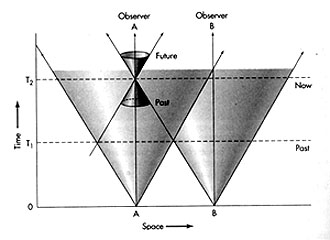
our Light Cone, an imaginary surface that encloses all possible paths of light
reaching us since the beginning of time. (The second illustration below is an
example). Check page 20-10 for further discussion
of these ideas.
The controlling factor
in this "visual" awareness is just the speed of light (photons). If the Universe
is about 14 billion years old (in terms of our terrestrial perception of time,
based on a complete revolution of Earth around the Sun), then light leaving just
formed protogalaxies near the observable limit of the Universe departed some 13+
billion years ago but this radiation is only now reaching us, since it had to
traverse across a Universe that was expanding (ever increasing distances) and
drawing the protogalaxies away from us. (We actually have detected cosmic background
radiation [see page 20-9], which pervades the entire Universe, whose first appearance
was only about 300,000 years since the beginning of the B.B. - this is the present
longest-term limit to the lookback time involved, thus peering into the past to
find the earliest discernible event). A distinction must be made between observed
and observable: as will be discussed in detail on pages 20-8 and 20-9, there is
strong reason to believe that the real Universe is (much?) larger, but part lies
beyond the present limits of observation. As time moves through the future, the
horizon will move into ever more of the ultimate Universe.
A corollary: In the
Standard Model for the Big Bang, there have been and are parts of the Universe
which cannot directly influence each other because there hasn't been enough time
for light from one part to have reached the other. Thus, the 'horizon' relative
to Earth as the observing point (but any other position in the Universe is equally
as valid an observing point) refers to the spatial or time limit that demarcates
between what we can establish contact with in any part of the Universe and what
lies beyond. This figure illustrates an extreme example of parts that cannot mutually
communicate:
Let astronomers look
out towards the apparent limits to the "outer" Universe, say at a distance of
13 billion light years, in two opposite directions. We, at the center of this
diagram, would assume that the galaxies at the opposing edges are 26 billion
light years apart. But for a 14 billion year old Universe, and radiation from
each set of galaxies traveling at the speed of light, a signal from one galaxy
group would not have had enough time to penetrate well beyond US into the region
of space on the other side. Thus, there is no (time for) communication between
one part of the Universe and various other parts. This is true throughout a
Universe whose dimensions are equivalent to a 28 billion light-year diameter
sphere (not necessarily the real shape of the Universe, but an adequate means
to visualize the collection of objects in the observable part of the Universe).
Within this sphere, there are pockets of space that are not in touch with other
pockets. (A pocket of the pervasive Cosmic Background Radiation, for example,
that covers about 2° of the sky hemisphere above us on Earth does not interact
with radiation beyond it as the Universe continues to expand.)
This seeming paradox
is called the "Horizon problem". Simply stated: how can these isolated regions
have very similar properties (such as similar densities of dark matter, Cosmic
Background Radiation, and numbers of galaxies) if they are not in contact. This
appears to violate the fundamental principle of universal causality, which
holds that during expansion all parts of the Universe would need to have been
in communication (by light transfer or other means of exchanging energy) so that
the fundamental principles of physics would have ample causal opportunity to influence
each other. This is seemingly necessary if at a gross scale the Universe is to
maintain uniformity (the essence of the Cosmological Principle which postulates
broad homogeneity and isotropism). One explanation that accounts for the causality
needed to obey this Principle is given below in the subsection dealing with Inflation.
Nevertheless the isolation
of regions of the Universe from one another is a real fact, as evident in the
above illustration. And, specifically there were situations whereby some parts
of the Universe were not in causal contact shortly after the Big Bang, and thus
not visible to one another during early cosmic history, but will eventually as
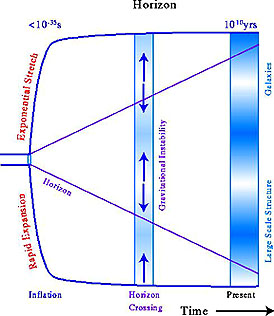
expansion proceeds become known to each other. Consider the diagram below:
Commenting further on
the Universe's geometry: One view holds the present Universe to be finite but
without boundaries; its temporal character is such that it had a discrete beginning
but will keep on existing and growing into the infinite future (unless there is
sufficient [as yet undiscovered] mass to provide gravitational forces that slow
the expansion and eventually cause contraction [collapse]). A much different model
considers the Universe to be infinite in time and space - it always was and always
will be (philosphically, there are concepts that equate God as an "intellectual
presence" distributed throughout this naturalistic Universe). These and other
important ideas - whether the Universe's shape is analogous to spherical, hyperbolic,
or flat; whether it is open or closed, whether it is presently decelerating or
accelerating, and whether it is infinite or finite in time and space - are treated
in detail on pages 20-8, 20-9, and 20-10.
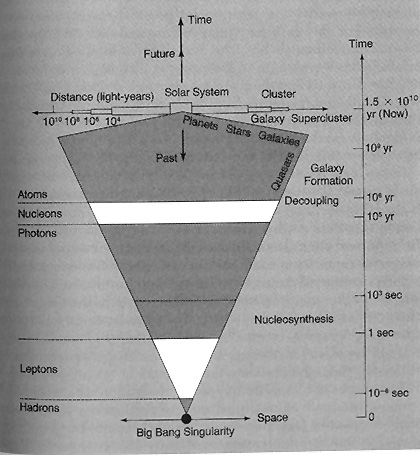
The next figure is a
spacetime diagram that summarizes the history of the expanding and evolving
Universe in terms of what is popularly known today as the general or Standard
Big Bang (B.B.) model for its inception. (It received its descriptive name
as a derisive comment from the astronomer Fred Hoyle, then precept of expansion,
who advocated instead a Universe of constant size as described in his Steady State
model; variants of this and other models have been put forth, as described on
page 20-9). Simply stated,
the Standard Big Bang model holds the Universe to have expanded from a infinitesimally
small point. In essence, the Big Bang is the creation event that started
the Universe and determined its ultimate course of evolution through the state
now observed and into its long term (perhaps infinite) future.
A variation of this
figure which gives a summary of energy levels and temperatures for the evolutionary
history of the Universe is too big for this page. You can access it by clicking
here.
Note that most temperatures are expressed in energy equivalents as eV's or electron
volts (GeV refers to Giga-electron volts). To return to the present page, you
will need to hit the X button on the upper right of the screen that comes up with
your browser.
The Big Bang as an expansion
theory traces its roots to ideas proposed by A. Friedmann in 1922 to counter ideas
attendant to Albert Einstein's Theory of General Relativity, from which that titan
had derived a model of a static, non-expanding, eternal universe (he eventually
abandoned this model as evidence for expansion was repeatedly verified and he
realized his General Relativity proved very germane to the expansion models).
The Abbe George Lemaitre (a Belgian priest) in 1927 set forth another expansion
model that started with his proposed "Primeval (or Primordial) Atom", a hot, dense,
very small object that resembles the "singularity", a term more widely accepted.
The nature of a Big Bang was refined and embellished by G. Gamow and others in
the 1930s. Confirming evidence for expansion came from Edwin Hubble in the late
1920s. The Big Bang can be mentally related to the above-mentioned singularity
by imagining that the expansion is run in reverse (like playing a film backwards):
all materials that now appear as though moving outward (as space itself expands)
would, if reversed in direction, then appear to ultimately converge on a "point
of origin" that is represented by the singularity.
As described later in
this Section (page 20-9),
the B.B. concept drew its principal support from the observations by Edwin Hubble
and others on radiation redshifts associated with the distribution of galaxy velocities.
The Universe has been enlarging ever since this first abrupt explosion, with space
expanding, and galaxies drawing apart, so that the size of the knowable part of
this vast collection of galaxies, stars, gases, and dust is now measured in billions
of light years (representing the distances reached by the fastest moving material
[near the speed of light] since the moment of the Big Bang [14 to 15 billion years
ago]). This age or time since inception is determined from the Hubble Constant
H (which may change its value) which is derived from the slope of a plot of distance
(to stellar or galactic sources of light) versus the velocity of each source (see
page 20-9).
Aside from quantum speculation,
nothing is really known about the state of the Universe-to-be just prior to the
initiation of the Big Bang (a moment known as the Planck Epoch). The Laws and
the 20 or so fundamental parameters or factors that control the observed behavior
of all that is seeable in the Universe become the prevailing reality at the instant
of the Big Bang, but Science cannot as yet account for the "why" of their particular
formulation and values, i.e., what controls their specifics and could they have
come into existence spontaneously without any external originator, the "Creator"
or "Designer". Among these conditions that had to be "fine-tuned" just right is
this partial, but very significant list: homogeneity and isotropy of the Universe
(the Cosmological Principle); relative amount of matter and anti-matter; the H/He
and H/deuterium ratios; the neutron/proton ratio; the degree of chaos at the outset;
the balance between nuclear attraction and electric repulsion; the optimal strength
of gravity; the decay history of initial particles; the total number of neutrinos
produced early on; the eventual mass density which affects the Critical Density;
the specific (but varying) rates of expansion after the Big Bang; the delicate
balance between Temperature and Pressure, both during the first moments, and much
later during star formation; the ability within stars to produce carbon - essential
to life; and much more. (See also another list at the bottom of page 20-11a.)
Some of these are interdependent but the important point is that if the
observed values of these parameters/factors were to differ by small to moderate
degrees, the Universe that we live in could almost certainly not have led to conditions
that eventually fostered intelligent life capable of evolving during the history
of the Universe as we know it. (Also presumably necessary: beings that can attest
to the Universe's existence and properties by making observations and deductions
that lead to knowledge of the Universe; this requires the eventual appearance
of "conscious reasoning" at least at the level conducted by humans on Earth, and
perhaps also human-like creatures existing elsewhere in the Universe, - this concept
is one of the tenets in what is referred to as the "Anthropic Principle").
At the moment of the
Universe's conception, gravity, matter, and energy all co-existed in some incredibly
concentrated form (but capable of supporting fields of action) that cannot
be adequately duplicated or defined by experiment on Earth since it requires energy
at levels of at a minimum 1019 GeV (Giga-electron volts; "Giga" refers
to a billion; one electron-volt is the energy acquired by a single electron when
accelerated through a potential drop of one volt; 1 eV = 1.602 x 10⁻¹²
ergs); 1019 GeV is vastly greater than currently obtainable on Earth
by any controllable process (presently, the upper limit obtained experimentally
in high energy physics labs (with their large particle accelerators and colliders
is ~103 GeV). Best postulates consider the singularity (whatever its
origin) at this instant to be governed by principles underlying quantum mechanics,
have maximum order (zero entropy [see page
20-8]), and be multidimensional (i.e., greater than the four dimensions -
three spatial and one in time - that emerged at the start of spacetime as the
Big Bang got underway). Quantum theory does not rule out discrete "things" (some
form of energy or matter) to have existed prior to the inception of the Planck
Epoch; on the other hand, this existence is not required or necessary. But, as
implied above and discussed in detail on page 20-10, "fluctuations" within
possible energy fields in a pre-Universe quantum state (an abstract but potentially
real condition that runs counter to philosophical notions of "being") may have
been the triggering factor that started the B.B.
This theory allows cosmologists
to begin the Universe at a parameter called the Planck time , given as
10-43 seconds (what happened or existed at even earlier time is not
knowable with the principles of physics developed to this day). At that instant,
the Universe must have been at least as small at 10-35 meters - the
Planck length (about the same size as a string in superstring theory [see
below]). At the initiation of the Big Bang, the four fundamental forces (gravity,
and the strong [nuclear], weak [radioactivity], and electromagnetic [radiation]
forces, referred to collectively as the Superforce) that held the Universe
together existed momentarily (until about 10-32 sec) in a special physical
state that obeyed the conditions imposed by one meaning of the term Symmetry***. During this fraction
of a second interval, gravity then was as strong as the other forces. Its tendency
to hold the singularity together had to be overcome by the force that activated
the Big Bang. The onset of fundamental force separation may have been tied to
the force driving Inflation (see below).
But gravity thereafter
rapidly decreased in relative strength so that today at the atomic scale it is
2 x 10-39 weaker than the electrical force between a proton and an
electron (according to one recent theory, gravity remains strong until about 10-19
seconds). However, since the forces between protons (positive) and electrons (negative)
are neutralized (balanced) in ordinary matter, the now much weaker gravitational
forces are the major residual force that persists and acts to hold together collective
macro-matter (at scales larger than atoms, specifically those bodies at rest or
in motion subject to and described by Newton's Laws; includes those aspects of
movements of planets, stars, and galaxies that can be treated non-relativistically).
And gravity has the fortunate property of acting over very long distances (decreasing
as the inverse square law). Although we think of gravity as the most pervasive
force acting within the Universe, there is growing evidence that some form of
gravity-like force also resides within an atom's nucleus but extends its effects
over very short (atomic scale) distances.
The non-gravity forces
that separated from the gravitational force are described by the still developing
Grand Unified Theory or GUT, which seeks to explain how they co-existed.
The GUT itself is a subset of the Theory of Everything (TOE) which, when
it is finally worked out, will specify a single force or condition (or, metaphysically,
a state of Being) that describes the situation at the very inception of the Universe.
Thus, TOE unites the gravity field with the quantum field within the singularity
that emerged as separate entities almost instantaneously at the start of the Big
Bang. The TOE speculates on what may have existed or happened prior to the Big
Bang, based on both quantum principles and belief that some other type of [pre-Bang]
physics yet to be developed governed the pre-Universe void. At the Planck time,
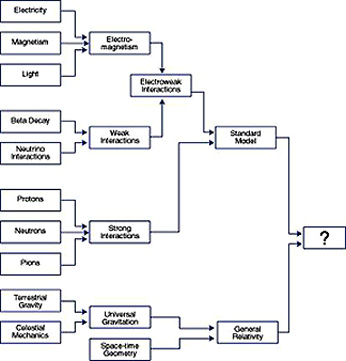
the four fundamental forces are said to be united (the Unified Epoch). The flow
chart below (see also the third figure below) specifies the major components of
each of the forces as they are assumed to exist after the first minute of the
Big Bang. When unified at the outset of the Big Bang, they are presumed to exist
in a state shown by the ? (whose nature and properties are still being explored
theoretically; at present this condition cannot be produced experimentally because
of the huge energies [way beyond present capabilities in laboratories] involved).
One model, now gaining
some favor, based on Superstring theory (see last paragraph on this page) contends
that at the first moment of the Big Bang (at the 10-43 sec mark;
before which any singularity or other state of existence cannot yet be described
by present physics) the Universe-to-be consisted of 10 dimensions. As the process
of the Universe's birth starts, six of those dimensions collapse (but presently
exist on microscales as small as 10-32 centimeters) and the remaining
four (three spatial; one time) enlarged to the Universe of today.
The behavior of these
forces in the earliest moments of the Big Bang was critical to the construction
and development of the Universe as we perceive it today. Gravity in particular
controls the ultimate fate of the Universe's expansion (see below) and formation
of stars and galactic clusters. (According to Einsteinian Relativity, gravity,
which we intuitively perceive as attractive forces between masses, is a fundamental
geometric property of spacetime that depends closely on the curvature of space,
such that concentrations of matter can "bend" space itself; Einstein and others
have predicted the existence of gravitational waves that interact with matter;
see the Preface for additional treatment). For all its importance, it is surprising
that gravity is by far the weakest of the four primary forces; its role in keeping
macro-matter together and controlling how celestial bodies maintain their orbits
is just that it becomes the strong, action-at-a-distance force left whenever the
other forces are electrically neutral and have influence only out to very short
distances.
Between
10-36 and 10-33 sec (a minuscule but vital interval of
time - about a billionth of a trillionth of a trillionth earth seconds - referred
to as the Inflationary Stage) a mechanism to explain certain properties of the
Universe was first proposed by Alan Guth, then at Princeton University), to
explain some aspects of the Universe [see below]; that were serious difficulties
in the Standard Model. The theory holds that the nascent and still minute Universe
underwent a major phase change (probably thermodynamic) in which repulsion forces
caused a huge exponential increase in the rate of expansion of space. Through
this brief moment (approximately a trillionth of a trillion of a trillionth
[10-36] of a second), the micro-Universe grew from an infinitesimal
size (but still containing all the matter and energy [extremely dense] that
was to become the Universe as it is now) to that of a grapefruit or perhaps
even a pumpkin. This is an expansion factor that may have been between 1050
and 1078 (this is the range of uncertainty, although some theoreticians
choose 1050 as the more likely number). Or, using another analogy,
this is equivalent to increasing the size of the proton (~10-13 cm)
to roughly the size of a sphere 10,000,000 times the Solar System's diameter
(arbitrarily, taken as the distance from the Sun to the far orbital position
of Pluto, or ~5.9 x 10⁹ km). This extreme growth determined the eventual
spatial curvature of the present Universe (in the most "popular" model, tending
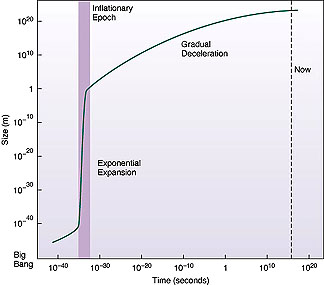
towards "flat"). This next diagram illustrates the extreme growth of the incipient
Universe during the Inflationary moment (both horizontal and vertical scales
are in powers of ten); in the version shown, the Big Bang expansion is shown
as decelerating over time but a vital modification is discussed on page page 20-10.
Within this inflationary
period, temperatures dropped drastically. During this critical moment, the physical
conditions that led to the present Universe were preordained. The driving force
behind this huge "leap" in size (which has happened at this extreme rate only
once in Universe history) is postulated by some as a momentary state of gravity
as a repulsive (negative) force (perhaps equivalent to Einstein's once-defunct
Cosmological Constant but in a new form: forces such as the Higgs boson or the
postulated "inflaton") that forced this tremendous expansion.
The source of the energy
that powered Inflation has not been precisely identified but the separation of
gravitational force from the remaining three forces (see third diagram below)
may have released a huge amount of energy capable of bringing about the repulsion
that marks inflation (see paragraphs on page 20-10 that describe Einstein's
Cosmological Constant which depends on a similar repulsive energy related to an
as yet undiscovered but apparently real "dark energy"). During the brief inflationary
period, different parts of the still "empty" void (energy existed but the first
particles that would form matter had not yet appeared and organized) separated
at a rate greater than the speed of light - in effect, it was this initial evolving
dimensionality or space that was expanding. (Recent discoveries indicate that
the Universe is now undergoing a second but relatively much slower rate of accelerating
expansion that has turned around the post Big Bang gravitationally-mandated deceleration,
beginning at some [still undetermined] stage [probably prior to the last 7 billion
years] of the Universe's growth; see page 20-10.)
During inflation, as
gravity began to act independently, gravitational waves were produced that had
a critical bearing on the minute but vital variations in distribution of temperatures
(and matter) in the subsequent history of the Universe as we know it. As time
proceeded, gravity then reverted to the attractive force that took over control
of further expansion. Specifically, a metastable state called the false vacuum
- devoid of matter per se but containing some kind of energy - underwent a decay
or phase change by quantum processes to a momentary energy density that produces
the negative pressure capable of powering the inflation. Inflation continues until
the false vacuum potential (which starts out as positive when its associated density
field is zero), which initiated the expansion, drops to zero (now with a positive
field that has varied in space and time).
Advantages of the Inflationary
model are that it sets the stage for the "creation" of matter, it accounts for
the apparent "flatness" of the Universe's shape, and helps to explain its large-scale
homogeneity and isotropy (smoothness). Before the Inflation began this uniformity
condition existed, with the initial conditions in causal contact, and was subsequently
"frozen in" to the Universe by the rapidity of inflationary expansion. Theory
suggests that during inflation, energy may not have been pefectly uniformly distributed,
producing narrow zones of greater concentration called "cosmic strings". These,
during the following slower expansion, served as the irregularities which eventually
led to concentrations of matter that localized into the early Universe structure
around which the first galaxies formed.
Inflation also seems
to solve the above-mentioned "horizon problem" (recall that horizon refers to
the sections of the Universe that are limited in their interactions [causal contact]
by the distances photons can travel at light speed during the interval of time
in which a cosmological phenomenon is being considered). This problem is present
in this diagram:
In this diagram parts
of the Universe seem to lie outside these horizon limits. Such parts are not now
in contact with one another (do not exchange light signals) and would seem causally
independent. But this isolation, which appears to defy causality, in the Inflation
model gets around this by 1) assuming these and all parts were in contact in that
miniscule fraction of the Universe's first second before Inflation, and thus 2)
had inherited, or "locked in" the co-ordinating physics underlying the Universe's
operations that subsequently preserved general uniformity as the Universe went
through its huge inflationary expansion.
A good summary of the
essence and history of Inflation is at a Web site prepared by John Gribbin.
Although theoretical
calculations and certain experiments seem to be confirming the essential points
in the Inflation model, not every cosmoscientist has come to accept this innovative
explanation of the earliest moments of the Universe and the consequences of
its subsequent history that inflation seems to predict. In the past few years,
some have turned their attention to alternate models. Most striking in its departure
is the Varying speed of Light (VSL) model first espoused by Dr. Joao Magueijo
in 1995, who later joined forces with Dr. Andreas Albrecht when they collaborated
at the Imperial College in London. The essence of VSL is that during roughly
the same time in the first B.B. second that Inflation would have operated, at
this earliest moment the intense energy being release would cause the speed
of light to be greater than today's value. That speed, ever decreasing, would
then converge on the now constant value today, thus meeting Einstein's fundamental
posit that this speed is constant. Magueijo and Albrecht have calculated that
this phenomenon of rapidly dropping speed in these early instances can produce
most of the same outcomes that the spatial expansion of Inflation leads to.
Initially largely rejected by his colleagues, recent observations of possible
light speed changes in the post B.B. Universe, if confirmed, have refocused
attention on VSL. Like Inflation, VSL remains hard to prove since its essential
characteristics occur under physical conditions that are still near-impossible
to duplicate experimentally. Stay tuned.
Returning to the progression
of physical events after Inflation but within the first minute of the B.B.: As
described above, during the first fraction of a second following the Planck moment
incredible events unfolded in rapid succession that led to release of kinetic
energy that powered the Universe's development and created the initial stages
of radiation. From the radiation associated with this energy, matter was formed
(an E = mc2 transformation)(in the first minute some of the matter
decayed back into radiation, releasing neutrinos and other particles). These primitive
forms of matter rapidly organized into a myriad of elementary particles. They
fall into two broad classes:
I) the FERMIONS: all
particles with quantum spins of 1/2 of odd whole numbers such as 1, 3, 5 (includes
protons, electrons, neutrons); they all obey the Pauli Exclusion Principle which
states that no two different particles can have the same values of the four quantum
numbers. Fermions can be divided into subgroups: 1) the heavier Hadrons (minute
particles, consisting of certain quark combinations held together by gluons permitting
strong interactions within atomic nuclei), further subdivided into (a) the Baryons
(combinations of three quarks [see 4th paragraph below on this page] that include
the familiar protons and neutrons (each about 10-13 cm
in size [compared with diameters on the order of 10-8 cm for the classical
Bohr atom]) and (b) the Mesons (short-lived heavier particles) families, and 2)
the Leptons, even tinier discrete particles that are weakly interacting (that
are represented by electrons, tauons, muons, and three types
of neutrinos (electron-neutrino; tau-neutrino; muon-neutrino; the discovery
of the latter two imply that the neutrino may have a small mass, and if proved
could account for some of the missing matter in the Universe talked about later
in this Section), and
II) BOSONS, the force
carrying messenger particles; these have unit [1] spins. Best known of the bosons
are the 1) photons (which have zero rest mass) that are quanta **** of radiant energy
responsible for electromagnetic (EM) forces which travel at light speed as oscillatory
(sinusoidal) waves and 2) the gluons that bind the nucleus by mitigating against
the strong repelling forces therein. A boson that theory says exists, but as yet
has not been "found" is 3) the graviton, which transfers the force of gravity
(also, at the speed of light).
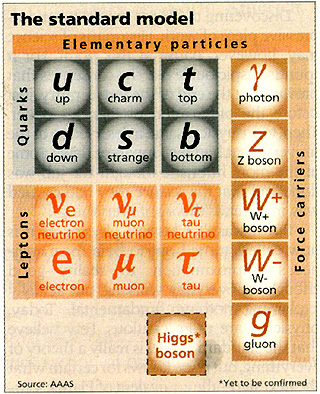
Much of the above information
is summarized in the chart below. This classification of particles and their interactions
is an integral part of the Standard Model for the ways in which matter
is put together, which applies to any Big Bang scenario (without the refinements
of Inflation) that leads to a broadly homogeneous, isotropic large-scale Universe
and is an acceptable summary of what is verifiably known now about the origin
of matter and energy (with the caveat that the model is subject to continual modification
or revision).
Illustration produced
by AAAS, taken from The Economist, Oct. 7-12, 2000, p. 96
In this classification,
the major entities are the quarks (elementary particles with fractional charge
that comprise protons, neutrons, and mesons), the leptons (including the electron),
and the bosons, force particles with finite (but very small) mass. The gray field
containing the quarks is the Baryon group. The quark particles have generally
been discovered and proved to exist from high energy physics experiments using
particle accelerators.
Quarks were the first
(sub)particles to form during the early moments of the first minute. The nomenclature
for the 6 quarks (of which there are six types or "flavors" [up, strange, etc.
each subject to variants or "colors" ; various combinations of quarks give rise
to the different nucleons) are descriptive terms for convenience and carry no
special physical significance. Quarks have a baryon number of +1/3, charge numbers
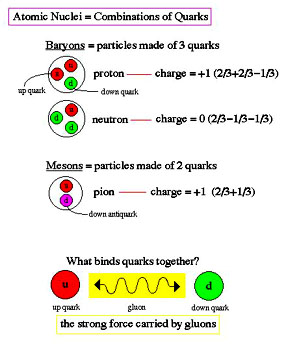
of +2/3(up) and -1/3(down), and a spin quantum number of 1/2. The two baryons
familiar to most are made of three quarks: the proton consists of two up (each
+2/3) and one down quark (-1/3) for a net charge of 1; the neutron two down and
one up quark, for a net charge of 0 (zero). Mesons contain only two quarks. As
a visual aid, this is summarized in this diagram:
Quarks also can have
a reverse sign, thus they can organize into anti-protons and anti-neutrons. Other
combinations of quarks lead to more exotic particles; one group includes mesons,
which include members such as the pion Π-, consisting of an anti-up
quark (-u) and a (d) quark and the kaon K+ made up of a (u) and an
(-s) quark.
The leptons have much
smaller masses and are single particles (not containing the quark subparticles).
They are not influenced by the strong nuclear force but can interact through the
weak nuclear force. Three of the leptons (upper row) are neutrinos which have
extraordinary penetrating power (one can pass through the entire Earth without
interacting or changing); once thought to be massless, evidence now suggests a
very small mass.
The force particles
(bosons) are involved with the individual fundamental forces mentioned above.
For example, the gluon holds the nucleus of baryons together; z and w bosons
control the weak nuclear force; photons are the force carriers that are associated
with electromagnetic radiation; gravitons transmit the force of gravity. The
Higgs boson has not yet actually been proved to exist (but from theory is considered
almost certainly to be real); recent experiments in a European supercollider
may have witnessed a few genuine Higgs particles but confirmation will likely
await several new supercolliders capable of much higher energies due to come
on line before the end of the first decade in 2000. The Higgs boson is considered
to be the force particle that accounts for mass in the fundamental particles
that have that property. The Standard Model,
when examined rigorously, is now considered only an approximation to full reality
in subatomic physics. It fails, for example, to explain and integrate gravity.
Theoreticians believe that gravity must have its own boson which they have named
the graviton. Although it most likely exists in some form, its actuality has
yet to be proved. It has not been found during any of the current particle accelerator
experiments (which are also looking for the Higgs boson).
Now, returning to the
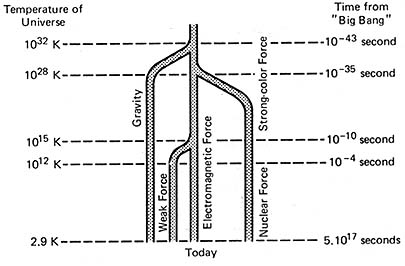
events of the first minute: By ~10-39 sec there was a fundamental symmetry
break that brought on a split between the GUT forces and the other fundamental
force known as gravity, dependent on the graviton (an infinitesimal particle which
has yet to be "discovered" or verified by physicists). The history (pattern) of
force dissociation during the first second is depicted in this illustration:
The
BIG BANG; The First Minute of the Universe;
Introductory Overview

The First Minute
of Universe History