Models
for the Origin of Planetary Systems
This "crash course" on Cosmology
closes with the following brief synopsis on the methods and results of astronomers'
search for other planetary systems and consideration of the origin of our own
Solar System, plus a quick look at several of the latest, provocative, and especially
exciting theories (or brash speculations) on the presence of other intellectual
beings in our Universe that might be "out there".
Two hallmarks in particular
distinguish planets from stars they orbit: First, they usually show marked differences
in composition, being either gas balls with other elements besides hydrogen
that have rocky cores or they are dominantly rock with many elements making
up usually silicate minerals. Second, they are significantly smaller in diameter
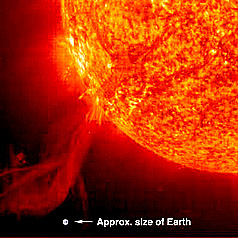
(hence volume) than their parent star. This SOHO image of a part of the Sun,
with a solar prominence, illustrates this size difference, as displayed by adding
a drawn sphere the size of the Earth to allow comparison:
This huge size difference
between the Earth and its normal G star Sun is humbling in its stark truth.
The great disparity in size also makes it clear how difficult it will be to
find Earth-sized planets around nearby stars - and even more of a technology
challenge as astronomers entertain hopes of finding stars elsewhere in the Milky
Way galaxy and galaxies beyond.
It is natural for humans to
wonder if there is life elsewhere in the Milky Way, and by implication in other
galaxies. The starting point in searching for life is to prove the existence of
other planets and inventory their characteristics. In the last decade the hunt
for planetary systems has intensified. The first extrasolar planet was found in
1995 orbiting the star 51 Pegasi. As of this writing (June 2002), planetary bodies
have now been detected in at least 67 other stellar (~solar) systems; as of November
2002 more than 100 individual planets have been associated with these systems.
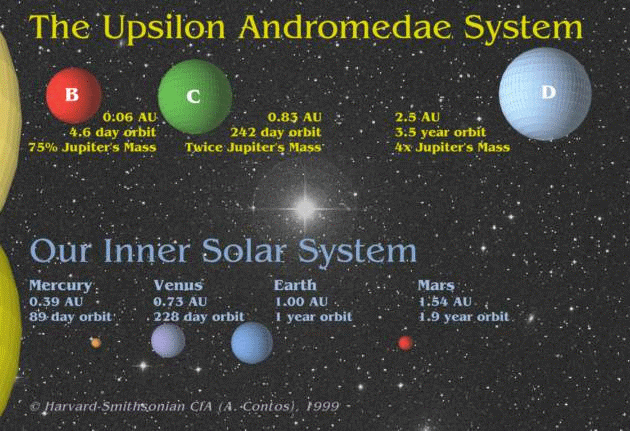
Analysis of one such system - Upsilon Andromedae -indicates it to have 3 planets
(a second triple star system was recently discovered); 8 other stars have 2 planets.
The U. Andromedae system consists of Giant (probably gas-ball) planets (much smaller
ones presently cannot be detected), all within orbits occupied by the four small
terrestrial planets in our Solar System:
So far, no planet has actually
been seen, being too small to be detected optically using present day technology,
but the existence of such low-luminosity bodies can be deduced from their interactions
with their parent star. Almost all discovered so far are large - Jupiter-sized
or greater - and are gas balls. Several are extremely close to their star (at
distances less than Mercury's orbit). Many planets have much more elliptical orbits
than those moving in the Solar System. It is hypothesized that most planetary
systems will consist of multiple planets but the smaller ones are presently still
invisible to us.
A high point in the current
search for planets occurred on June, 2002 when several groups of astronomers
announced jointly the discovery of up to 20 new planets - including at least
two of Jupiter size - in the Milky Way galaxy, whose stellar parents reside
at distances ranging from 10.5 to 202 light years from Earth. The closest in
has been provisionally named Epsilon Eridani b (its star is the one actually
cited in the Star Trek series as the location around which Mr. Spock's
home planet, Vulcan, was orbiting). The rate of planet discovery seems to be
accelerating. With it is the growing belief by cosmologists that planets could
well exist in the billions, i.e., they are the inevitable result of processes
that take place when most stars are born. Thus, planets may well turn out to
be the norm - the expected, and perhaps the most significant products
of nebular collapse in stellar evolution. The proponents of SETI (Search for
Extraterrestrial Life; seeking primarily radio signals that have non-random
character [perhaps some form of mathematical organization]) have been galvanized
by these recent discoveries. (The writer is convinced that it is only a matter
of time - probably during the 21st Century - until contact with other
intelligent beings is achieved.) We will return to the SETI idea near the bottom
of this page.
Current search for extra-solar
planets is restricted to the Milky Way and galaxies close enough to Earth for
an individual star to be resolved to the extent that changes in its motion can
be measured. Gravitation attractions from orbiting planetary bodies cause the
central star to wobble. This is the basis for the three methods currently being
used to detect anomalies in a star's behavior that lead to the inference of one
or more orbiting bodies.
The method that has so
far been the most successful in locating (invisible) planetary bodies is called
the radial-velocity technique. A component of a star's wobble will potentially
lie in the direction on-line to the Earth as an observatory. This to and fro
(forward-backward) motion causes slight variations in the apparent velocity
of light. That, in turn, gives rise to small but measurable Doppler shifts in
the frequencies of light radiation from specific excited elements, as expressed
by lateral displacements of their spectral lines. From the wobble magnitude
and period, the approximate orbit and mass of its presumed cause - the orbiting
planet - can be calculated. This method is sensitive to wobble velocities as
low as 2 meters per second. (Jupiter, for example, causes a wobble velocity
of 12.5 m/sec imposed on light radial from the Sun. Generally, this method,
applied to nearby stars, will detect mainly large planets close to their star
but in March of 2000, two planets about Saturn-size (1/3rd the mass of Jupiter)
were found.
The second method, astrometry,
also relies on wobble but depends on measuring side to side displacements by
direct observation through periodic sightings. This determination of relative
shifts can be done on photographic plates taken of part of the sky at different
times, commonly using the same telescope. But, considerable improvement shift
resolution results when two telescopes are positioned apart and joined electronically.
This permits application of interferometry such that the two telescopes act
as though they were one large one. Resolution as sharp as 20 millionths of an
arc second (an arc second is 1/3600ths of an arc degree on the sky hemisphere
[0° at the sealevel horizon; 90° at the zenith near Polaris in the northern
hemisphere]). The Keck interferometric telescope in Hawaii will soon be operational.
This should facilitate detection of even smaller planets in nearby space or
large planets in stars 10s of light years away.
As we have seen with the
HST images in this Section, resolution (and clarity) is significantly improved
by operating a telescope in space, above the distorting atmosphere. The use
of two telescopes mounted on a single boom but separated by meters allows the
interferometric method to work on space-quality imagery. SIM (Space Interferometry
Mission) is a NASA probe slated to fly during or after 2005. This will lead
to a millionth of an arcsecond resolution, capable of inferring the presence
of planets just larger than Earth-size or of large planets with far out orbits.
A third method is called transit
photometry. When a planet's orbit takes it on a path where it passes across
the face of the star under observation, the body will block out a small amount
of radiation (usually visible light) for the period of transit. Sensitive detectors
can note the slight diminution (up to about 2%). To distinguish this from a "transient
event" of other origin, the astronomer needs to establish some regularity (reproducible
at fixed intervals) of the drop in radiation, which will depend on the nature
of the orbit (ellipticity; distance, etc.) Depending on planet size and proximity,
the drop in stellar luminosity will be a few percent or less (an accurate determination
helps to establish the planet's actual size). Such an effect was first noted in
1999 when a giant planet (earlier found by the radial-velocity method) passed
in front of a star (HD 209468) whose light intensity underwent a drop of 1.5%.
In a June, 2002 meeting, two other groups using telescopes in Chile have reported
3 and 13 possible transit detections, but these observations have yet to be confirmed
independently.
This promising transit approach
will be used in the recently approved Kepler mission (launch in 2006) in which
a space telescope would be pointed on the same areas in the stellar field for
up to four years, integrating brightness measurements to single out variations
as small as 0.01% (capable of detecting Earth mass-sized planets). Up to 100,000
stars can be conveniently monitored over time and individuals with multiple planets
should reveal the relative number of stars that possess planetary systems. Two
other non-U.S. missions, COROT and Eddington, are in the planning
stage. Thus, as detectors improve and instruments become spaceborne above the
atmosphere, sometime in the next 10-20 years Earth-sized planets should become
detectable by measuring drops in stellar light curves owing to transits of large
planet(s) across their parent star.
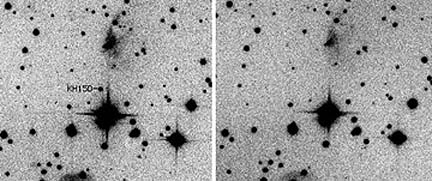
A fourth method has just
had its first success in June of 2002. Examine this pair of images:
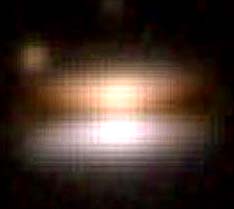
This is called the eclipsed
or "winking" star method. In the left image (a photo negative), a Milky Way
star KH 15D (2400 l.y. away; about the size of the Sun) is visible behind a
much closer (or larger) star. In the right image it is totally absent, a condition
lasting for about 18 days, and then it reappears. This on-off cycle occurs every
48 days. The eclipsing body could not be another star nor is it likely to be
a huge (star-size) planet. The interpretation is that there is a cloud of asteroids
and dust in a smeared-out clump orbiting KH 15D which block the starlight when
a clump passes across the parent star; speculation considers that there may
already be one or more planets formed from this debris. There may actually be
two clumps (symmetrical pairing) at opposite positions in a single orbit; this
has yet to be confirmed.
A fifth method is still
in the experimental planning stage. The Terrestrial Planet Finder program at
Princeton University is developing a special type of "cats-eye" mirror that
will greatly reduce the effect of the luminous parent star. When this technology
is deemed ready, they hope to persuade NASA or some other agency to use mirrors
on several telescope-bearing satellite flying in formation and spaced to utilize
the principle of interferometry to improve resolution and to detect small planetary
objects.
The ultimate dream is to
directly visualize individual planets. This may be possible using several HST
type spacecraft flying in formation ("clusters") with separations of a few hundred
meters to hundreds of kilometers. In one mode, data will be combined using interferometric
principles. Light from the central star can be blocked out by specialized image
processing, leaving a residue of low luminosity orbiting bodies detectable by
resolution- and radiation-sensitive interferometry. Both NASA and ESA each have
in the planning stage such a mission (called The Terrestrial Planet Finder
and Darwin, respectively).
Statistically speaking, the
number of such planetary systems should extend into the millions within individual
galaxies and the billions when the whole Universe is considered. It would logically
be likely therefore that non- or weakly-self-luminous bodies, i.e. planets, are
the norm orbiting around a central star for at least some of the size classes
on the Main Sequence of the Hertzsprung-Russell diagram. As such stars proceed
through their developmental stages (before they leave the Main Sequence), planets
seem the inevitable outcome of the formational processes involved in star-making.
Two scientists, C. Lineweaver
and D. Grether of the University of New South Wales in Australia, have recently
published a study that relies on reasonable probabilities to estimate the number
of planets just in the Milky Way. They argue that, of the approximately 300 billion
stars they calculate to be the total population of the M.W, about 10% or 30 billion
consist of stars similar to our Sun and most likely to have favorable conditions
for planet formation. Assuming that, of these, at least 10% will produce giant,
Jupiter-like planets. Such large planets would almost certainly be accompanied
by smaller ones formed out of the materials (they call "space junk") associate
with the parent star. These giants help in the collection process that leads to
smaller companions. But, more importantly, the giants serve as the principal attractors
that gravitationally pull comets and asteroids into them (remember the Shoemaker-Levy
event discussed in Section 19) and thus function as "protectors" of the small
planets by minimizing the impacts these receive.
For a while, astronomers
assumed that most stars with planets would be relatively small - Sun-sized to
perhaps 10 solar masses. These stars last for billions of years and thus favor
the eventuality of life if planets developed during the stellar formation process.
Now, several notably larger stars in the Milky Way have been found to have large
planets. So, planetary formation is a function of process primarily and may
have little to do with how long its star can survive. But the really big stars,
even with planets, would burn their fuel and destruct long before evolution
would likely foster even primitive organic matter.
While astronomers exercise
caution about conclusions that specify the number of earthlike planets to be expected
from their estimation procedure, they do propose that that number should be in
the millions. Whether such planets also harbor life is much harder to pin down
numerically but their statistical approach suggests that a significant fraction
of the earthlike planets would possess the proper conditions. How much of that
is intelligent life is still guesswork. The current sample of 1 (us!) is the only
data point. But if the reality is actually a much larger number, then, purely
from statistical logic, we should expect that some of these intelligent civilizations
should be more advanced than ours. Why we have yet to "hear" from them remains
uncertain (but now SETI improves the chances for this) unless there is some fundamental
reason that makes space travel, even from nearby stars, very difficult.
Now, let's turn to consideration
of the ways in which planets form. The paradigm summarizing the processes involved
in the formation of the Sun and its planets probably applies (with variations)
to other planetary systems in general. The first realistic notion of how planets
form was proposed by Pierre Laplace in the 18th Century. In its modern version,
both stars and their planets are considered to evolve from individual clots or
densifications within larger nebular (cloudlike) concentrations dominantly of
molecular hydrogen mixed with some silicate dust particles that spread throughout
the protogalaxies and persisted even as these galaxies matured. In younger stars,
much of the hydrogen and the heavier elements are derived from nova/supernova
explosions that have dispersed them as interstellar matter that then may initiate
clouds or mix with earlier clouds. Such nebulae are rather common throughout the
Universe, as is continually being confirmed by new observations with the Hubble
Space Telescope.
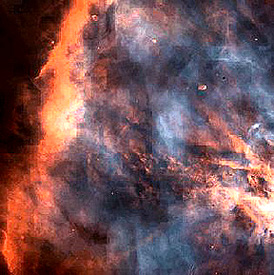
One of the best studied
and, in itself spectacular, is the Orion Nebula, seen here:
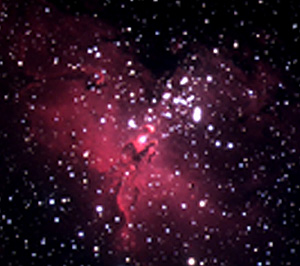
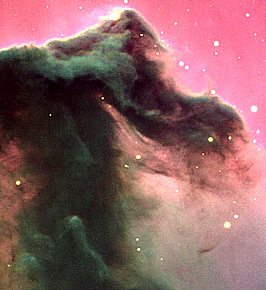
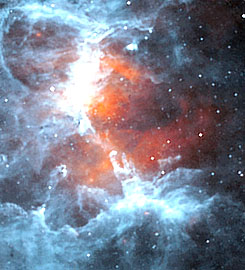
Below are three views of
nebular materials associated with the famed Eagle Nebula: Top = full display
of the M16 (Eagle) nebula (note the dark dust areas; the white dots are stars
lying outside this nebula); Center = part of Eagle nebula, showing top of the
Horsehead pillar of dust and gases from which stars and planets may eventually
evolve (a few stars already being evident), made by combining three film exposures
through the Kuevn Telescope at the European Southern Observatory ; Bottom =
details of the temperature variations in the dust making up the solid particulates
in the Eagle nebula as imaged by the European Space Agency's (ESA) Infrared
Space Observatory (ISO) at two thermal infrared wavelengths, in which red is
hot and blue is cooler (about - 100° C):
As individual stars start
to develop within these gas and dust clouds, in many instances that dust will
organize into a protoplanetary disk (see third figure below). The NICMOS infrared
camera on the Hubble Space Telescope has observed a prime example of this stage,
in which the glowing gases moving into the central region where a protostar
is building up are cut by a band of light-absorbing dust that is most likely
disk shaped (can't be verified from the side view in this image):
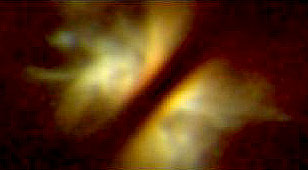
An Earth-based telescope
has captured this view of a nearby star (nicknamed the "flying Saucer"), again
with a girdling disk of dust (and an as yet unexplained anomaly in that the
upper half of the image is redder than the bluer lower half):
Examination of these gas
and dust clouds by HST has led to the discovery of small clumps or knots of
organized gas-dust enrichment within the protoplanetary disks called Propylids
found in the neighborhood of a parent star. This may be a more advanced
stage of concentration that results in a new star with an envelope of gas-dust
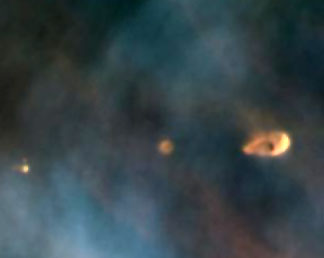
suited to accretion that produces planets. Three such propylids are evident
in this image of the nebula associated with the Orion galactic cluster (go back
to the top image in the three above to try to spot for a conspicuous propylid).
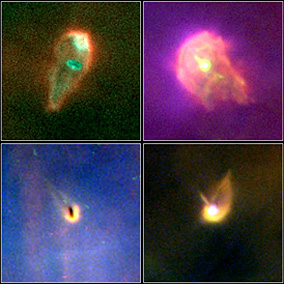
Other individuals, at least
one possibly as recently formed as 100,000 years ago, found during the Orion
study (see page 20-2 for
a view of the entire young nebula in the Orion group) look like this in closer
views:
Propylids are vulnerable
to being destroyed by UV radiation from massive, young nearby stars. It is surprising
therefore that many propylids (some shown below) have survived in the Carina
Nebula, which has numerous UV-emitting stars. Other factors must be involved
Development of planetary
cores, from which full larger planets then form, is a race against time. Examine
this model:
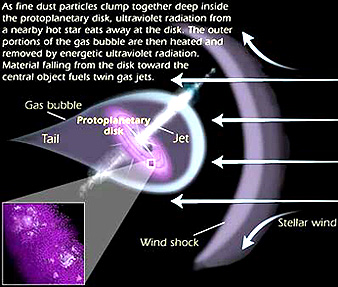
As the gas and dust cloud
forms, particles of solids begin to clump. However, the cloud is threatened
by stellar winds and UV radiation from the parent star that remove most gas
and some dust. Evidence suggests that most propylids are blown away before a
planet grows large enough to survive, implying that the planet formation process
may be less efficient and common than had been thought during the last decade.
If the planetary cores do build up fast enough, they will survive the expulsion
of the bulk of the gas/dust. This phase of planet formation occurs typically
in a time frame of just 100,000 years or so; it is estimated that 90% of such
clouds are dissipated before significant planetary cores can form. Planet accretion
leading to survival is estimated to take up to 10,000,000 years.
Most galaxies
began during the first half of the Universe and contained a large number of
massive stars that formed early in galactic histories. These galaxies have continuously
been evolving through the eons as supernovae synthesized elements (see page 20-7) and dispersed them,
and new, mostly Main Sequence stars, chemically enriched with elements of higher
atomic number, have continued to form well into younger times up through the
present. The smaller stars have lasted much longer and are probably the preferred
sizes suited to planetary formation and survival. Even today stars are developing
from the gases contained in remaining nebular material, so new planets could
still be forming. What is not yet known is the percentage of stars in a galaxy
that actually have planetary systems. The low number so far found does not necessarily
represent an indication of sparsity, since planets are so small and most low
in luminosity (mainly from reflected light) relative to their parent star that
present direct observations will produce extremely low numbers, thus subjecting
our current conclusions that planets may be rare to a misleading bias.
Some models of star formation from gaseous nebula suggest that a fraction of
the gases, dust, and free molecules is trapped in orbit without infalling to
the central star and can organize in planets of various sizes, distances, and
composition in a manner similar to our Solar System. If a valid argument, this
says that planetary bodies are commonplace throughout the Universe.
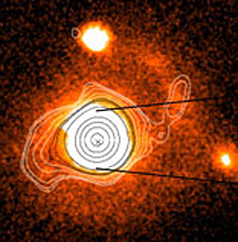
A telescope observation, reported
in April, 1998, records the sighting (through the Keck II telescope on Mauna Kea,
Hawaii) of what is interpreted to be another "solar" system around star HR 4796
(about 220 light years away). This image (at a resolution in which individual
pixels stand out), taken in the IR, shows this central star (yellow white) surrounded
by a lenticular (in an oblique view), flattened disk of gases and solid matter
(glowing hot [reds] in the infrared):
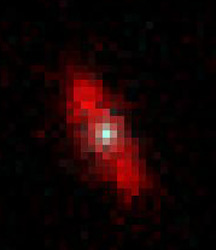
The diameter of the lens is
about 200 A.U. No evidence of individual planets can be made out but the discoverers
judge this feature, which has caused quite a stir of interest, to be an emerging
planetary system in a "young adult" stage of development. It will certainly be
a target for more detailed HST observations.
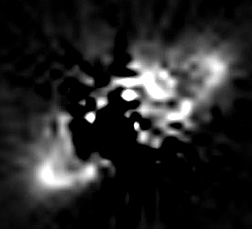
More recently, the Hubble
Space Telescope has imaged star HR4796A, in our galaxy, which shows both a disk
and irregular dust and gas clouds. This disk is interpreted to be in a more
advanced (mature) stage of development than the protodisks shown above. Although
not discernible, there may be planets already in the evolving gas/dust cloud
which is made visible by the star's light.
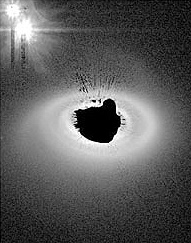
Star HD1569A, in the Milky
Way galaxy, also shows wide disk of dust glowing from reflected light emanating
from the black objects (their light blocked out by the coronagraph on Hubble's
High Resolution Camera) which astronomers have identified as a triple star complex.
This disk may be in an earlier stage of organization than shown in the preceding
image, but it too may eventually lead to planets.
Theory indicates that, in
the earlier stages of planetary formation, some number of broad rings should develop
at various distances around the central star. One or more of these would appear
as torus like glowing collections of dust and gases. At least two stars with this
feature were imaged by HST and reported in January of 1999. Here is one of the
star-ring systems:
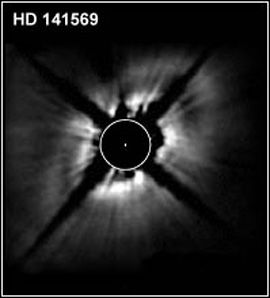
Visible is a bright ring at
some considerable distance out from the tiny parent star (white dot) and a more
diffuse, darker mass extending beyond, both features occupying a flattened disc.
In this instance, there are no rings close in (analogous to the regions occupied
by the inner planets of the Solar System). The white circle is added by the astronomers
to mark a boundary; the broad black cross (X) is an optical artifact. This star
is about 350 light years from Earth.
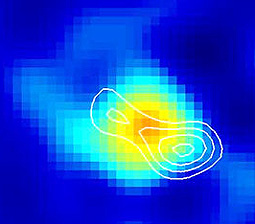
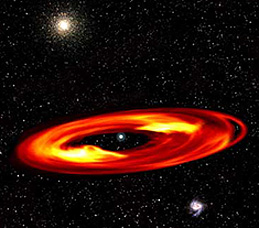
A recent image, made from
data detected at 1.3 mm by a French radio telescope, may have caught the formation
of two large clots of matter likely to eventually contract into giant planets.
These occur in the ring around the central star Vega, 25 light years away (in
the Constellation Lyra). Here is an image based on observations made by D. Wilner
and D. Aguilar of Harvard's Smithsonian Center for Astrophysics. (Note: this
image has been enhanced artificially as an artist's rendition.)
Drs. C. Chen and M. Jura,
Univ. of California-Berkeley have detected (monitoring infrared radiation) a
ring of dust which seems to contain asteroid-like bodies around Zeta Leporis,
a star some 70 l.y. from Earth. The ring is much closer (~2.5 A.U.) to its parent
star than the distances found for other recently observed or inferred planetary
bodies around stars. They propose this ring to be the precursor of eventual
formation, by collision of asteroidal bodies, of rocky planets analogous to
those of the Solar System. These bodies, form from smaller particles (dust)
condensed from the gas-particle cloud associated with the forming star. Much
of that dust can move inward towards the star by a process called Poynting-Robertson
drag. This is caused by radiation from the parent star being absorbed and re-radiated
differentially, leading to a Doppler effect (here, the energy of emission in
the direction of dust motion is at shorter wavelengths [more energetic] and
thus by retro-action slows the particles) that promotes drift of the dust towards
the star.
The following is a generally
accepted model (called "core accretion") for establishing a planetary system:
A nebula is subject to gravitational irregularities and other perturbations that
cause free-fall collapse to numerous clots around which surrounding gases and
particulates usually adopt a disklike form. The influence of gravity, which builds
up progressively as clots enlarge, is the prime driving force promoting both planet
and star (Sun) formation. In some instances, shock waves from a supernova can
cause interstellar matter to initiate collapse and compress into protostars and
debris orbiting them. Matter is also redistributed along magnetic field lines
by magnetohydrodyamic processes. The main phases of planetary formation extend
over about 10-20 x 106 years but it may require up to 108
years to progress from the early infall to the late T Tauri stage of a protostar's
development. While a particular clot is organizing, the materials tend to redistribute
such that hydrogen and much of the lighter elements flow towards a growing center
to accumulate in a gravitationally balanced sphere, the star. Under one set of
conditions, instabilities lead to a double (binary) star pair. As protostars form,
the rotating gases and dust particles collect in a spinning disk around each center
and eventually organize by accretion into planets. The same process, with variants,
works at single stars.
If our Solar System is
the norm, inner planets should be rocky, with thin or absent atmosphere (lost
from insufficient gravitational ability to retain the gases or by being swept
away by the solar wind). Outer planets should have rocky cores and be less susceptible
to loss of gases, so that their increased mass serves to gather in still more
gases. However, the discovery that giant planets can lie quite close to their
parent stars places this assumption of size distribution with distance into
question.
Two recent hypotheses are
adding new twists to the above concepts. First, in addition to or in place of
core accretion, another mechanism called "disc instability" may play an important,
perhaps key role, in planetary inception. This is related to gravitational irregularities
that can cause rather rapid accumulation of materials in the proto-planetary disc.
Earlier-formed planets can contribute to setting up further instabilities. A second
idea holds that planets can move inward or even outward in a form of migration
or "wandering" so that their orbits change both in relative distance to their
parent star(s) and in eccentricity.
But for the present, astronomers
continue to build and refine their models on the much easier-to-make observations
at the astronomically short distances within the Solar System. Like other stars,
the Sun (whose diameter is 1,392,000 km [870,000 miles]) is an end-product of
gravitationally-driven condensation and collapse of hydrogen/helium gases and
associated matter (both solid and gaseous) consisting of other elements and compounds
that once made up a diffuse (density ~ 1000 atoms/cc) nebula. Probably many stars
were generated in the timeframe of a few hundred million years from this particular
"cloud".
The protosun built up from
centripetal, gravity-induced infall of nebular substances towards one of the
concentration centers in the nebula. The bulk of the gases enters the resulting
star itself along with much of the other materials, leaving an enveloping residue
of matter enriched in Si, C, O (and H), N, Ca, Mg, Fe, Ti, Al, Na, K, and S
(most organized into compounds, particularly silicates, that can be sampled
by recovery of iron and stony meteorites - representing fragments of comets
and broken protoplanets that are swept up onto Earth). This material, bound
by gravity to the Sun but free to move inertially in encircling orbits, remained
distributed in the space making up the Solar System. This system of particles
rather rapidly organized into a disc-like shape whose present radius is about
100 A.U. (Astronomical Unit, defined as the average distance [149.6 x 10⁶
km, or about 93 million miles] between the centers of the Earth and Sun;
solar light takes about 8 and a half minutes to travel that distance; Pluto,
lies 39.5 A.U. from the Sun whose gravitational influence is exerted well beyond).
The disc rotated slowly (counterclockwise relative to a viewpoint above the
north celestial pole [which passes through Polaris, the North Star]), its motion
influenced by external gravitational effects from nearby stars.
As this rotation got underway,
and thereafter, the stellar (solar) magnetic field churned up the dust and gases
(descriptively compared to the action of an "eggbeater" in a thin batter) causing
them to collect into clots much smaller than the Sun that underwent various
degrees of condensation. This field also expels and guides this material into
jets that carry matter out to great distances, as seen here in this Hubble Space
Telescope view of a jet ejecting from another star in our galaxy:

Both jets and irregular
nebular patches (e.g., the Horsehead and Eagle nebulas shown above) contain
not only gases but significant amounts of dust. The dust is very small and consists
of three types: 1) core-mantle elliptical particles, typically 0.3 to 0.5 microns
in long dimension, with a silicate interior coated by icy forms of gases; 2)
carbonaceous particles (~0.005 microns), and 3) open frothy clots called PAH
dust (polycyclic aromatic hydrocarbons) (~0.002 microns). Shock waves and radiation
can strip off the ice mantle leaving grains that are incorporated into coalescing
bodies that form the prototypes which accrete into the planetesimals from which
asteroids or planets then build up. Ultraviolet radiation can modify the organics
into more complex molecular forms. In this way, organic molecules are introduced
from space onto planetary surface and, if conditions are right, can eventually
serve as viable ingredients for the inception of living things (see below).
The possible role of shock
waves in planetary formation is now the subject of considerable study. Evidence
for a shock wave that develops as material falls towards a nearby protostar
against its remaining gas/dust cloud has been observed at L1157, in which the
present cloud is about 20 times the solar system diameter. As this cloud proceeds
to infall into the newborn star as it organizes into a disk, it produces shock
waves that may clump dust together, as described in the next paragraph. Here
is this cloud:
For the Solar System, shock
waves and intense radiation acted on the dust such that some of it melted into
tiny droplets which chill into chondrules. These spherical bodies then
were caught up with remaining dust to produce the primitive small solid bodies
(fluffy "rockballs") that populated much of the heliosphere surrounding the
Sun. We see samples of these bodies today as meteorites. Most infallen
meteorites are ordinary chondrites that, in thin section, appear much like this
sample from the Tieschitz meteorite:

The most primitive meteorites,
called carbonaceous chondrites, are enriched in carbon and contain water. Other
meteorites are iron-rich (some with > 90% metallic iron), and may have once
been the interiors of planetary bodies since disrupted. The chondrules themselves
generally show a very limited size range, suggesting that ones larger than these
fell back into the Sun through gravitational pull whereas smaller ones were
swept away into interstellar space through expulsion by shock waves and solar
wind.
Magnetically-driven eddies
within the gas/dust cloud helped to impart additional angular momentum to the
larger condensed rotating objects beyond the spherical Sun (which possesses
only 0.55% of this momentum even though it contains 99.87% of the total mass
of the system). These objects now remain in orbits around the Sun in positions
that remain stable because of the counterbalance between centrifugal forces
related to angular momentum and inward-directed gravitational pull from the
Sun.
Planets appear to form simultaneously
with the star around which they associate in well-defined orbits. As the formative
process operated, local instabilities in the nebula tied to the Sun caused the
chondrule-laden rockballs within turbulent zones to cluster and further aggregate
into objects ranging from meter-size up to planetesimal dimensions (tens
to a few hundred kilometers, typified [perhaps coincidentally] by asteroid proportions).
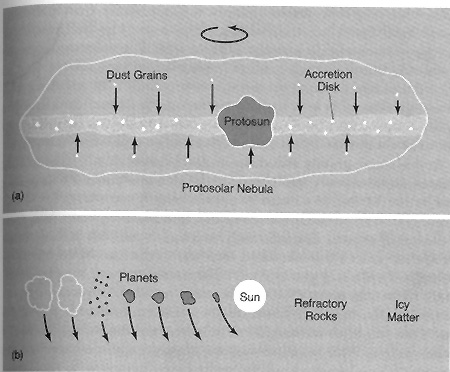
From J. Silk, The Big Bang,
2nd Ed., © 1989. Reproduced by permission of W.H. Freeman Co., New York
During this growth stage,
smaller planetesimals tended to break apart repeatedly from mutual collisions
while larger ones survived by attracting most of the smaller ones gravitationally,
growing by accretion as new matter impacted on their surfaces. Once started,
"runaway" growth ensues so that many planetesimals combine into bodies that
eventually enlarge into fullblown planets. The bulk of the matter beyond the
Sun was swept into the planets and their satellites, although some remains in
comets and cosmic dust. Mercury, and some Outer Planet satellites are preserved
remnants of this later stage in planetary growth, as indicated by their heavily
cratered surfaces that were never destroyed by subsequent processes such as
erosion. In contrast, the Moon appears to have built up by re-aggregation of
debris hurled into space as ejecta from a giant impact on Earth soon after our
planet formed; once collected into a sphere (which probably melted), the lunar
surface continued to be bombarded with its own remnants as well as asteroids
and other space debris. Its oldest craters are hundred of millions of years
younger than the time at which the debris reassembled, melted and formed the
lunar sphere; at least some of its larger basins are somewhat older.
As mentioned above, in our
Solar System, the four inner planets (the Terrestrial Group) are largely
rocky (silicates, oxides, and some free iron; three with atmospheres) and the
outer four (Giant Group) are mostly gases with possible rock cores. These
Giants developed large enough cores to attract and capture significant fractions
of the nebular gases dispersed in the accretion disk.
Analysis of argon, nitrogen,
and other gases in Jupiter indicates their amounts are such that this Giant
must have formed under very cold conditions; if further work bears this out,
Solar System scientists may adopt, as one plausible explanation, an origin of
Jupiter (and perhaps the other Giants) at much greater initial distances from
the Sun with these having since moved significantly closer through orbital contraction
or decay. The ninth planet, Pluto, the smallest and, at times, farthest out
(its elliptical orbit periodically brings it within that of Neptune), appears
to be made up of rock and ice and may be a captured satellite of Neptune.
Theoreticians differ as
to the exact methods and sequence in which the planets accumulated after the
condensation and planetesimal phases. Timing is a critical aspect of the formation
history. One version - the equilibrium condensation model - considers
condensation to happen early and quickly, in a few million years, with the observed
sunward zoning of higher temperature minerals and greater densities in the rocky
inner planets both being consequences of the increasing temperature profile
inward across the solar nebula. Accretion was stretched out over 100 million
years or so. The heterogeneous accretion model holds condensation and
buildup of planetesimals to proceed simultaneously over a few tens of millions
of years. Neither model adequately explains the fact that both high and low
temperature minerals aggregate together in the inner planets to provide materials
capable of generating the atmospheric gases released from these planets. The
models also do not fully account for the strong preferential concentration of
iron and other siderophile ("iron-loving") elements in the inner, terrestrial
planets. One solution is to add (by impact) low temperature material to the
growing protoplanets carried in along eccentric orbits from asteroidal and giant
planet regions. This material is then homogenized during the total melting assumed
for each inner planet early in its evolution (this melting is the consequence
of heat deposited from accretionary impacts, from gravitational contraction,
and from release during radioactive decay). As cooling ensues, materials are
redistributed during the general differentiation that carries heavy metals and
compounds towards the center and allows light materials to "float" upwards towards
the surface.
From an anthropocentric
outlook, the importance in understanding planetary formation mechanisms and
history is the assumption (not a clearcut fact) that planets possessing certain
appropriate conditions are the harbors of life. Life, it is believed by Earth
dwellers who can think, may well be the most complex and advanced feature in
the Universe, based on the presumption that it has (through us) evolved into
a state resulting in lifeforms that perceive beyond sensing, analyze through
reason, and evaluate most other aspects of known existence. Life, under this
viewpoint, is the quintessential achievement in the evolution of the Universe
to date. Whether life on Earth stands at the pinnacle, or somewhere below, has
yet to be established - statistically, it is most likely that somewhere in the
Universe even more highly developed living creatures, with superior intellects,
exist today or have in the past. (The ideas just enunciated are closely associated
with the modern doctrine called humanism.
Thus, the capstone of this
Section on Cosmology must surely be a consideration of the most provocative
and fascinating Quest in the history of life - the attempts to determine whether
life - and specifically intelligent life - exists elsewhere in the Universe.
Philosophically, many on Earth hope that we are unique - thinking beings that
are the pinnacle and teleological goal of a Creator's act. Scientifically, most
cosmologists, biologists, etc. are coming around to the firm conviction that
life does indeed exist elsewhere - throughout the Universe. This is a logical
conclusion, since a huge Universe with just one tiny inhabited body on which
conscious creatures exist strikes most scientists, and a growing number of philosophers,
as extremely unlikely, and, from a practical sense, even a foolish, wasteful
action by any Creator (this viewpoint is touched upon again later on this page).
One of the prime motivations
that has stemmed from space exploration continues to the the Search for
ExtraTerrestrial Intelligence (SETI) - which is a much
higher goal than simply seeking evidence that lower levels of life exist elsewhere.
This has so far been something of an ad hoc effort by a small number
of dedicated astronomers who have had limited support from private sources (the
movie "Contact" captures the essence of this effort). Now, NASA and other large
organizations have become involved and a more concerted and systematic hunt
for advanced life forms is being funded.
The ways in which SETI
now seeks evidence for intelligent life are diverse and innovative. This is
a very daunting and intriguing subject that could warrant considerable coverage
space on this page but reluctantly must be confined to a synopsis of a few key
ideas. However, we choose to guide you to several sites on the Internet for
many of the omitted details. The starting point is the SETI
site itself. The SETI Institute is currently being directed by Dr. Frank
Drake, the originator of what is now known as Drake's Equation. Here are three
Internet sites that discuss in some depth that equation: (1), (2),
and (3).
For the record, we now
state the Drake Equation (in its "dimensional analysis" format) and add some
comments on values used in its terms (you can choose your own set of value in
(2) above to see how changes affect the outcome):
N = R fp
ne fl fi fc L
where,
N = the number of communicating
civilizations in the Universe.
R = the rate of formation
of stars of types around which planets can form
ne = the number
of Earth-like bodies in the planetary system
fl = the fraction
of planets with life
fi = the fraction
with intelligent life
fc = the fraction
that has developed interstellar communication systems
L = the lifetime (span)
of civilizations (up to extinction)
Of course, none of these
parameters has yet been fixed with reasonably certainty, so that many values
(and ranges thereof) have been proposed. One common set (but still provisional)
has R = 10; fp = 0.5; ne = 0.2; fl = 0.2; fi
= 0.2; fc = 0.2, and L = 50000 (source: Article "Why ET hasn't Called",
by M. Shermer; Scientific American, August 2002). For our galaxy, this
set of values give N = 400 civilizations.
Each of these term inputs
is easily challenged. For fp, any number chosen would depend on such
variables as the total number of stars in a galaxy and the type of star suited
to planetary formation (usually limited to G and K types) and its percentage
of the total population. Recent estimates center around 10% (factor = 0.1).
At the 2001 Annual Meeting of the American Astronomical Society, Dr. J. Bally
of the Univ. of Colorado presented an argument which concludes that only about
5% of the stars in the Universe are capable of producing (surviving) planetary
systems. Massive stars will blow away the gas and dust needed for planets to
form. Binary or ternary star systems, which are the most common arrangement,
also are unfavorable for planetary growth, especially since one of the pair
or trio is likely to be a Giant, and matter is collected as jets owing to attraction.
He concludes that planets need to form soon after a star is born in order to
have a reasonable chance for survival.
Plausible arguments can be
made for values/ranges of each of the others. For example, fl will
be sensitive to such related variables as the presence and importance of water,
the nature of the evolved atmosphere, and the time needed for higher order life
forms to evolve (relative to planet age; rate can vary as these others assume
values other than that of our Earth). The possibility of non-carbon-based life
forms must be factored in. In Shermer's article, he calls attention to the great
uncertainty of L, the time over which any intelligences will persist before extinction.
Pessimists feel that this number can be small. For Earth, civilized life is only
about 5000 years old (based on the time at which agriculture and earliest urbanization
become practiced). With the advent of the atomic bomb, these doomsayers consider
that total mass destruction may be likely. On the other hand, one can conceptualize
human society as overcoming its self-destruction tendencies and lasting (into
the future) for millions of years (the upper limit then may relate either to a
catastrophic impact or the stage in which the Sun burns out and expands to envelop
the inner planets).
Still another factor that
is not stated in the Drake Equation (or commonly discussed online) is the nature
and strength of the communication signal. Present-day radio waves are probably
too weak to have much effect in all but the nearest part of our galaxy. Higher
energy waves (such as gamma radiation) would be more powerful but we on Earth
have not yet devised suitable transmitters of these rays. And any signal sent
must move away in many directions from it planetary (spherical) source; if only
directional beams are emitted, the number of planetary receivers (made by other
intelligent recipients) in the right position to pick the signals will be greatly
reduced. But, directional beams (those using laser light are especially promising)
have one advantage - they remain concentrated over a small angular volume. As
we on Earth continue to find many more planets (most would be in our Galaxy at
this stage of our detection capabilities), we can systematically send signals
to these with a good chance to intercept them in the narrow field of view encompassing
our signals. Likewise, any intelligent and technically capable life on any one(s)
of these may have by now spotted our solar system and have, or will, send signals
to us. What the "message" should be, owing to uncertainties of language recognition
and translation, is probably dictated by the need to transmit something of a universal
nature: sending intermittent signals (sound or light) that consist of a series
of prime numbers is a favorite suggestion. Since mathematics has a unifying generality
to it - all intelligent beings should find some of the same fundamental theorems
and expressions - the message we receive (or send) is most likely to be in that
format (spoken/written
Start with hypothetical observers
at two points A and B not then in contact in early spacetime. Over expansion time,
their light cones would eventually intersect, allowing each to see (at time t1)
other parts of the Universe in common but not yet one another. At a later time,
beyond t2 ("now") in the future, the horizons of A and B (boundaries
of the two light cones) will finally intersect, allowing each to peer back into
the past history of the other.
language is ruled out because
each one on Earth has a unique set of meanings attached to words that therefore
precludes universality).
All in all, we are still a
"far cry" removed from having any reasonable estimate of probabilities of other
civilizations actually extant. Shermer develops arguments that produce numbers
as low as 2 to 3 for our galaxy (if really strong signals can reach other from
other galaxies, this number would then greatly rise). T.R. McDonough of the Planetary
Society arrives at 4000; Carl Sagan during an optimistic moment, came up with
1,000,000. Today, no one is arriving at zero, so those seeking ET can remain hopeful,
even optimistic.
In October 2001, the Scientific
American magazine carried a review article (pages 61-67) by G. Gonzalez, D. Brownlee,
and P. D. Ward bearing the provocative title of "Refuges for Life in a Hostile
Universe". We will not paraphrase its many intriguing statements and conclusions
but urge you to track the article down and read through it. Its bottom line is
that there appears to be only a narrow range of conditions around stars and within
galaxies that would likely harbor life (organic matter; not necessarily intelligent).
They define CHZ and GHZ as Circumstellar and Glalactic Habitable Zones respectively.
In systems like our Sun's this is confined to a narrow inner zone. In spiral galaxies
the GHZ is beyond the inner bulge, halo, and thick disk that consist mostly of
old stars; the more favorable region is an annulus about midway from the center
to the edge defined by the spiral arms, in that part known as the thin disk.
The condition most pertinent
to possibilities for life is the metallicity of the star groups. Metallicity
defines the proportion or percentage of chemical elements with atomic numbers
above 2 in the total mix of elemental and molecular gases and dust available
for star formation. Smaller stars with metallicities between 60 and 200% of
the Sun's value are favored. These stars comprise about 20% of the total in
a galaxy. Other factors include the frequency of supernovae (which over time
build up the supply of the "metal" atoms), excessive radiation (continuous or
in bursts), and the distribution and numbers of objects capable of destroying
protoplanets by impact. Giant planets seem less likely to foster conditions
that would aid life's establishment. They conclude that 1) most stars don't
have planets and 2) complex life is rare even on those stars with planets. While
they don't propose that Earth is unique, they do caution that the statistical
distribution from their GHZ and CHZ models support the notion that it may prove
very hard to find evidence of life of any kind either in the Milky Way or (even
more so) in more distant galaxies.
The expectation that some
life exists elsewhere in the Universe will depend on the nature of life itself.
Life can be defined by properties that are both chemical and functional. Judging
on what we know conclusively from the one sample available to earthlings - namely,
life on Earth itself as the only confirmed example in the Solar System - the
essential chemical incredients are carbon, the crucial element in organic
molecules (of which proteins are the fundamental component) of great complexity
and variety that are the basis of life, together with hydrogen, oxygen (and
water), nitrogen, and to a lesser degree phosphorus and sulphur and other elements
as important traces. The amazing thing about this assemblage of critical elements
is that they all at times in the past resided in stars and much of the
hydrogen itself can be traced back to the first minute of the Big Bang. You
and I, as humans, are truly star people - our heritage is cosmic in that our
ingredients are either primordial- or stellar-derived.
The principal functional
manifestations of life are: metabolism; reproducibility; cellular-organization;
growth cycle and dependence on nutrition; respiration (in some types); (usually)
movement of some kind; propensity to evolutionary modification, and, for some
types, utilization of photosynthesis. Intelligent life, furthermore, is marked
by consciousness, reasoning, abstraction, reliance on memory, communication,
and awareness of time and other essentials of existence; free will and "soul"
are properties of a more metaphysical nature and harder to prove as realities.
If Earth defines the standard
state, from which there can be no major deviations if life is to form and survive,
then life-supporting planets are constrained to vary in their physical and chemical
properties only within a narrow range. A planet must have accessible and reactive
carbon capable of polymerizing (some have postulated an alternative element, silicon,
as the keystone in complex life-sustaining molecules but no such compounds have
been successfully synthesized and made to function like carbon life). It appears
(but is not totally certain) that water is also essential. If so, in an environ
like Earth, this limits the range of temperatures at which life originates
to the freezing and vaporization (boiling) point values of 0 to 100 °C (however,
life, once formed, has been found to exist at temperatures that are higher and
lower, but generally in the presence of liquid water; witness, the "smokers",
which host symbiotically specialized life, that eject superheated water and steam
on active divergent ridges on the ocean floor). Atmospheres of oxygen and nitrogen
favor many forms of life; planets that are either airless or contain hostile chemicals
such as methane and sulphur compounds tend to suppress life.
If such conditions, and their
ranges, are indeed limiting factors, then only a few, if any, planets in a given
planetary system are properly suited to the origin, development, and persistence
of living creatures. Thus, while billions of planets are probably existent universally
today, only a small fraction are suited to supporting life. These will be confined
to those at a distance from their star where temperatures are in appropriate ranges
to allow water in a suitable state (not chemically bound or heated so that
all has evaporated and escaped to space). They will have proper sizes to maintain
fostering atmospheres. Their chemistry will allow production of molecules (most
likely carbon-based) that can, over time, evolve into organic ones of sufficient
complexity to merit the status of "living".
Water has been detected
in the Solar System, mainly on icy satellites, on Mars, and in comets. A search
for this compound beyond the Solar System has finally met with success. Astronomers
have now detected water around CW Leonus, a carbon-rich star in its waning life,
some 500 l.y. from Earth. This water is believed to now be vapor derived from
billions of comets about the star, as it rapidly releases its heat during an
explosive phase.
The best review of the
Origin of Life found so far by the writer is the 1999 book by Paul Davies, The
Fifth Miracle: The Search for the Origin and Meaning of Life, Simon &
Schuster.
Whether the evolutionary mechanisms
we have found to operate on Earth - change into diverse and usually more complex
forms in response to changing conditions, aided by genetic processes and natural
selection - lead to intelligent life elsewhere can only so far be the subject
of speculation (devoid of any direct evidence). But, again, considering the large
number of favorable planets - almost certainly in the millions - spread throughout
the billions of galaxies, it would not be surprising, and is to be expected, that
organisms with consciousness and other aspects of intelligence will someday be
communicated with, thus supporting the thesis of Universal life. It is provocative
to conjecture whether these "alien" thinkers have some insight into the concept
of an Intelligent Designer (Creator or God) and whether they believe, as most
here still do, in the special gift of that God of the "soul" destined to persist
in some form of immortality.
Notice that we have progressed
well down this page without mentioning the favorite topic among those - scientists
and laypersons - who speculate on the possibilities and ramifications of intelligent
"alien" life in our galaxy, and by reasonable inference, in most other galaxies:
the reality of whether we have been visited by these creatures in their spaceships
(UFO's) at times in the past, and a corollary, whether we on Earth will ever have
the means to visit other planets by some means of space travel. In light of present
knowledge, any extraterrestrials will almost certainly not originate in any other
solar sytem planet but would reach us from beyond - well into outer space. We,
in turn, must gain experience in space travel by first journeying to one or more
of our neighboring planets. Probably in the lifetime of some who read these words
this will happen. But extending this travel to other stars - interstellar travel
within the Milky Way - may not happen in this timeframe, although 100, 500, 1000,
a million years hence, the advances in science and technology should bring this
about. But, complications and limitations must be overcome.
By far the biggest problem
in interstellar travel is distance. A simple example illustrates the difficulty.
The nearest star is Proxima Centauri, 4.2 light years away (actually, Alpha Centauri,
0.1 l.y. farther away, is a better choice owing to its size), or about 42 trillion
kilometers (26 billion miles) from Earth, would be a reasonable first target.
To help you visualize these distances, look at this diagram (the distances are
in Astronomical Units [1 A.U. is the distance between Earth and Sun, or 149 million
kilometers {~93 million miles}]).
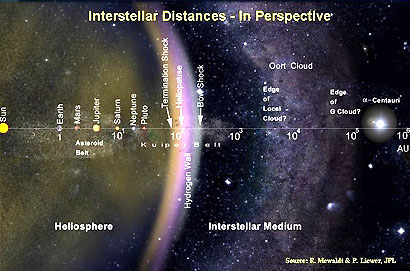
If a manned spacecraft were
to leave the solar system at the same velocity that Pioneer 10 had when it actually
did escape the system, namely, 60000 km/hr (37000 mph), it would take approximately
80000 years to reach one of these two stars. (And, the same time to return to
Earth, unless a one-way trip is the choice, then at least double that total.)
This obviously would be impractical under the psychology of today's thinking.
The solution should be obvious: Earthlings must build a spacecraft that contains
all those materials and provisions needed to sustain life for eons. Chief among
these would be foodstuffs, water, oxygen and other essentials. Then, even if human
life spans can be extended, the strategy would still have to be: to continually
recreate people on board through breeding, so that those who arrive at Alpha Centauri
(hopefully, we will discover planets there; none have been detected as yet) will
be many generations down the time path of continuing life of the future. Trips
to other more distant stars may be more enticing if these show evidence of planets
that can sustain life. Surely, from the billions of humans on Earth when this
time of launch comes there may be volunteers who are agreeable to setting forth
on this voyage; if and when we develop the appropriate technology, the travelers
may need to consent to being placed in some kind of suspended animation (a body
freeze technique is commonly proposed to put living creatures into hibernation).
Such a trip is likely to fulfill at least one of four motivations: 1) either the
innate need for man to explore; (2) and/or a desire to establish contact
and exchange knowledge with other civilizations; (3) and/or a compelling
need to survive if Earth should threatened to become uninhabitable); (4)
and/or a decision to colonize another (uninhabited) planet with suitable
living conditions for organisms, or if intelligent beings are found to settle
with them.
However, most readers of
this Tutorial would judge the long duration travel scenario (with or without
hibernation) to be rather undesirable even if altruistic. Is there any alternative.
Yes, if we can find new means of propulsion through space at much greater speeds
than presently achieved. For instance, let the inertial velocity reach 0.2 the
speed of light 'c'. If that occurs soon after launch, the spacecraft should
reach Alpha Centauri in 5 x 4.3 l.y., or 21 years (earthtime), or 42+ years
roundtrip. Theoretically, this transit time can be greatly shortened if the
spacecraft attains a velocity near light speed. However, relativistic effects
will come into play (see Preface to this Section), including differential aging
between space travelers and those remaining on Earth. Thus, time dilation would
make the high speed trip appear to those on Earth to have taken longer than
the 4.2 years plus adjustments for being somewhat under light speed.
There are many other factors
required for success and safety to take into consideration. Perhaps at the top
of the list is to find propulsion systems that can reach these high speeds (significant
fractions of the speed of light); to get to such speeds requires huge expenditures
of energy. Presently, none is known, but some sound proposals for possibilities
already have surfaced: ion engines, anti-matter engines, controlled nuclear
processes, gravitational "slings", laser beams pushing on light sails, and various
other innovative but speculative mechanisms for powerful propulsion systems.
Quantum-minded thinkers can conjure up schemes that depend on "wormholes" and
"quantum tunneling", "timewarps", and the like. A long shot depends on the proof
of existence of the hypothesized "tachyons", particles that travel at faster
than the speed of light; if real and accessible, some technique would be needed
to harness them as aids to propulsion. Whatever propulsion systems is eventually
proven feasible, one requisite is that it be one that travels with the spacecraft
(instead of a "one-shot" push at the outset) so that there would always be a
means for course corrections, maneuvering, handling the unforseen, possible
landing, and eventual return to Earth if that is a mission requirement. If we
base our predictions for space travel eventuality on the huge advances in science
and technology over the last two centuries - now seeming to occur as though
growing exponentially - it is reasonable to expect that the possibility of interstellar
travel will turn into reality in the not too distant future (say, in this millenium).
If that indeed happens, then the counterpoint argument is that aliens "out there"
may be ahead of us and have in fact visited Earth - if we are judged to be interesting
enough.
These last paragraphs have
no doubt been fascinating for some. There are a large number of books devoted
to this mind-boggling subject. These are referenced on the Internet; just use
your Search Engine to look for topics such as "Space travel", "Interstellar travel",
or similar keywords. The writer found many that discuss the potentialities and
the difficulties underlying outer space exploration; here are two of these URLs:
(1); (3)
To sum up the hard realities
of space travel: 1) present and foreseeable technologies still far short of
making such trips plausible, safe and worthwhile 2) in time (probably many centuries),
humans may learn enough to engage in such endeavors; 3) almost certainly, a
manned trip will be preceded by unmanned spacecraft to prove the workability
of the technology; 4) if mankind survives itself (or evolves into some form
of superintelligence that can control the various threats to self-destruction
(wars; environmental nihilism), trips to other stars will someday be inevitable;
and 5) in the meantime, we should continue to inventory suitable planets and
search for intelligent life elsewhere (SETI), so as to develop the incentive
for undertaking travel to candidate planets; we should also hunt for any evidence
that Earth has previously been visited (the Fermi Paradox: If aliens have already
come to Earth, as might be expected since statistically there could well be
many more advanced civilizations than those on Earth today if intelligent life
is widespread in the Universe, then why haven't we found any valid signs of
their visit?)
In closing Section 20,
contemplation of Cosmology, and its astronomical substructure, is a truly humbling
experience for one's brain. The wonder is: that there exists on one tiny point
in a humongous Universe something called the "conscious" and that the human
mind (yours, for instance) can conceive of, and begin to understand, the truths
of this Universe's attributes and history that are continually being discovered
and refined. Finally, it is both astonishing and reassuring to realize that
all beings - be they people or animals/plants or inanimate matter - are remarkably
cosmological in nature: All the atoms in our bodies were once contained in stars
or interstellar space; our parts in a sense are variously billions of years
old and their atomic constituents, even after multiple dispersions and reassemblies,
will last at least as long as the present Universe - estimated to continue for
perhaps 50 b.y or more. In one way, then, our essences will have achieved some
kind of plausible Immortality in view of the many incarnations that preceded
our current atomic arrangement and are yet to happen. But, from the humble side,
perhaps "We are not alone" and certainly we are not at the center of the known
Universe; our importance is sui generis and our rank among the Universe's
populations is probably just average.
This Section on Cosmology
has doubtless been heavy going for most readers. Some may be inspired to wish
to learn more. Refer to the Preface link accessed from page 20-1 for the references
to books consulted by the writer in preparing this overview:
For those who would like to
learn much more about astronomy through illustrations, we want to steer you to
a Web site that allows you to seek more pictures and textual information about
most of the topics that have been covered or touched upon so far in this Appendix.
NASA Goddard astronomers have put together a Web site that features many previous
Astronomy Picture
of the Day (APOD). In the Search box, you simply type in a topic, e.g., young
stars; supernova; black holes; spiral galaxies, planet, etc. and if the category
is there a running text with links to subtopics and pictures will be delivered.
This can be an adventure.
And, finally, here is a
quiz of sorts - actually a Web Page that poses many questions (FACs) coming
from those who have accessed the site. Many of these you should be able to answer
now that you have gone through this Section. Others touch upon topics that may
not have been considered before. Still others provide concise reviews of ideas
we've presented but perhaps will give you a different slant or will offer supplemental
information. Anyway, log on to "Ask the Space Scientist"
and choose the group of topics that obviously fall within The Cosmos pervue.
But, you may also want to check out the Planetology group or even some of the
other subjects.
Some Additional
Comments
For the curious, these paperback
books by Paul Davies offer valuable insights into both scientific and metaphysical
aspects of Cosmology: God and the New Physics and The Mind of God
[especially Ch. 2]., Touchstone Books, Simon & Schuster, Inc.; this author
considers the question of life elsewhere in the Universe in Are We Alone: Philosophical
Implications of the Discovery of Extraterrestrial Life, Basic Books, 1995.
A book that relates cosmological discoveries to teachings associated with the
Christian God is Beyond the Cosmos by Hugh Ross, Oxford Press, 1996. A
balanced review that considers how religious beliefs and observations of the physical
Universe are not necessarily incompatible is When Science meets Religion
by Ian Barbour, Harper, 1999. A general overview of arguments contrary to the
exclusively natural and spontaneous Universe such as described in this Section
is A Case against Accident and Self-Organization, Rowman & Littlefield.
In the March, 2002 issue of
the magazine First Things, which deals with topics in philosophy, theology,
and the social order, an outstanding review of the possibilities of life elsewhere
in the Universe and its implications for humankind, written by Fred Heeren, and
entitled Home Alone in the Universe?, provides comprehensive and provocative
insights into the question of how discovery of intelligent life beyond the Solar
System would affect and change the outlook of Earth's inhabitants towards their
place and role in the Universe. Highly recommended! And, as of August, 2002, the
full text remains online at this URL.
Two Internet Sites that
address the possibilities of other worlds, extraterrestrial life, and the implications
that such life, and cosmology in general, would have on the religions of our
world has been prepared by Florida
Today and Stanford Encyclopedia
(the latter rather heavy-going).
And last (but hopefully
not least) you have the option of clicking here to read two letters
written by the writer (NMS) to his local newspaper (The Press-Enterprise) as
he joined a running debate on the editorial pages between one faction - the
conservative Creationists - and another - the progressive Scientists - concerning
the role that a God-Creator may have had in producing the Universe we have just
been studying. The ideas in these two letters summarize my still developing
viewpoint on the philosophical/scientific interweavings of the notions that
God does/does not (+/-) exist. Read these letters if you are curious.