Evidence
for the Big Bang:
The Redshift; Stellar/Galactic Distances; Age of the Universe;
Cosmic Background Radiation; Expansion Models; Dark Matter/Energy
What evidence leads to
and supports the Big Bang model? A good review of the resulting expansion (and
calculated rates) and ages derived from these observations can be found in a
Scientific American article (October, 1998; pp. 92-96) prepared by Dr. Wendy
L. Freedman.
Two
accepted lines of proof for the Big Bang have already been described: 1) the
details of the creation physics and progressive emergence of various elementary
particles during the first minute of the Big Bang (the Standard Model and its
variants; review page page 20-1) are consistent with
a model based on Big Bang precepts; these particles are the outcome of a history
that can be predicted and explained by Quantum and High Energy Physics, that
is, the theoretical production and sequence of particles seems verified by the
observed amounts of H, He, and Li atoms in the Universe; and 2) the observations,
particularly from HST, of the farthest galaxies as being more primitive in appearance
and development, are precisely what is expected from the expansion model in
which those parts of space (in which the galaxies are embedded) that have moved
the fastest are now the most distant; thus, we see them in earlier stages of
evolution when they were younger as we look back in time outwards from our frame
of reference,.
But, even more convincing
are two other physical observations that are best explained by a Big Bang origin
for the Universe, especially in terms of its expansion behavior: redshifts
of light (towards longer wavelengths) from the stars as a composite source in
galaxies and cosmic background radiation.
Redshift
and the Hubble Law
The first derives from relative
velocities as divulged by the measured redshift of radiation wavelengths
(see below for details). This was formalized by V.M. Slipher in 1912 but, in fact,
H. Robertson noticed a bit earlier that the farther nearby galaxies were from
our telescopes, the greater was the redshift. However, Edwin Hubble in 1924 has
received credit for promulgating this redshift-velocity-distance relationship
because he included many more galaxies as data points. He thus is recognized as
the key individual behind the Expanding Universe model, from whence later came
the Big Bang conception of its origin. (Note: Hubble himself never completely
accepted the implications of his observations and had doubts about the Big Bang
and most of the Universe models described below; for many years after drawing
attention to this phenomenon he continued to prefer a Steady State rather than
an Expanding Universe, although his position on the latter "mellowed" near the
end of his life.)
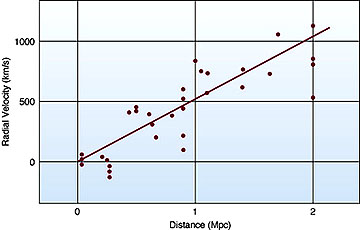
Some of Hubble's observed
redshifts led to estimates of galaxy velocities of 100 million kph, about 0.1
the speed of light. Here is a plot of his original data, from which he deduced
the expansion concept that later led to the Big Bang model
Hubble noted that, as recessional
velocities Vr were measured for stellar sources over a wide range of
astronomical distances D, the plot of Vr/D disclosed a straight line
relation whose slope has a value H, known as the Hubble Constant, named
after him. This, the Hubble Law, is the fundamental statement of the Big
Bang model. Here is one of his published plots of velocity versus distance.
From Astronomica.org
The resulting straight
line plot is easily described mathematically, in the basic equation:
Vr
(velocity of recession) = H (the constant determining slope) x D (distance [from
observer])
The constant has been designated
by the letter H, and is called the Hubble Constant. It is normally given the units
of Km/sec/Megaparsec (an alternate form is km/sec/million light years). The prime
information derived from this equation is that objects (such as galaxies) appear
to travel at ever increasing velocities as their distance from the observer (Earth)
becomes ever greater. The upper limit to expansion rate is the speed of light
(although some interpretations of inflation suggest that this huge leap in dimensional
enlargement occurred at greater than light speed). The current rate of expansion
is specified as one light year per Earth year (think about this and its logic
should be revealed).
One problem troubling Hubble
in the early years after his discovery is that when he used the first value for
H he derived to calculate the age of the Universe, it came out around 2+ billion
years, a number in stark conflict with the then accepted age of the Earth at about
4 billion years. The contradiction resulted from very imperfect - and too small
- estimates of distance to the nearby galaxies he used. As more trustworthy values
were obtained, and elliptical galaxies further out were better fixed as to distance,
an improved curve resulted (but still applicable to redshift z values [see below]
of less than 1):
From Astronomica.org
The diagram below is a recent
plot of galaxy velocity (in km/sec; converted to kph by multiplying by 3600) versus
distance (in megaparsecs) of each galaxy from Earth; the green dots denote specific
galaxies for which "reasonably good" measurements have been made (other galaxies
have also been so measured but their values are not on this diagram). Most of
these values come from galaxies 5 billion or less light years away. H0
is the present-day Hubble Constant whose precise value is still a major goal in
cosmological research; its spread of estimates is related to the uncertainties
both in determining the redshift and in fixing the distance of a galaxy at the
time light now received left it.
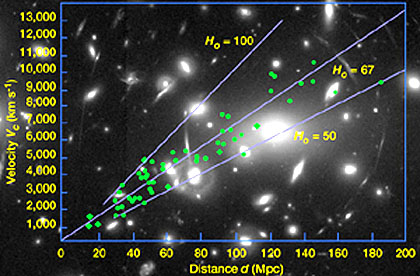
The Hubble Law works best
(gives a straight line) from plots of V versus D involving galaxies a few billion
or less light years away; uncertainties as to the correctness of distances further
out cause an increasing scatter of points in the plot that suggest (or mask) some
degree of non-linearity related to the cumulative effects of the curvature of
space.
Although called a "constant",
H has in fact varied in value over time. In this, it behaves much like the three
non-linear plots of R (Scale Factor) versus time shown on the previous page. R
describes how distances (as a measured parameter) change over time; H relates
distance traveled in a unit time span at each distance moving outward from the
point of observation. The two are related. H refers to the relative rate of change
of R. The reason that H has different values going back through the past is that
it is unlikely that the expansion rate of the Universe has itself been constant
since the Big Bang. Until recently, one model of expansion is strongly influenced
by deceleration due to gravitational forces pulling back on the enlarging universe,
which means the rate of expansion has been continually decreasing, giving rise
to a systematically changing H over the past (its value would increase as we move
back in time towards the outer Universe). But now, new evidence for a gradual
acceleration about midtime in the Universe's history (see next page) would also
affect the variability of H. At best, we can now only determine with reasonable
accuracy the value of H0, which proxies for the current value that
takes into account the variations in earlier eons of the Universe. We can also
say that H was at its maximum value relative to the present right after the extremely
large (anomalous) expansion rate of Inflation; we cannot measure this value since
we are unable to determine any redshifts until the Universe became transparent.
Let us now look into the details
of the concept of "redshift". Increases in recessional velocities are associated
with changes in the wavelength of light being received, such that as the velocity
becomes greater the wavelength becomes longer, i.e, moves to higher values (say,
from 0.4 to 0.6 µm in the visible; wavelengths in other regions of the EM spectrum
also are shifted towards greater values). This change is very much like the Doppler
effect studied in Introductory Physics: this shows the influence of motion towards
or away from the observer of a signal of some given wavelength, resulting in a
systematic wavelength shift. One manifestation of a wavelength shift's effect,
which can be experienced in everyday life on Earth, is exemplified by an audible
phenomenon - recall the sound of a whistle or horn on a fast-moving train as it
approaches and then moves past where you are stopped at a crossing. The pitch
of the sound varies systematically, rising on approach (higher frequencies) and
then falling as the train recedes after passing (lower frequencies). This wavelength
shortening (higher pitch) on approach and lengthening (lower pitch) with recession
is called the Doppler effect, which results from velocity and/or position
changes (relative motions) between moving source and stationary receiver.
In a sense, the lengthening
of wavelength as light sources (mostly galaxies) recede from Earth at progressively
increasing velocities and distances is analogous to the above Doppler effect.
Strictly speaking, this familiar effect as observed by us on Earth is not the
same as applies to cosmic distances (although it is a good approximation for nearby
galaxies in relative motion away from our observing location). As applied to more
distant objects seemingly moving away from us during Universe expansion, the wavelength
shift actually results from a different mechanism known as the Cosmological
Redshift. From a relativistic standpoint, while Dopplerlike in its consequences,
the cosmological redshift is analogous to the "stretching" of light caused by
the progressive increases in distance resulting from the continuous expansion
of (curving) space. This in turn results in proportional increases in recessional
velocities (thus in the formula for velocity v = d/t, it is the d that changes
with respect to steady time progression) with increasing distance from Earth (recall
the rubber band analogy on page
20-8).
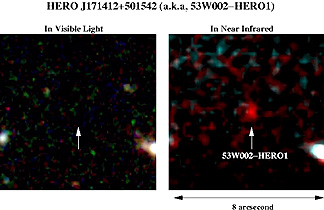
A recently reported observation
of a type of galactic body called a HERO (Hyper Extremely Red Object) may be
the result of this cosmological redshift. Check these two images:
On the left, the object
is not detected in visible light; but it appears as a red blotch in the near
infrared. The object, at least 10 billion light years from Earth, has been found
to be speeding away from us at nearly the speed of light. One interpretation
considers this object to be red (from a large propoortion of older stars) at
the time its light left the source 10 b.y. ago . But another considers this
this object to be composed in large part of bright, bluish stars, perhaps even
farther away (13 billion l.y.) but owing to the cosmological redshift the light
as received has been stretched to near infrared wavelengths (but assigned red
in this false color rendition).
Redshift phenomena are effectively
studied from their spectral states. As a star or galaxy emitting radiation recedes
from an observing (measuring) spectrometer (somewhere on or near the Earth), the
wavelength associated with a particular line will be shifted towards the red (longer
wavelength-lower energy end of the visible spectrum) and even into the near infrared.
What is measured is the displacement (δλ/λ = the incremental wavelength
shift ratioed to its initial wavelength λ) of this line to a new apparent
wavelength relative to its [rest state] wavelength in a spectrum obtained by exciting
the element on Earth in an emission or absorption spectrometer. The spectra are
commonly recorded on a photographic plate showing multiple lines that result from
the spectral spread of wavelengths characteristic of all detected elements) representing
an element in its ground or some excited state in the visible.
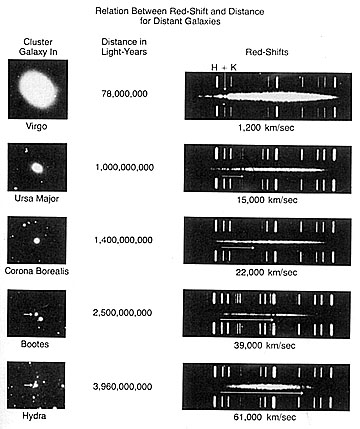
This next illustration shows
telescope images and spectra from five galaxies at increasing distances from Earth.
From J.
Silk, The Big Bang, 2nd Ed.
To pick out and thus intrepret
these spectra, start with the Virgo galaxy example (top right). The top and
bottom lines are the same emission spectra for this spectral interval (unspecified;
they are white instead of black because the photographic plate is printed as
a negative) obtained by spectroscopic analysis of a sample on Earth. The two
leftmost lines are the H and K spectra for the excited Ca++ state.
The spectrum from the galaxy appears as a long lenticular white smear in between
the two reference spectra. The vertical arrow points to the now shifted H and
K line pair, which here appear black because they are absorption rather than
emission lines. In the second spectral image, the horizontal arrow leads to
the position of the line pair for a galaxy in Ursa Major, now shifted notably
to the right. In the three succeeding spectal images, the horizontal arrow carries
to the position of the two dark H and K lines after each greater redshift. From
these observed shifts, the recessional velocities listed under each spectral
image have been calculated. These could be plotted on the distance-recessional
velocity diagram above, and would fall within the general distribution shown
thereon.
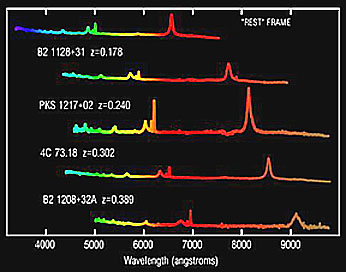
Today, the spectra are
more commonly recorded as continuous tracings on a strip chart. The next figure
shows a spectrogram recorded by a Kitt Peak National Observatory telescope in
which the top spectrum (obtained at rest in the laboratory) has peaks for three
hydrogen lines at 4340 A (in the blue); 4860 A (green) and 6552 A (red). The
next four are spectra from distant quasars at progressively greater distances.
Source:
M. Corbin
The displacement of a spectral
line owing to redshift can be used to calculate the redshift value z associated
with a source simply from the rest wavelength of a given line and the observed
wavelength of the same line displaced by the source's motion: The formula:
z = (λobs/λrest)
- 1
Using the z value,
the velocity v of receding motion of the source is given by:
v = cz
(1 + 0.5z)/(1 + z)
Since the redshift is velocity
dependent, its magnitude is a direct indication of the rate of recession, i.e.,
the larger the shift, the greater the velocity. The redshift z is a number that
represents the fraction by which spectral lines from a luminous source shift
towards longer wavelengths. Values of z range from less than one for closer
sources and have risen for the most distant sources (early time galaxies) to
numbers around 6.
If instead the source advances
towards the observer, the shift will be towards the blue (shorter wavelengths).
Since it is postulated in the Big Bang model that all sources are apparently moving
away from one another, a blueshift would seem anomalous. However, this
occurs, for example, when spectra are acquired from a rotating spiral galaxy in
which arms on one side (from the center) may indeed be moving away but the other
side must be approaching from opposite directions. Likewise, some galaxies in
a local group may appear to be moving towards Earth towards Earth, but the entire
group is still receding relative to our galaxy.
Another mechanism can cause
redshifts, namely, the effects of gravity on radiation. This gravitational
redshift is a consequence of General Relativity. When light leaves a massive
gravitational source, such as a White Dwarf, gravity causes a shift towards a
longer wavelength (conversely, light passing into a huge gravitational field will
undergo a blueshift). The massive body thus slows down photons representing a
range of energies as these escape from it, causing a loss in their energies that
results in reducing their frequencies and increasing their wavelengths This effect
has been observed for light grazing supermassive bodies, including Black Holes.
Overall, the effect is localized or confined to individual bodies, and
normally the shift is very small, so that even the cumulative effects of light
reach Earth from the outermost reaches of Space are quite small compared with
the motion-induced Cosmological Redshifts related to expansion. Nevertheless this
local redshift must be accounted for when individual receding galaxies are used
in determining the cosmological-scale redshifts.
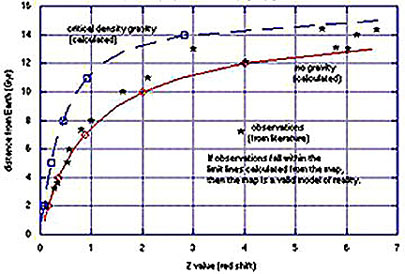
There is another, more
general effect of gravity, shown in the plot below, which shows the redshift
curve for a Universe with maximum gravity influence versus no gravity at all.
This range of possibilities is pertinent to the accelerating Universe model
discussed on the next page.
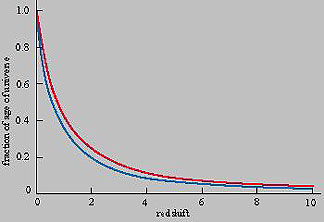
A variant of this is shown
in this figure:
The ordinate denotes relative
age: At this time, that can be given by "1", with those nearby galaxies that
appear most fully evolved (to the present time) having very low redshifts. The
exponental drop in the curves (the red curve applies to a Universe with 70%
Dark Matter; the blue curve described a Universe without Dark Energy [Cosmological
Constant = 0) shows that the maximum rate of increase in the value of 'z' occurred
when the Universe was less than a relative 0.2.
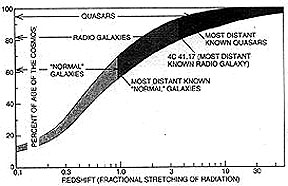
Most redshifts measured
so far include the lower values of z obtained by examining a range of "normal"
galaxies at distances from Earth under about 7 billion light years. Higher redshifts
have been found for galaxies that are strong radio sources and even larger values
(around z = 5 to 6.5) from very distant quasars (mainly those which display
their effects in the first two billion years of Universe history). Values of
'z' increase rapidly towards infinity for Universe events older than the first
stars. For instance, at the time of Recombination (page 20-1) z = 1000. This
is the general relationship as tied to major cosmological entities:
Stellar
and Galactic Distances (from Earth)
To apply the redshift to estimate
R (Scale Factor), and to determine the Hubble contant H, the distances to the
shifting bodies must be specified. Distance measurements obtained for nearby bodies,
e.g., in our own Milky Way galaxy, can be made on visible stars whose magnitudes
can be directly ascertained. One technique is that of parallax observations. While
not fully explained here, the gist of this technique can be sensed by this simple
experiment: Hold your index finger first about 6 inches in front of your nose
and rapidly alternately close your left eye and then right one repeatedly. Your
finger will appear to shift back and forth relative to a fixed background, perhaps
seeming to displace several inches. Now, put your finger full out (about 24 inches)
and do the same thing. Note that the displacement is now less. This is the parallax
effect. The amount of shift decreases with increasing distance and that distance
can be determined by simple trigonometry. As used to measure stars within about
100 parsecs (326 light years), the left and right eye positions are proxied by
the positions at opposite points in the Earth's elliptical orbit six months apart.
A star's apparent shift relative to distant background stars, even though proportionately
much smaller than that of the finger experiment, is sufficient to provide an accurate
distance measure for stellar bodies close to Earth.
Redshift measurements for
more distant starlike bodies are actually made on galaxies (their individual stars
may not be resolvable) whose luminosities are the average of all component stars.
Approximate distances to much closer host galaxies containing separable stars
rely on determining the intrinsic luminosity of certain types of individual stars.
One class is the so-called pulsating stars, i.e., those whose luminosities vary
systematically over periods of days to several months. These include stars that
have used up nearly all of their hydrogen fuel and are enroute off the Main Sequence
towards then becoming Red supergiants. During this phase of their history, their
atmospheres expand rapidly with a rise in luminosity, only to revert back to their
previous state during a cycle whose time is that of a regular period. What happens
is this: the star in its more compact state has a specific internal pressure;
at some point the nuclear processes cause the star to expand, increasing its diameter
by a factor around 2. The pressure gradient decreases until a condition is reached
in which gravity now reverses the process causing contraction. The expansion-contraction
repeats at its characterist nearly constant time period (in Earth days) for a
long time before a particular pulsating star evolves into a more stable Red (Super)Giant.
Most stars showing this phenomenon have initial masses from 5 to 20 times that
of the Sun. More massive stars have longer periods of expansion-contraction and
are also more luminous to start with.
One class of periodically
pulsing star group are the RR-Lyrae stars whose periods are in hours to a single
day. More important are the Cepheid supergiant stars. Cepheids were first
discovered by astronomer Henrietta Leavitt in 1912 in the nearby Magellanic Clouds;
she then showed them to have regular, pulsating variations in luminosity proportional
to their pulse periods (in so doing, determined that the brighter the star, the
longer its period P). Cepheids flare up to peak brightnesses, then dim
down, over periods of days to weeks. Using the parallax method, the distances
to some of these were independently fixed and their absolute magnitudes M
were calculated. Since these distances varied (within the Milky Way and in the
Magellanic Clouds), the various M values could be associated with their corresponding
periods in the cycle, thus establishing the M-P relationship. Of course, Cepheids
having the same values of M but located at widely varying distances from Earth
will experience an apparent decrease in brightness m depending on distance
(and subject to the 1/d2 relation that defines the falloff in brightness
with distance). These ideas are illustrated for one of the type Cepheids (δ-Cephei).
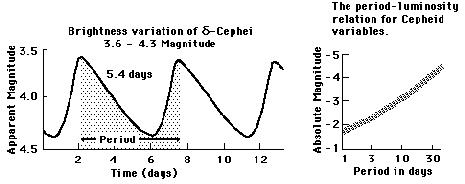
Once absolute luminosity for
a given Cepheid is calibrated from this relation, the drop in apparent (observed)
brightness m from that value owing to its specific distance d can
then be included in the following equation to determine that distance to this
star:
m - M
= 5(log d/10)
In the 1920s, Edwin Hubble
more firmly established the relation that the longer the period, the greater
is the increase in the intrinsic (absolute) brightness in a Cepheid. He applied
this pulse cycle approach to these stars in different galaxies and over a range
of distances. It was Hubble's use of primarily Cepheid-derived distances that
led to his first major hypothesis of an expanding Universe, after also introducing
the redshift relation. Some of the values he used were not highly accurate (but
were later corrected) so that his initial postulated rates of expansion were
considerably off-the-mark.
The Cepheid variable star
method works well out to a distance of 50 million light years (roughly, out to
Virgo). For galaxies farther away, other methods of measuring distances to them
(such as the rich cluster- brightest galaxy indicator which gives usable approximations
out to 10 billion l.y.) have been worked out and applied (they have varying degrees
of accuracy. Use of multiple methods applicable at different distances is called
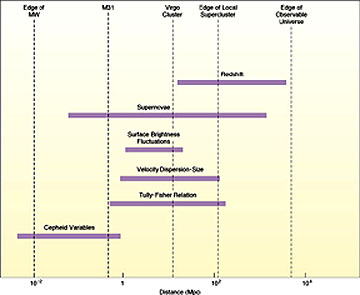
the Cosmic Distance Ladder. To sum up: Among these methods are (in order
of usefulness at increasing distances: 1) Parallax; 2) Moving Cluster; 3) Color-Magnitude;
4) Period-Luminosity (Cepheids); 5) Supernovae. This diagram shows several of
these and some other methods; the abscissa in the chart is in units of Megaparsecs.
A good, in-depth review of the principal methods used in distance determination
is found at Ned Wrights Cosmology site.
From Astronomica.org
The Cosmological Redshift
z is given as: z = ( rec - em)/ em
= Vr/c, where em is the wavelength
given out in the past (then) at the emitting galaxy or star, rec
is the shifted wavelength received today (now) at the detector (on Earth),
Vr is the recessional velocity for the particular redshift, and c is
the speed of light. (The above equation applies to low to moderate z's but for
large z's, which are attained as the velocities near that of light speed (and
are characteristics of the early moments of the Universe) a modified expression
must be used:
rec - em)/ em
= Vr/c, where em is the wavelength
given out in the past (then) at the emitting galaxy or star, rec
is the shifted wavelength received today (now) at the detector (on Earth),
Vr is the recessional velocity for the particular redshift, and c is
the speed of light. (The above equation applies to low to moderate z's but for
large z's, which are attained as the velocities near that of light speed (and
are characteristics of the early moments of the Universe) a modified expression
must be used:
z + 1 =
(1 + v/c)/(1 + v2/c2)1/2
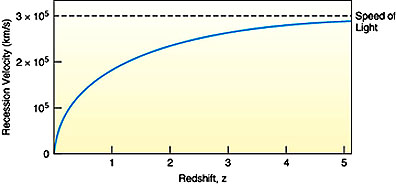
When redshifts begin to
exceed about 1, the speeds of the objects concerned begin to approach relativistic
values, i.e., they are ever larger fractions of the speed of light. Thus, although
the actual speeds continue to increase, the incremental rate of velocity increase
itself decreases (slope asymptote approaches 0). This gives rise to a redshift
vs recessional speed curve that is like this:
From Astronomica.com
Another relationship: z =
1/R(tem) - 1 describes the redshift in terms of the Scale Factor R
pertinent to tem which refers to the particular time when the light
was emitted . This relationship can also be cast in the following way:
Dnow/Dthen
= Rnow/Rthen = z + 1 = λrec/λem,
in which Dnow is
the distance to the emitter when the light is received and Dthen refers
to the distance in the past when light left the emitter.
We see a redshift (towards
longer wavelengths) because the Universe had a different Scale Factor when the
light left the emitter. The redshift is due to the relative expansion of space
(increasing "D's" [for distance]) rather than actual speeding up of more distant
galaxies. Look at the two circle drawing shown earlier on page 20-8. Note the S-like
curl that represents part of a wavelength train. It has a shorter wavelength in
the left circle; as the circle expands with its enlarged coordinates, note that
the wavelength on the right is now longer.
Before new data from the HST
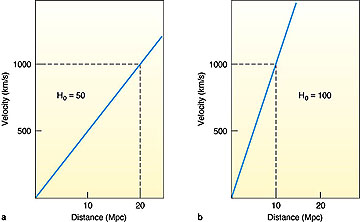
and other observing systems, the present-day value of H (i.e., H0)
had fallen to between 50 to 100 km/sec/Megaparsecs (a parsec is 3.26 l.y). (In
some expressions of H, megaparsecs are replaced by 1 million (106)
light years; thus 75 km/sec/Mpc = 23 km/sec/106 l.y.) One goal of the
Hubble Telescope is to better zero in on the most accurate value of H - essential
to an accurate estimate of the Universe's age. From most recent best estimates,
a range of H0 (value at the present time) between 65 and 79 km/sec/Mpc
is considered the most likely to contain the eventual most accurate value (still
being sought).
Cosmic
Ages
The general relation for the
Universe's age (since the Big Bang) is given by the expression: t0
= 1/H0. In the actual calculations, when H units (in the Mpc mode)
are adjusted to give an answer in billions of years, the formula becomes: Age
= 977.8/H0. For an H0 of 65 km/sec/Mpc, the formula gives
an age of 15.04 billion years (estimated uncertainty is +/- 2 billion years).
Currently,
13.5 billion years (H0
= 72.5 km/sec/Mpc) is the most widely accepted value (ages between 14 and 15 billion
years are also quoted in papers published in the last few years). The lower the
value of H, the larger is t0 and thus the Universe becomes older.
The formula t0
= 1/H0 is deceptively simple. Just putting in a value for H0
yields a number that is not years as such. The proper units must be included.
Here we will run through the calculation that leads to the end-result age for
a value of H0 = 70 km/s/Mpc (s = sec; Mpc must be converted into
mega-light years):
t (109
years) = 1/70 km/s/Mpc x 3.26 Mly/Mpc X 106 ly/Mly
X 9.46 x 10¹² km/ly X 1/3.15 x 107
s/year = 14.02 billion years
(Note: / denotes values
to its right are in the denominator of that term; X is the multiplier sign
between terms.)
However, the Hubble Age also
depends on whether the Universe is open, closed, or flat, and may be influenced
by the type of space involved (see below). In the absence of gravity the value
of tH is 1/H0. The Hubble age for a Universe with flat expansion
varies as the relation tH = 0.67/H0 (this applies to the
Einstein-DeSitter Universe [see below]). For an open Universe, tH falls
between 1 and 0.67. For a closed Universe, tH can be less than 0.67.
These several cases for ages that are less than 1/H seemingly point to Universes
that began less than ~14 billion years ago. But, if the ages of the most distant
galaxies, now only estimated from distance-brightness relations, prove to be around
that value, then the resulting paradox - parts are older than the whole - will
need to be explained away. To some extent, resolving this paradox can help to
specify the type of Universe that actually exists, since age-incompatible situations
would seem to argue against the types that don't fit.
Over the past 5 years, observational
data analyzed by HST Teams whose prime task is to try to pin down the Universe's
age using a better determined Hubble constant suggested in May of 1999 a best
estimate for the Hubble constant of 70 km/sec/Mpc. (That number also coincides
with the local expansion rate based on redshift-distance measurements for galaxies
near the Milky Way.) For the H range they arrived at, an age of 12 to 13.5 billion
years would result. The age uncertainty represents an accuracy variation to within
+/- 10% for the value of this constant. Their value depends on analysis of redshifts
in 18 galaxies within 67 million l.y. from Earth; in these they have found up
to 800 Cepheid variable stars which are the most reliable indicators of large
distances. From the combined determinations for the 18 galaxies, this best estimate
of expansion rate gives an increase in velocity of 256,000 km/hr (160,000 mph)
for every 3.3 million l.y. farther out the stellar entity (galaxy or individual
stars) is from Earth.
Most astronomers disputed
the above age conclusion based on the galaxy distance model, citing older ages
according to their calculations and their interpretation of H values using different
inputs. In the last few years most cosmologists (e.g., Alan Sandage and associates)
are advocating a value of H that yields an age closer to 14 Ga; this recent
age is now the preferred "best estimate". However, a vital note of caution: As
more galaxies at great distances from Earth are detected and measured astrometrically,
so that their intrinsic brightnesses, distances, and redshifts are known with
notable accuracy, the value of H could be recalculated to a lower number. This
would mean an older Universe (greater than 14 Ga) and would mean that the oldest
galaxies now known lie well within the limits of the knowable Cosmos. Said another
way: there may be considerably more space beyond our present observable Universe,
that is where our time horizon now extends, and this additional outer volume would
likely contain galaxies. This can be assessed when/if we can see the outermost,
already detected galaxies in such detail that we can specify how primitive or
early they are in their evolution. If they appear to be in the first stages of
formation, if we know enough about their rates of growth, and if galaxies indeed
to form within the first billion years after the Big Bang, then these galaxies
are probably near the edge of the expanding Universe, with little or no space
beyond. This does not rule out an infinite Universe, if it is destined to continue
expanding into an infinite future.
The first reported (before
1995) HST-derived ages fell between 8-12 Ga, anomalously low compared with pre-Hubble
reported ranges of 12 - 18 Ga. This was especially confusing in that separate
evidence and theoretical calculations indicate some distant galaxies might well
be 13 Ga and possibly older. This Age Paradox - stars seemingly older than the
Big Bang's start time - proved particularly troubling to cosmological theorists
for several years. The problem was minimized with further studies of nearby globular
clusters which contain very old stars. These clusters formed along with the organization
of the oldest galaxies around which the clusters are tied by gravity within the
galactic halos. Data from the Hipparcos astronomical satellite led to a redetermination
of globular cluster luminosities, and correlative rates of fuel consumption. From
this new information the average ages of clusters was reduced by 14% so that their
oldest stars (Red Giants) could not be older than the 13 Ga cited above. This,
together with the more refined 13-14 billion year Hubble age (see below), obviates
the discrepancy posed by the Paradox. One consequence of this most recent age
estimate is that the farthest galaxies whose distances from Earth is said to be
13 billion l.y., and possibly a few yet to be detected that are even farther away
(older) (page 20-8), must lie near the
observable edge of the Universe.
Thus, from the above, variations
in the chosen value for H0 have a major, definitive influence on
two fundamental cosmological parameters that scientists seek to know "exactly"
- the size of the observable Universe and the age of the Universe. This notion
is brought home by considering the consequences of changing the H0
value, as is done in this figure:
The question to ask in
interpreting these H curves is which one leads to a younger Universe; which
Universe is smaller? Check the conclusion by clicking on this *.
The critical factors determining
the Universe's age are its overall density (mass and energy) and the value of
the Deceleration Parameter (related to the Hubble Scale Factor), as discussed
elsewhere on this page. These specify the rate of expansion which in turn reveals
how long it takes for galaxies to get to the farthest reaches of observable
space (i.e., the limits or horizon defined as the farthest bodies that have emitted
radiation which has had time since the beginning of the Universe to travel to
Earth's observing stations; this will be marked by the first vestiges of materials
capable of emitting detectable radiation during the early moments of the Big Bang;
so far, detectors covering optical and other spectral regions have not yet picked
out these oldest sources, so the currently observable Universe presently is smaller
than the total observable Universe).
The Hubble equation specifies
that the fastest receding objects must be farthest away; conversely, those near
the Milky Way are the slowest moving. Thus, in an expanding Universe, with all
galaxies ultimately drawing apart from each other, those progressively farther
away must travel at proportionately greater speeds, but at the same rates in all
directions, to preserve an overall uniformity of spatial relations during these
expansive movements. As a general rule, the greater the lookback time,
the smaller was the size of the Universe at such times, and the hotter and denser
is the early expansion status of matter and energy. (Lookback time connotes the
idea that the farther out in space one looks, the further back in time [earlier]
is the event or stage of development associated with objects [e.g., galaxies]
when light left them; a large Lookback time means a younger age]).
Because most galactic measurements
made on distant galaxies show red rather than blue shifts (the latter are seen
for mostly nearby galaxies moving towards us [Andromeda is approaching Earth at
~360,000 kph] or can be noted in individual spiral galaxies as one arm moves towards
Earth), this evidence for overall (net) recession is the principal proof for the
Big Bang expansion model. The redshift is related to recessional velocities
(ratioed with respect to the speed of light) by an exponential curve in which
the velocities rise rapidly towards infinity as that speed in approached. Most
measurements of z from less distant galaxies afford numbers between 0 and 1 (for
example, z = 0.1 represents a distance of about 1 billion light years). Farther
out galaxies showing redshifts of 1.2 correspond to ages in light years of about
8 billion years; HST has now observed many galaxies with z's up to 2+; distant
quasars, some about 10-11 billion l.y away, have shifts of 3 - 4 or higher (at
an observed age much earlier in Big Bang time).
As implied above, the farthest
galactic-sized objects found to date are about 13 billion l.y. from Earth . These
most distant sources yet detected have a redshift z verging on 5.8 (reaching to
about 90% of the speed of light) and represent galaxies that formed in the first
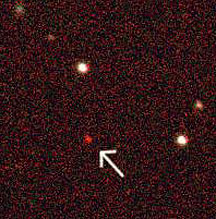
billion years or so after the Big Bang. Here is an image obtained during the Sloan
Digital Sky Survey (SDSS) showing a galaxy with a redshift of 5.82 that is unusually
bright (a quasar is inferred as the cause).
The time at which such large
sources of detectable luminosity is sometimes cited as the Friedmann time,
taken as the narrow time span when stars first formed and collected in significant
groupings. These often contain quasars that presumably grew from young (protogalactic)
gas clouds which at the time were emitting photons at an observed temperature
of ~3,000° K (referenced to an idealized blackbody - one which completely absorbs
incident radiation of all wavelengths and acts as a perfect emitter; at that temperature,
the wavelength signature peaks at ~1 µm, however, at higher z values the actual
blackbody temperatures can be much higher, causing a peak in the ultraviolet).
Recessional velocities as
a function of distance of cluster galaxies from Earth as the observational
frame of reference can be calculated from the Hubble equation and z values.
Choosing a Hubble constant that gives 14 Ga as the age of the Universe, a galaxy
recedes an additional 25 km/sec for each million l.y. further out one looks through
space. For a cluster in the Virgo Constellation, at a distance of 78 million light
years, the recessional velocity is ~ 1200 km/sec. For the Bootes cluster, at 2.5
billion l.y., the velocity has increased to 22000 km/sec. Galaxies whose distance
is about 5 billion l.y., attain velocities approximately one-third the speed of
light (100000 km/sec). The most distant observed sources (mainly quasars) reach
recessional velocities approaching light speed. The same type of velocity distribution
would be ascertained at any other observational point (such as set up by the distant
galaxy "civilization" referred to earlier) in the Universe.
As HST observations accumulate,
it is becoming evident that, with its resolving power, structure in galaxies can
still be recognized out to about 4 billion light years. Present evidence is that
beyond a z value of 2.75 no well-formed spiral galaxies can be confirmed to exist
(but at least some are likely). Those that lie farther out seem to be ellipitical
or commonly "dismorphous" (no regular form). Since these are older, this implies
that spiral galaxies may not develop until later in galactic evolution. Some of
the earlier-formed spirals have one or more extra arms compared with younger ones
(the Milky Way has 3 major ones).
The discussion in the above
paragraphs is confined to redshift measurements that can be made from observable
astronomical phenomena such as galaxies and quasars. There is another aspect
which is more theoretical, namely, the redshifts in the earlier history of the
Big Bang prior to the onset of the Decoupling Era (before which no direct observations
is possible). At the Planck Time of 10-43, the redshift z is calculated
to be 1032. After one minute - the beginning of the Radiation Era,
z drops to 109. In the first 1-2 billion years after the B.B., the
redshift decreases from about 30 to 6. The latter is near the maximum value
determined so far by direct measurements - the galaxies with that value are
about 13 billion l.y. away.
This systematic decrease
in redshift accompanies the expansion of the Universe. The process of enlarging
space leads to a lengthening of the wavelength of light - hence the progressive
drop in the redshift value of z. Since redshift also depends on the velocity
of a receding object, it follows that the maximum velocities of galaxies are
found in the outer reaches of the observable Universe. This is logical: if all
matter/energy was concentrated at a singularity at the time of the Big Bang
and then dispersed thereafter, those manifestations of matter such as the galaxies
that are farthest from the observation point (for us, Earth) must have been
traveling at the fastest speeds.
There is also another theory
which can, in principle, modify the implications of the observed redshifts, namely,
that the velocity of light is not constant but has changed over time by
gradually slowing down: this is the "tired light" concept which, while intriguing,
has so far not been supported by data or observational proofs. It has its supporters;
some cosmologists and quantum physicists have postulated that the current values
of certain fundamental parameters have changed with time, having different values
[especially in the early moments of the Big Bang] that evolve into their present
numbers as the Universe grew. Even though evidence for this is presently lacking,
this is not trivial or frivolous speculation but falls into the time-honored scientific
methodology of proposing seemingly outlandish theorems or propositions capable
of explaining some phenomena and then conducting experiments to confirm or deny
the idea.)
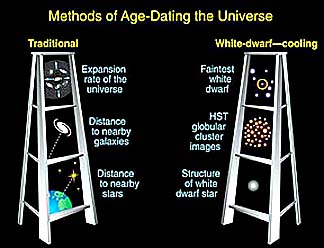
The age of the Universe
is a fundamental value which cosmologists seek with great care and effort to
establish accurately. What will help in settling on a "best value" would be
an independent measurement using a technique other than the recessional velocity
extrapolation. In April of 2002, a seemingly reliable second method has been
reported. It is based on knowledge of the time involved in white dwarf stars
burning out their remaining fuel to reach a "glowing ember" state. Theory sets
a fairly precise time span for this to occur. In the earliest stages of galaxy
formation, globular clusters will contain rapidly produced white dwarfs as large
stars burn their hydrogen over a brief time and then enter the dwarf stage.
The "embers" that are very old are hard to detect by telescopes. But, the Hubble
ST has been used on a globular cluster near the Milky Way to search for these
embers; by taking a long exposure image (8 days, spread over 67 days) these
faint white dwarfs were detected, as shown in this set of images of stars within
cluster M4:
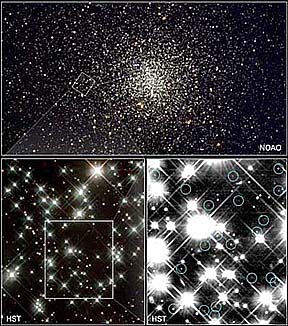
As reported by Dr.Harvey Richer
and his colleagues, calculations place the age of these white dwarf "cinders"
at between 13 and 14 billion years. By adding ~1 b.y. (typical time for the first
globular clusters to develop) to these values, this independent age assessment
falls right within the same range now generally accepted from recession measurements.
The two methods of determining Universe age, using a "ladder" approach to arrive
at the final values, are shown schematically in this diagram:
Unless fatal flaws are
discovered in either or both methods, it seems now that an upper limit of 14
billion years will stand as the actual age of our Universe.
Cosmic
Background Radiation
Another solid proof for the
Big Bang was the discovery that Cosmic Background Radiation (CBR) peaks
near the wavelength of 1 mm (1000 µm [micrometers]) which lies at the far IR/microwave
boundary region of the EM spectrum. This is the wavelength expected from a radiant
blackbody source whose temperature is now 2.72° K. George Gamow and his colleagues
had first predicted such radiation (their estimate of its peak was at 5° K) in
1948. The CBR now evident as pervasive throughout space can be traced to an equilibrium
state between nucleons, electrons and photons that was arrived at when the Universe
had cooled to about 10 million °K at approximately 6 months after the Big Bang.
Evidence of what it was doing during the Radiation Era, up to Decoupling, is lacking
because of the opacity brought about by scattering and internal entrapment of
photons (see page 20-1) within the early Universe
during the next 300,000 years. At that time, as the temperature dropped to about
4000 °K, almost all electrons (the principal scatterers) and protons were able
to combine as hydrogen atoms that no longer scattered the photons so that light
and other radiation emerged from the radiation "fog" which was fully lifted by
1,000,000 years after the B.B. With the resultant transparent Universe, CBR first
became detectable, displaying the higher temperatures it then possessed in the
still early Universe. From Decoupling to the present time, the CBR has experienced
a redshift of ~1200.
The photon radiation now
being measured is a manifestation of the present-day Cosmic Microwave Background
(CMB), inherited from the original radiation (much hotter and therefore then
of much shorter wavelengths in the infrared) released at the Big Bang. Astronomers
commonly refer to the CMB as the general residue of photons that were produced
and released during particle interactions in the first minute of the Universe
- colloquially, the CMB is the remnant of the "burst" of radiation that marked
the "explosion" of the Universe (but which really didn't explode in the sense
of detonation of a nuclear device in which there is an initial "flash" of light).
It is also referred to as the "afterglow" of the B.B. This radiation seems to
be very uniform and isotropic throughout the Universe. The vast majority of
all photons found in the present Universe are tied up in the background radiation.
However, despite their huge numbers, it is estimated that they comprise only
about 1/50000th of the mass contained in all the galaxies. The present ~3° K
value is consistent with a predictive model that requires very energetic high
temperature radiation (mainly gamma rays, with much shorter wavelengths) that
constituted the early CMB released soon after the Big Bang to cool drastically
by adiabatic (no energy added or removed) thermodynamic expansion
(a good Earth analog: expansion of an air mass is accompanied by release of
heat with resultant cooling) within a Universe having at the least the presently
observed spatial limits. Mechanistically, as space is stretched the original
short wavelength photons experience a corresponding lengthening of their wavelengths
into the microwave region and so lose energy (E = hc/λ) which in turn is
expressed as a much lower temperature.
The extraction of a weak radio
telescope signal (after receiver noise was subtracted) in the microwave region
at 7.3 cm (4.1 GHz) was made in 1965 by R. Wilson and A. Penzias (for which they
received the Nobel Prize in Physics; actually, a similar signal was first detected
in 1961 by E. Ohm, then verified by B.Burke, but not connected to the CBR prediction),
with its correlation to cosmic background radiation then confirmed by R. Dicke
and his group at Princeton. This test, along with the work by Hubble, the theory
of General Relativity by Einstein, the pioneering concepts of a primordial singularity
by Lemaitre, the Inflationary Model by Guth, and supporting contributions by numerous
cosmologists, astronomers, physicists, and mathematicians, taken together, make
up the critical foundation concepts that support and explain the Big Bang in its
present form. Further discoveries will likely lead to refinements but the fundamental
concept and the proper numbers predicted from the general model now seem to be
solidly substantiated.
The value of satellites in
this refinement process is well illustrated by COBE (Cosmic Background Explorer),
launched in 1987 (check out its current Internet site).
Earlier attempts by Smoot and others to map the apparent non-variant (uniform)
background radiation over the entire sky using balloons and aircraft, to make
measurements above the atmosphere which blocks out (absorbs) radiation in the
.001 to 0.1 m region of the spectrum, gave strong hints of radiation uniformity
but were subject to imprecision. With COBE, the mapping process was greatly improved
so that a detailed chart covering the full sky was assembled in just a year. COBE
verified the high degree of uniformity of the present background in all directions
and also confirmed that the general expansion is extremely uniform in all directions.
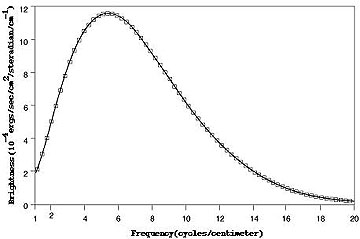
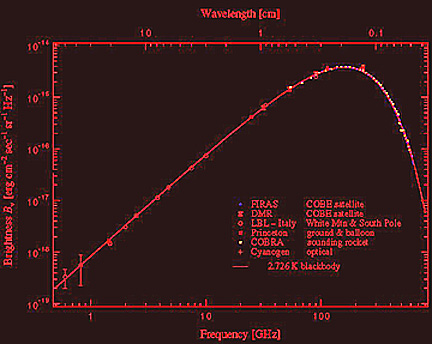
And, COBE took extremely accurate readings over much of the wavelengths involved
in the blackbody curve determined experimentally for a 2.726° K body, demonstrating
that the background radiation fits that curve at better than 99% accuracy (an
astounding achievement seldom attained in most scientific measurements). These
measurements were then combined with those covering other wavelengths and obtained
by different means to produce this classic blackbody radiation curve (see page 9-2) in which the
COBE values were so accurate that error bars could be omitted (when the COBE curve
was first displayed to participants at an Astronomy conference, the audience was
moved to give a standing ovation; such an extraordinary curve with all points
precisely on the best fit version is the dream of all experimental scientists).
A variant of this includes
measurements made by other CMR measuring experiments (different systems).
COBE also allowed the mapping
of radiation in the early stages of the Universe (specifically, at the close
of the Radiation Era some 300,000 (perhaps to 500,000) years after the Big Bang,
when the plasma in the expanding Universe had cooled sufficiently to become
transparent to photons) to an accuracy such that it showed variations in temperature
and density as slight as 1 part in 100000 during the first billion years after
time zero. The maps below show the broad distribution of minute temperature
differences across the early Universe as detected by COBE's DMR (Differential
Microwave Radiometer) using data collected at 53 and 90 GHz. The blues represent
slightly cooler and reds slightly warmer temperatures - thus also define regions
of greater and lesser densities.
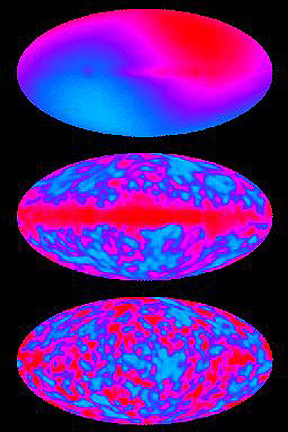
The top map is the "raw"
data plot in which the dipole effect caused by the Doppler motion of the Milky
Way galaxy has not been removed. The middle map results when the dipole effect
is eliminated, but the radiation from the Milky Way (central band) has not been
compensated for. The bottom map is the final product with both dipole and galaxy
effects removed - this is the one usually cited as the model for CMB distribution.
Another such plot, using different colors, recasts the distribution in terms
of the northern and southern hemispheres of the celestial sphere:
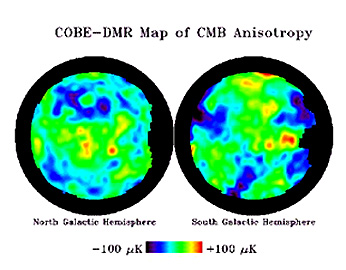
These small differences were,
however, vital in allowing matter to break from the initial extreme uniformity
into regions of slightly cooler, denser conditions where the protogalaxies could
begin to form. Eventually, in the early Universe these seed fluctuations promoted
localized clotting of particles that became gravitational centers whose growing
attraction of more matter led ultimately to development of the billions of galaxies
that populate the Cosmos as we now know it.
COBE has allowed an estimate
of the total energy in the Universe by sampling yet another part of the spectrum.
This results from painstaking analysis of radiation in the far infrared using
the Diffuse Infrared Background Experiment instrument onboard. This measures heating
of the dust distributed throughout the Universe, using windows at 140 and 240
µm. However, the overall background is "contaminated" by dust and other sources
within and around the Milky Way, the Earth's atmosphere, and other sources, which
require correction. The procedure is indicated in this figure:
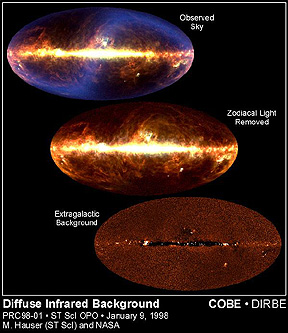
The upper panel shows a sky
map of the infrared radiation for the whole Universe with a bright central band
representing the Milky Way contribution. The central projection is the change
after Zodiacal light is removed. The bottom panel is the residual infrared radiation
for the Universe after the Milky Way Galaxy's influence has been removed. The
net effect is that there is much more starlight in the Universe as "fossil radiation"
than heretofore suspected owing to the masking by dust (ranging from near-Earth
to intergalactic) whose influence is now accounted for with this corrective DIRBE
inventory.
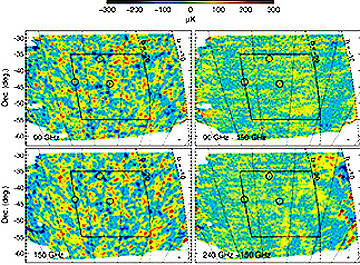
In April, 2000 a group of
scientists presented the results of project BOOMERANG (acronym for Balloon Observations
of Multimetric Extragalactic Radiation and Geophysics) One output was a more detailed
map of 3% of the sky which shows variations (with a 35x improvement in resolution)
in CBR at the end of the Radiation Era - which also signals the beginning of the
Decoupling Era marked by the recombination of protons and electrons to form hydrogen
atoms. This map was constructed by measurements obtained with a passive microwave
telescope suspended on a balloon for 11 days at approximately 36400 meters (120,000
ft) above the Earth's atmosphere over the Antarctic. The variations depicted are
in units of microKelvins.
Here are several more maps
from this experiment using radiation detected at different wavelengths. The
upper and lower left maps are at 90 and 150 MHz respectively; the two right
maps are differences between 90 - 150 (top) and 150 - 240 (bottom) MHz.
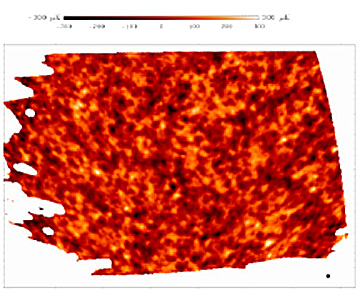
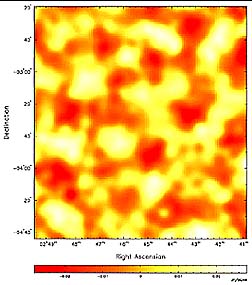
These results are confirmed,
with more detail, by the CBI (Cosmic Background Interferometry) experiment run
jointly by CalTech and the NSF. Thirteen 1 meter diameter dish antennae are
synchronized in an array with a broad baseline. This next figure is a map of
the background radiation over an area equivalent to about 2 widths of a full
Moon. The differences being measured are temperature values in microKelvins
(µK) that vary around the mean sky temperature of 2.73 K.
What is being sensed are
small temperature differences when the CBR was around 6000° K. Associated with
these differences are variations in material density. This observation supports
the idea that matter in the Universe at this early time was unevenly distributed,
thus allowing the first stages of density/gravity variations required to initiate
the galaxy formation process. The data displayed in these maps also bear on
the model that predicts the Universe had undergone a dramatic Inflation in its
initial moments, and in effect provide a positive test of that concept. They
likewise point to the notion of a flat Universe that will expand forever (see
below).
A recent announcement from
Hubble scientists carries this cosmic background concept into the visible radiation
realm. Based on estimates of quasar populations at the farthest reaches of observable
space (the Deep Field region), extrapolations of visible light sources to the
entire Universe can be made. Results suggest that most of these sources are now
accounted for and that the total amount of visible light which persists throughout
the Universe is approximately of the order to be expected (by calculation) from
the same model that predicts the amount of Cosmic Background Radiation. In other
words, as different parts of the EM spectrum are analyzed for total energy involved,
the numbers remain consistent with expectations and thus support the energy distribution
predicted from the Big Bang model. The overall notion of an expansion appears
on firm ground based on the ever accumulating scientific evidence.
The results from COBE proved
of such import to understanding the early Universe, especially the small but critical
fluctuations it detected, that a more sophisticated satellite, MAP (Microwave
Anisotropy Probe), was launched in July of 2001. Background information on this
important new astronomical observatory can be found at NASA Goddard's MAP
site. (Another CBR satellite, the Planck Surveyor, is planned for launch no earlier
than 2005.)
The long-awaited preliminary
results from MAP were announced at a press conference on February 11, 2003.
Prior to that MAP was renamed WMAP, honoring David Wilkenson, a leader in the
field.
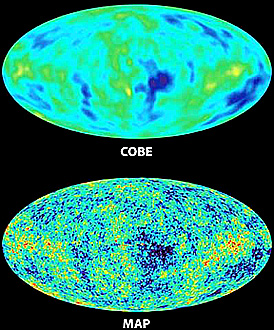
The higher resolution of
WMAP, in terms of ability to measure even smaller temperature variations, is
evident by comparing the new all-skies thermal map from WMAP with the equivalent
coverage by COBE:
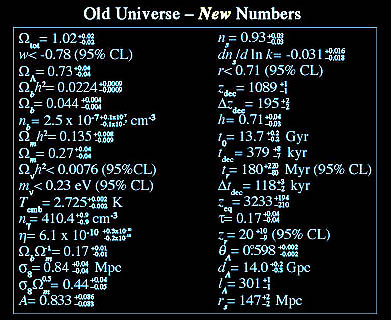
Some very far-reaching
conclusions about the Universe have been drawn from interpretations of the WMAP
data. One is a new (but still not necessarily the most accurate, although an
accuracy of +/- 1% is claimed) age for the Universe of 13.7 billion years. Another
is strong confirmation of the reality of Inflation during the first fraction
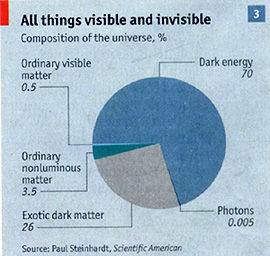
of a second after the Big Bang. The amount of detectable ordinary matter in
the Universe has been reset at 4% whereas dark matter is 23% and dark energy
73% (but the results offer no clear indication of the nature of these dark states).
The time when the Universe first became transparent is now given as 380000 years
after the B.B. Further evidence for accelerating expansion is derivable from
the data, leading to a firm conclusion that the Universe should expand forever.
Finally, many of the fundamental physics and cosmological parameters have been
refined, as shown in this table (without any attempt by the writer to identify
each).
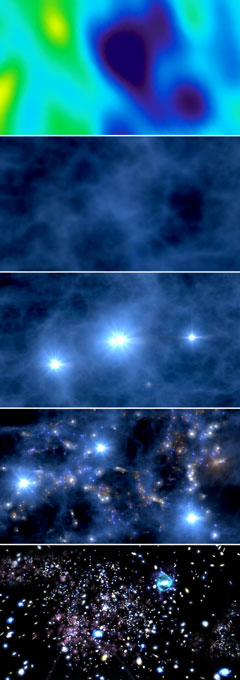
Some of the recent ideas
on the start times for the first stars and galaxies received support and specificity
from the WMAP results. The first stars began to form as Supergiants about 200,000,000
million years ago. The first galaxies began to organize some 300,000,000 million
years later. This diagram depicts these stages (from top): 1) initial stages
of CBR variations; 2) clots of dark matter prior to organization as stars; 3)
the first supergiants; 4) developing galaxies; 5) galaxies after the first billion
years.
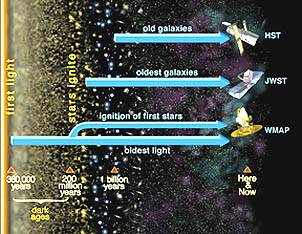
The time lines for the
first stars and galaxies as measured by different space telescopes (JWST is
the James Webb Space Telescope planned for 2010) are shown in this diagram
Some cosmologists attending
the press conference went on record as believing the WMAP results will prove
to be the most important new data sets obtained from observations over the last
decade.
A major future objective of
WMAP still to be addressed is to measure extremely small temperature fluctuations
that should support/confirm the existence of gravitational waves. These were first
postulated by Einstein as a consequence of his General Theory of Relativity. Gravitational
waves represent moving disturbances within gravitational fields that are generated
by various interactions of matter and/or energy, such as collisions of black holes
or neutron stars. With their force particles, the gravitons, they are analogous
to electromagnetic waves, with their photons, except that gravitational waves
can move unimpeded through matter that itself interacts with photons by absorption.
Like the graviton, gravitational waves have yet to be detected but their behavior
and influence within the Universe can be simulated with computer-based models.
As gravitational waves move through space, they cause the geometry of space to
oscillate (stretching and squeezing it). The wavelength of a gravitational wave
depends on the mechanism of its generation.
Theory holds that gravitons
and gravitational waves were first created during the Inflation period between
10-38 and 10-35 seconds at the outset of the Big Bang.
These waves participated in the extreme expansion of those moments and as a
result their wavelengths were greatly elongated. The inflationary gravitational
waves played a key role in bringing about the slight variations in the distribution
of matter and energy during the Radiation Era which ended in the Decoupling
Era at which time photons were no longer scattered - this latter period is the
earliest in which Cosmic Background Radiation could then be detected. WMAP will
seek to determine more exactly the temperature fluctuations in the CBR field
which correspond to the pertubations imposed by the gravitational waves. In
theory, these waves are detectable by analysis of the CBR coming from the Cosmic
Microwave Background; gravitational waves will cause the radiation to be right
or left polarized whereas density variations in the CMB will induce radial polarization
(the two modes of polarization must be separated and distinguished by Fourier
analysis.
Models for the Expanding
Universe
Models of the Universe can
be classified in several ways: 1) Newtonian vs Relativistic; 2) with or without
a Big Bang, i.e, expanding vs steady state; and 3) for the Big Bang models, these
are either Standard or with a Cosmological Constant.
As a fundamental conclusion
drawn from the general acceptance of the Big Bang model for the Universe's origin
and development, the initial small space developed in the first minute has been
continuously enlarging - a process analogous to expanding in the manner described
on the previous page. However, the precise nature of this expansion, still not
fully known, depends on the specific expansion model, as we shall see below.
This is related to the amount of mass/energy available to control or influenced
the expansion. As we will see in the following paragraphs, proposed geometries
of the expanding Universe range from spherical to hyperbolic to flat. The duration
of expansion ranges from finite to infinite. The terms "open, closed, flat"
refer to certain constraints on the curvature of space and on its expansion
history.
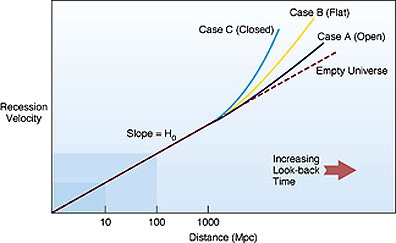
The type of Universe "shape"
model - open, closed, flat - is a factor in the change in the Hubble constant
(and the corresponding redshift) with time. A generalized relationship depending
on expansion models is shown in this next plot:
Before reviewing the various
models that were proposed in the 20th Century, we pause to briefly describe
a useful and (deceptively) simple view of the Universe embodied in the term
Hubble Sphere. This is based on the idea underlying the Hubble Length,
which is just the distance outward from Earth, as an arbitrary center
(remember, the Universe actually has no meaningful center), that has traveled
in 1 Hubble time (tH = 1/H). In this framework, that distance is
represented as the farthest out we can look from Earth with our best telescopes
to see the first evidence of the Big Bang (which is not really possible owing
to the opacity soon after the B.B.); it is closely related to lookback time,
defined above. Consider the Hubble distance to be the radius r for a sphere
that encloses all of the Universe that we can presently see (this seems legitimate
in that currently the farthest galaxies [only a few found so far] all seem to
be about the same distance in light years from our observation point; these
distances are somewhat less that the outer limit that is defined by the current
value of H0). A simple way to visualize this sphere with its contents
is to imagine the points within (galaxies) such that the farthest away (representing
star systems in their earliest years are colored blue, intermediate green, and
closest (more advanced in development [but not necessarily any older or younger
than the blue group]) as red. The occupants of the Hubble Sphere would thus
show concentric color bands with blue closest to the sphere boundary and red
closest to the center. That boundary is, of course, a time horizon and
not an actual physical surface encompassing the sphere. As we progress into
the future and our instruments "see" still farther, the apparent surface of
the sphere moves outward with the increase in rH. There are galaxies
beyond the Hubble Sphere; they just haven't been seen yet but will come into
view later. Beyond the outermost galaxies, assuming they occur at light year
distances equivalent to that of a precisely known Hubble Age, we cannot as of
now specify "What's there".
Using this simplified,
rather easily visualized model, let us take a moment to say a few things about
the size of the known Universe. It would seem to be determined by the
Hubble Distance (DH), which relates to the Hubble Age, around 14
billion years. This is the distance out to the event horizon, the farthest
out in spacetime that we can see discrete particles or objects in the Universe
(To quantify the distance in Earth kilometers [or miles], just multiply the
distance that light travels in 14 billion years by the speed of light. Thus:
14,000,000,000 b.y. x 300 x 104 km/sec x 3600 sec/hour x 24/hrs/day
x 365.4 days/year. For this case, the result, which I will call DH,
is 1.3245 x 1024 km, or about 1.3245 septillion kilometers.) From
the Hubble Sphere model, one might assume that the sphere has a diameter of
2 x DH, particularly when one is aware that the event horizon is
essentially the same looking outward, say from the North Pole at the northern
celestial sphere and from the South Pole at the southern celestial sphere. But,
this is no so. In relativistic space expansion, the distances outward in opposite
directions from the Earth framework are not additive. This is due to the fact
that all point in the singularity that are now galaxies were next to each other
at the beginning and have simply drawn apart with the expansion of space. With
no meaningful center, we can only state for now that space has expanded so much
in 14 billion years. Euclidian size is not a valid way to look at the Universe,
whatever "shape" it may have, as implied from the paragraphs further on this
page. In trying to think about "size" there is a further complication. The expansion
during the Inflation period (see page 20-1) may have proceeded at rates faster
than the speed of light. If so, the Universe may really be much bigger than
what we deduce from event horizon distances. We get our idea of distances only
from measurements of z and H as determined from we see now in the Universe after
the galaxies formed. Prior to those times, inflation expansion, yielding much
greater z and H values, could have pushed the outer edge of the Universe to
distances well beyond what can be detected as apparent event horizons.
So, what can we say about
our understanding of the size of the (our) Universe. Its minimum size must be
at least as far out in spacetime as we can see galaxies, quasars, and supernovae
- 13+ billion light years to the currently known event horizon. (We cannot [yet]
see timewise to anything before the Radiation Era; Cosmic Background Radiation,
which traces to about 300,000 years, is pervasive and thus not location-specific.)
The maximum conceivable size is infinity, with "outer limits" reachable only
in infinite time. If the Universe is indeed infinite, its present outer limits
are not fixed in any way, as they will enlarge forever in their expansion towards
infinity. If the Universe is proved to be finite (contrary to the most likely
scenario - see below), then its boundary is almost certainly beyond the event
horizon we now see - there are more galaxies farther away which will become
visible as time progresses and DH lengthens.
Now, to survey the major models
for the spacetime Universe:
Relativity has played a vital
part in the models of the Universe that remain the most plausible. The expansion
of the Universe from a relativistic framework can be summarized as the Friedmann
equation. We give it here in two forms, the first as a differential equation:
dR/dt = (8 Π G)/3
ρ R2 - kc2
And the second:
H2 - (8 Π)/3
G ρ= - kR2
In these equations, Π
(pi) is the familiar constant (ratio of a circle's circumference to its diameter
= 3.14159...), G is the universal Gravitational constant, ρ is a Greek letter
denoting the average density of the Universe, k is a curvature constant in which
values of 0, +1, -1 represent flat, spherical, and hyperbolic geometries respectively,
R is the Scale Factor for the observable Universe, H is the Hubble Constant, c
is the speed of light, and t is time. A solution to the Friedmann equation depends
on which Universe model is being tested, as the group described next has different
values for key parameters.
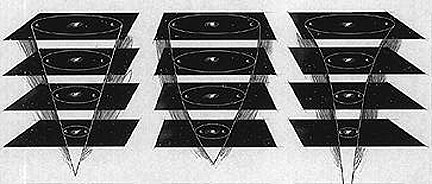
Several cosmological scenarios,
named after the scientist(s) who first proposed each (several scientists came
up with more than one model), for various modes of expansion lead to different
end results (shown graphically below for four general models).
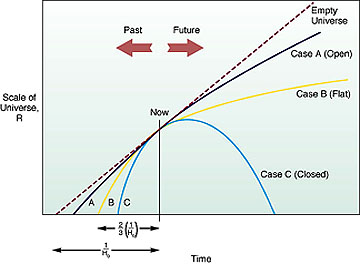
In common, they all obey
the Cosmological Principle, which states that the Universe is both homogeneous
and isotropic (essentially the same average distribution of matter/energy
in all directions) on the largest scales (this is not violated at the
scale of galaxy clustering since at the universal scale these tend to be "smoothed
out" by having much the same patterns anywhere one looks). Open models also
must be consistent with the restriction placed by the Second Law of Thermodynamics
which from a cosmological standpoint states that over time the entropy
(a measure of disorder of a system) must ultimately increase to (or towards)
a maximum (total disorder); interpreted at a universal scale this would lead
to complete dispersal of galaxies and their stars (perhaps rearranged as randomly
distributed Black Holes) and blackbody temperatures approaching zero. A corollary
holds the initial singularity to have minimum entropy which then rapidly increases
during the first moments of the Big Bang.
Note that when the above curves
are extrapolated back in time, they strike the horizontal axis at different positions
(times). This means that the age of the Universe will vary relative to the particular
model being considered. Thus, although the current Hubble time (1/H0,
which depends on the accurate determination of the rate of expansion) leads to
an age or duration of the Universe, that value can be modified when (and if) a
particular expansion model is shown to be the best or valid one.
The following table (modified
from Hawley and Holcomb, 1998) summarizes the principal Cosmological Models that
have been developed and tested by calculations. They fall into two groups: Non-Big
Bang (B.B.) and Big Bang. Another distinction category: Models in which the Cosmological
Constant L (see below) is a factor (upper five rows of table and the Standard
Friedmann (or Friedmann-LeMaitre) models in which L is not involved (i.e., is
O; bottom three rows); the three standard models also have Deceleration Parameters
q (defined below) that include the value 1/2 in some way.
|
MODEL
|
GEOMETRY (k)
|
L
|
q
|
FATE
|
| de Sitter |
Flat (0) |
>0 |
-1 |
No B.B.; exponential expansion; empty |
| Steady State |
Flat (0) |
>0 |
-1 |
No B.B.; uniform expansion |
| Einstein |
Spherical (+1) |
Lc |
0 |
Static; H = 0; now, gravity balanced by repulsive force; may be unstable
|
| Lemaitre |
Spherical (+1) |
>Lc |
<0 |
Expand; hover; expand |
| Negative L |
Any |
<0 |
>0 |
Big Crunch |
| Closed |
Spherical (+1) |
0 |
>½ |
Big Crunch |
| Einstein-de Sitter |
Flat (0) |
0 |
½ |
Expands forever; density at critical value |
| Open |
Hyperbolic (-1) |
0 |
0<q<½ |
Expands forever |
q = The Deceleration Parameter:
denotes the rate of change with time of the Hubble Constant and R; a positive
value indicates acceleration; negative = deceleration.
L = The Cosmological Constant,
introduced by Einstein to his field equations for General Relativity in order
to provide some constraint to gravity (a counter-effect) to avoid an inevitable
collapse of the Universe; if + (repulsive) L counteracts gravity; if - (attractive)
L augments gravity. Lc is one particular number known as the critical
value. L may be equivalent to the vacuum energy density associated with particles
at the quantum level. (L in texts is also given by a capital Greek letter Λ).
The Steady State, de Sitter,
and Einstein Universes, all non-standard, are currently not supported by observational
evidence.
The more general diagram
above showing four alternative expansion models can now be redisplayed in terms
of some of the specific models described in the above table:
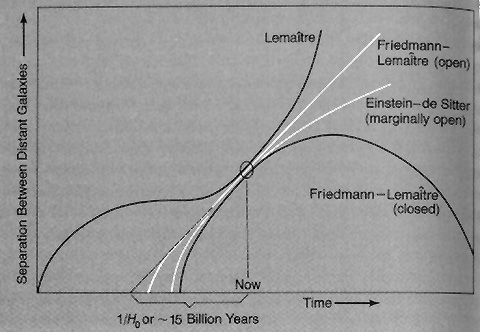
From J. Silk, The Big Bang,
2nd Ed., © 1989. Reproduced by permission of W.H. Freeman Co., New York
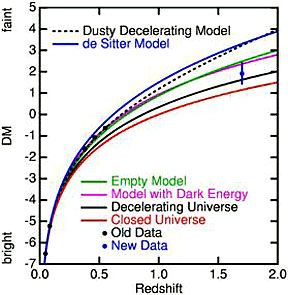
This next plot is a recent
display of the curves for various models in which the ordinate is the relative
brightness (luminosity) of galaxies used as data points. (The dark energy case
is discussed on the next page).
The nature and shape of the
Universe depends on its mass density (including energy forms that have mass).
The key parameter is the Critical Density, symbolized as ρc
(ρc = 3H3/πG). This is defined as just that total
mass that causes the Universe neither to expand forever nor to collapse on itself,
i.e., it is flat and will just stop expansion after infinite cosmic time has elapsed.
(As a practical measure it is estimated that, if all atomic matter - both galactic
and intergalactic - is redistributed to spread uniformly through space, its density
will average 10 atoms per cubic meter.)
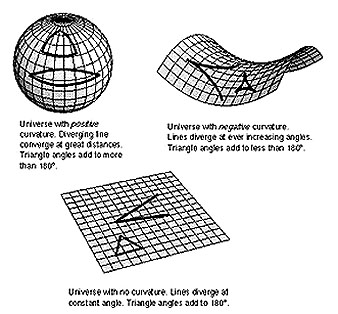
There are three general
shapes available as options for the configuration and expansion of the Universe.
Their geometric characteristics are depicted in this next figure. Note that
two properties help to define the nature and behavior of each shape: 1) What
happens to so-called parallel lines in traversing the shape, and 2) What is
the sum of angles in any triangle drawn on the shape?
The spherical shape is
said to have no boundary in that one would always remain on its surface and
if "walking" along a great circle would always return to the starting point.
It has positive curvature. Hyperbolic space is one that has negative curvature:
although difficult to visualize, and best described mathematically, descriptively
it has been likened to a horse's saddle; this geometry has the peculiar spatial
attribute that movement away from the lowest point on it can go either "downhill"
or "uphill", depending on direction. Flat space has minimal (zero) curvature
and obeys the precepts of Euclidean geometry. In flat space, parallel lines
remain parallel in this geometric sense; this provides a means to test the type
of Universe geometry that corresponds to reality. (So far, evidence is that
lines of radiation travelling in space remain parallel unless disturbed by gravity
from massive bodies.) Both flat and hyperbolic space can extend indefinitely
(to infinity) in contrast to spherical space (but, in principle, if it expands
continuously forever that too could lead to a kind of infinity).
These three general types
of shape can also be depicted in space-time cone figures, such as this one,
showing from left to right the steady, decelerating, and accelerating expansion
models:
One theoretical way to
distinguish which shape best describes that of the Universe: send two light
beams oriented parallel to each other but separated by some distance. In the
flat Universe, these beams will always remain parallel. In the hyperbolic Universe,
the beams diverge; in the spherical Universe they will eventually converge and
cross each other.
If the the total density (choosing
M as the sum of all matter and all energy; remember that energy can be stated
in terms of mass by Einstein's famed equation, restated: m = E/c2)
distributed throughout a finite Universe of some size or volume V is less than
the Critical Density, space is hyperbolic and open; if greater than critical,
spherical and closed; and if equal to critical, space is flat (at
least at the scales we observe it). This can also be expressed as the Density
Parameter or Ω which is the ratio of the actual densities ρ
of matter and energy present in the Universe to ρc, the density
that would apply to a Flat Universe expanding to infinity; the Open, Flat, and
Closed Universes are associated with Ω >, =, and < 1 respectively.
Considering all of these
models : If the Universe is open or flat, the Universe will expand infinitely
but at different rates depending on the parameters associated with each model.
The closed and negative L models, in contrast, predict finite expansion followed
by eventual contraction and thus at some time the Universe returns to a singularity
state. For each of the models, the expansion geometry and the behavior from
the onset (the Steady State model has no "beginning") to its eventual fate (Crunch;
Expansion) depends ultimately on the matter density that characterizes it.
The first five models are
all non-standard and were devised when Einstein's Cosmological Constant seemed
to have some essential validity (abandoned,by Einstein and the cosmological community
in the 1930s but now reinstated; a good review of the present status of the Constant
is found at this University of Chicago site).
Each of these models fits at least some of the general observations of
the Universe but failed on other accounts. Einstein himself spent many years in
calculating properties of such Universes but eventually abandoned the concept
of a counter-gravity force, admitting it was his "biggest mistake" in his scientific
reasoning. Evidence for this Constant is still lacking but in recent years variations
of it are again becoming fashionable to explain some of the phenomena essential
to a changing Universe, as we shall see on the next page which dwells upon an
Accerating Universe. Its possible equivalence to the concept of vacuum energy
density may have been a key factor in the Inflationary Stage of the early Universe;
a rapid increase in L (the Lambda-force) could be the driver behind the tremendous
expansion then but that increase had to be short-lived and L must revert towards
zero or the Universe would have long since "blown" away.
The Einstein Universe is a
static one, with spherical geometry, developed by this great scientist as an attempt
to apply General Relativity to Cosmology. The idea of the Big Bang had not yet
captured the attention of cosmo-scientists. In order to keep the Universe "going"
instead of collapsing under its own gravity, Einstein invented his Cosmological
Constant L to balance the attractive forces. While now considered notably incorrect,
this type of steady state model stimulated others to propose variants that incorporate
expansion. The de Sitter Universe is a strange one, being empty and never undergoing
a Big Bang. Its value of q being negative (-q) denotes an accelerating Universe.
But in working back towards time zero, its representative R(t) value never attains
zero, which means that it has no beginning, i.e., has an infinite past. While
theoretically interesting, the model defies most observational parameters. The
Steady State Universe was formulated by Hoyle and others as an "antidote" to the
Big Bang model. It accepts expansion and implies that the Universe has no beginning
or end. In order to preserve the matter density distribution determined for the
Universe, Steady State requires a "creation field" in which new matter (mass)
must be continuously created through time to balance the rate of expansion. Another
model (not in above Table) also does not start with a Big Bang; this, the Eddington-Lemaitre
model, is closed and finite and is static initially but thereafter starts expanding
when the galaxies begin to form by hydrogen gas condensation.
The Lemaitre model, derived
from the Big Bang concepts, begins with a rapid increase in R during the early
Universe but then experiences an extended period when R(t) remains nearly constant
(owing to the effect of L being greater than Lc) so that expansion
is minimal ("hovers") until much later resuming at an accelerated rate (read the
modern version of this resumption of acceleration on the next page). The Abbe
George Lemaitre (a Catholic priest from Belgium who also was a physicist) was
the first to consider the starting state to be one of extremely high (approaching
infinity) density (he called the singularity a "primeval atom"; Gamow applied
the Greek word "ylem" [primitive matter] to everything contained in such a singularity).
Among the three standard hot
(high temperature) Big Bang models, the Open Universe model (also known
as the Friedmann-Lemaitre model) predicts that expansion continues forever at
an essentially constant rate through an infinite and unbounded space based on
hyperbolic geometry (in which light can follow both positive and negative curvature
simultaneously). Evidence so far suggests that a (nearly) flat Universe
model, whose density is at the critical density (Ω = 1, the condition that
there is just enough matter distributed throughout the Universe to cause it to
expand forever even as it endlessly slows down) accounts for many of its observed
properties, so that the Einstein-DeSitter Universe is currently the model
most widely held to approximate reality. This model is in accord with current
estimates for the age of the Universe.
(The mental picture one gets
from the word "Flat" as we have been applying it to cosmic expansion may be somewhat
illusory: one meaning - just as the surface of a large balloon may appear flat
to an ant at some point on it, so the Universe may in fact be spherical but acts
as though flat within the region open to our direct observation (we experience
this on Earth as our local surroundings appear flat out to the horizon but would
show its real curvature if we were orbiting astronauts). However, flat on a Universe
scale may mean just that - flat in our experiential Euclidian sense - imagine
a table top that keeps expanding forever from within itself (not just by growth
at the edges) in two primary directions; points at different parts of this infinitely
growing top would all separate from each other. Table tops do have a third dimension
[thickness], as presumably does a flat Universe, but expansion in that dimension
may be finite.)
Closed Universes follow
spherical geometries. The prime model shows greater rates of expansion in early
cosmic time (this is not the same as the incredible but brief expansion almost
at the very beginning of the Universe if inflation indeed is a real phenomenon)
with decreasing rates of augmentation thereafter. Thus, the components of the
Universe move outward powered in part by the inertia imparted by the energy release
at the Big Bang. However, the mass/energy level is high enough for gravity to
effectively pull on galaxies, stars, and other matter so as to gradually slow
the expansion to a zero rate. Thereafter, the condition becomes one of increasing
deceleration. The rate of separation between galaxies diminishes with time until,
at some future time, expansion ceases and galaxies then draw closer at ever faster
rates until all matter and radiation converge to a singularity (perhaps 50 b.y.
in the future), undergoing what has been called the Big Crunch.
This raises the possibility
of Repeated Universes, as singularities explode, expand, ultimately contract
to the next singularity, and then repeat the cycle indefinitely, or, even infinitely;
however, this scenario seemingly would violate the entropy restriction in that
the singularity should have a minimum rather than maximum state of disorder that
is the outcome for every model. Multiple Universes (next page) that evolve simultaneously
are a possible consequence of the Chaotic Inflationary model which in recent
years has gained favor as a variant of the inflationary version of the Big Bang;
these Universes, however, have no likelihood of contact with one another, so that
their existences may be unprovable.
The "Missing" Mass
and Energy in the Universe
Whether the present Universe
is open or closed is still being debated. The key factor is the mass density of
the Universe. If this amount lies below a critical value, then gravitational forces
will be insufficient to finally halt the expansion that would eventually result
in all matter throughout space being pulled back into closure; in the open case,
expansion is forever in (apparently) the one and only Universe. As of now, inventories
of mass within the Universe have come up way short of the amount needed to maintain
a closed Universe but with further observation and experimentation the gap is
narrowing.
The missing mass (and energy
particles that have mass) may exist as dark (non-luminous) matter and/or
as neutrinos, both currently difficult to detect and thus count quantitatively.
There is still considerable uncertainty as to whether neutrinos (there are several
varieties) have any mass at all. They rarely interact with matter and are thus
very hard to detect. At this instant, billions of neutrinos are passing through
your body, and perhaps one or two at most will meet with an atom. Experiments
in several countries are attempting to find the elusive neutrino. Below is one
example of an experimental detection setup. Several thousand feet below the surface,
in a large alcove in a nickel mine near Sudbury, Ontario (the overlying rock screens
out most other high energy particles that might produce false signals), is a 12
meter diameter sphere containing heavy water (deuterium instead of hydrogen).
Around it are a bevy of event detectors. A few events have been ascertained, but
the number of solar neutrinos appears lower than theory had predicted.
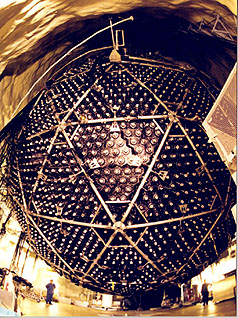
A recent estimate states outright
that the several kinds of dark matter, or its energy equivalent, comprise ~95%
of the Universe's mass, with varieties of normal matter accounting for the remaining
less than 5%. This means that most of the matter in the Universe presently is
invisible to detection so far on Earth (the billions of luminous galaxies, each
with billions of stars therefore make up only a tiny fraction of the Universe's
total mass).
This humongous amount of dark
matter is postulated by inferences drawn from observed effects; indirect evidence
comes from the behavior of galaxies and galactic clusters which seem to need this
superabundance of mass to account for their stabilities and motions. For example,
the velocities of stars in outer spiral arms is much greater than predicted from
the Newtonian 1/r2 force law, implying excess external mass. Another
line of evidence comes from the gravitational lens effect - much more mass than
observable is needed to account for the degree of bending of space as predicted
by General Relativity. This is revealed by a greater curving of light from more
distant light sources (therefore displaying larger displacements than expected)
than would be caused only by the mass of the specific galactic cluster whose gravitational
influence is being tested. Another sign of concentrations of hidden mass relates
to directional movement of galaxies near enough to observe and measure this motion.
Close to home, our Local Group (including the Milky Way) of galaxies is moving
through space in the direction of the Constellation Centaurus at greater than
expected velocities, under the influence of an invisible mass concentration dubbed
"The Great Attractor."(by itself, the Milky Way is moving at about 2.1 million
km/hr towards the region around the Constellation Leo). Also, huge masses of glowing
gas whose molecules are rapidly moving and hence indicate very high temperatures
have been detected; being very hot, they should fly apart but clearly are holding
together, indicating the attractive action of great quantities of invisible mass.
There is evidence that older,
more primitive stars (that have a paucity of those elements that were produced
in stars and dispersed by supernova explosions) contain around them higher concentrations
of dark matter. But, much (most?) of the missing mass may be tied up in Black
Holes; billions probably exist throughout the Universe, and many, if not most,
of the galaxies have Black Holes in their central cores. A Black Hole, with immense
mass and a size estimated to be more than 2.5 million Sun diameters has been verified
at the center of the Milky Way, around which the inner stars revolve about the
Hole at speeds up to 3 million km/hr as they spiral inward to eventually be sucked
in (by comparison, the Sun orbits around the galactic center at ~790,000 km/hr
and the Earth around the Sun at ~108,000 km/hr).
The composition of dark matter
is still speculative. Some is probably MACHOs (for MAssively Compact
Halo Objects), consisting of baryons (protons, neutrons) and other
matter (probably some fraction of the neutrinos pervading space) in the non-radiating
dark halos now known to distribute around galaxies and in intergalactic space.
In the halos they constitute most of the slower moving Cold Dark Matter (CDM).
MACHOs provide enough extra mass to provide the gravitational boost that holds
galaxies together (motion in the spiral disk would otherwise cause a galaxy to
fly apart). Dwarf galaxies and white and black dwarf stellar remnants - too small
for ready detection in more distant space - may also abound in this material.
Black Holes, Neutron stars, and Dwarfs, undetectable by visual means but identified
by their gravitational effects on nearby visible stars, also make major contributions.
In fact, the same (as yet undetected) material as occurs in MACHO's may also make
up planet-sized black holes, whose numbers in the Universe can be huge; this is
not yet verifiable if a B.H. is "standing alone", i.e., does not have a companion
star(s) feeding it material that becomes excited and luminous.
The bulk of the missing
matter, however, seems to occur in Hot Dark Matter (HDM), probably in the form
of fast-moving WIMPs (Weakly Interacting Massive Particles)
- elusive matter/energy that does not interact with electromagnetic (EM) or
strong nuclear forces. One WIMP type is the neutrino whose existence has been
proved. Once thought to be massless, a tiny but real neutrino mass has only
recently been verified - a determination that could account for much (most?)
of the "missing" Universe mass. An announcement in June 1998 by a Japanese-American
research team may dramatically change the role of neutrinos in the mass balance
sheet. Using a deeply buried detector and a huge array of detectors, they have
been able to capture light signals set off by neutrinos that disclose these
extremely small particles to have an infinitesimally minute mass, about
one ten-millionth that of the electron. But, because of the extremely large
population of neutrinos throughout the Universe (like the Cosmic Background
Radiation, they too are a residue of the Big Bang, being especially produced
in abundance during the first few minutes when protons were being fused into
deuterium and helum nucleii releasing energy as neutrinos), the cumulative mass
of these particles may make a sizeable contribution to the inventory of missing
mass. But other theoretic WIMP(s) that remain to be discovered (either from
future particle accelerator experiments or from still-to-be-built, more sensitive
space detectors) constitute the bulk of the WIMP population.
Recent reports from several
investigator teams claim that much of the dark matter is accounted for by the
very hot gases that are believed to pervade the intergalactic space that appears
"empty" compared with galaxies and nebular clusters of visible gases. A clue
to the presence of these gases (undetected at visible and longer wavelengths)
was found in UV spectrum data but the signal was weak. However, when Chandra
data for x-ray radiation was collected from intergalactic regions, indications
were for very hot gases in signficant concentrations in the so-called void.
An estimate of gas densities was obtained by calculating the weakening of certain
wavelengths as radiation from a gas-rich region passes through a nebular mass.
This is shown diagramatically:
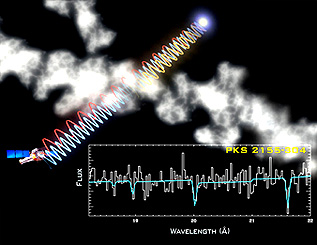
The relative amounts of matter
and energy (which can be expressed as matter using the E = mc2 conversion)
have been calculated based on data collected in the past few years. This is conveniently
displayed in this pie-chart diagram:
A similar diagram, made
a few years earlier, shows a slightly different composition, owing in part to
selection of different categories of the physical components of the Universe:
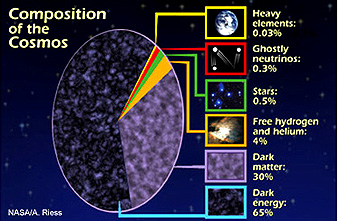
In this diagram, Ordinary
visible "matter", mainly in the galaxies, amounts to only 0.5%. Photon radiation
moving about the Universe contributes just 0.005%. The MACHOS make up the Ordinary
nonluminous matter (3.5%) and WIMPS comprise the Exotic dark matter(26%). The
bulk of the ingredients in the Universe is what is known as "Dark Energy", and
accounts for ~65% of the estimated total mass/energy; conjectures as to its nature
are described on the next page in the paragraphs that deal with the repulsive
energy that could relate to Einstein's Cosmological Constant.
In February 2003, F. Nicastro
and his associates at the Center for Astrophysics of Harvard's Smithsonian Astronomical
Observatory reported a refinement of the numbers for Ordinary matter. Of the
4% that comprises the total amount, about 1/3rd is visible (greater than 1%)
as stars and galaxies. The remainder consists of H, He, and other baryons that
occupy both galactic halos and beyond in intergalactic space. These exist in
a high temperature (105 to 107 degrees Kelvin) "fog" that
they have detected using both FUSE (Far Ultraviolet Spectrometer Explorer and
Chandra (x-ray) data. This fog is left over from the galactic formation process
and serves to provide the extra mass needed to gravitationally bind together
galactic groups (they studied the Local Group around the Milky Way) in clusters.
The roles of Dark Energy
and Dark Matter in the observed Universe are still being worked out. Both, or
perhaps Dark Matter in particular, seem to be needed to keep the galaxies intact.
It appears that the gravitational forces from the matter within a galaxy are
insufficient to keep them from flying apart and dissipating into intergalactic
space. Dark Matter may provide the mass needed to furnish the gravitational
stability that maintains the integrity of the galaxies once formed.
An interesting alternative
to Dark Matter as the stabilizing force is that of a concept called MOND, for
Modified Newtonian Dynamics. This is reviewed by its originator, Dr. Mordecai
Milgrom of the Weizmann Institute in Israel, in his article "Does Dark Matter
Really Exist?" in the August 2002 issue of Scientific American. Check this to
be familiarized with its essentials. In a nutshell, he postulates a constant
of acceleration, called a0, that determines the gravitational behavior
of matter. Acceleration values larger than a0 are consistent with
the Newtonian Second Law in which F (force) = m (mass) time a (acceleration
such as we observe experimentally for gravitational processes or for imposed
accelerations [e.g., a rocket launch]). But in his proposal values smaller than
a0 modify the behavior of galaxies in a way that obviates the need
for dark matter gravity. Using his non-Newtonian approach, his mathematical
analysis of galaxy dynamics based on values of a's that are less than
a0 reproduces most of the observed effects in the orbital patterns
and rates of motion of stars within galaxies. His model, initially disregarded
by most cosmologists, is now attracting serious attention.
An imaginative explanation
for why dark matter (in terms of mass) has so far eluded scientists as to proving
its existence and nature has been proffered by Dr. Jonathan Feng and his group
at the Univesity of California-Irvine. They postulate this matter to be hidden
particles that reside in an extra dimension beyond the three spatial ones that
we sense. This is plausible if the multi-dimensional space described at the
bottom of page 20-1 is
a reality. This model may be provable by this means: the extra-dimensional mass
particles would tend to collect around bodies that have strong gravitational
pulls. Under this influence, the particles would tend to collide with each other
more often, producing neutrinos with especially high energy. Experiments to
test this hypothesis around the Sun have been proposed.
The proof that Dark Matter
and Dark Energy really exist, and insights into their nature, rank near the top
of priorities that astronomers and cosmologists intend to address in the first
decade of the 21st Century. A number of approaches have been proposed. One is
to study the shapes of galaxies that have characteristics explainable by the presence
of dark matter. MGC 720, some 80 million light years away, shows differences between
visible and x-ray images that can be postulated as imposed by dark matter in the
halo surrounding the galaxy. As seen below, the galaxy has a flattened elliptical
shape when viewed in visible light but as imaged by the Chandra X-ray Telescope
the core appears round and the surrounding excited matter is distributed spherically.
A calculated model for this difference works well when a concentration of dark
matter is introduced. There is a hypothesis that galaxies will attract greater
amounts of dark matter surrounding them than would be found in intergalactic space.
Another potential proof
now underway is the installation of a 2.8 meter telescope, called the South
Pole Telescope, located close to that point in the Southern Hemisphere. It will
be capable of measuring small changes in conditions (primarily temperatures)
around galaxy clusters; these changes would verify expected variations caused
by dark matter/energy as predicted by models now being developed.
Some of the ideas introduced
on this and the preceding page are examined in a different manner, based partly
on the information provided by the Cosmic Microwave Background Radiation, on
this Internet
page prepared by astronomers at the University of California, Santa Barbara.
(It is rather technical.) Two other reviews on cosmic expansion and Einstein's
Cosmological Constant, prepared by Sten Odenwald for the Raytheon Corp., are
found at (1) and
(2).
The steeper sloped
H case represents a Universe that is more rapidly expanding, has covered less
distance, and is younger (10 billion years); the slope for H = 50 has expanded
more slowly over a longer time (20 billion years) but has covered a greater
distance (bigger Universe).