A perusal through current Astronomy textbooks supports the above thesis. Here is a partial listing of instruments and detectors used by astronomers to sample radiation inherent to different regions of the electromagnetic spectrum (note the general similarity to Earth-directed sensors): Conventional Optical Telescopes (refractors and reflectors); Optical Interferometers; Photographic plates; Photomultipliers (photons --> electrons); Image Intensifiers; Vidicons; Semiconductor detectors; Scintillation detectors; Charge-Coupled Devices (CCDs); Bolometers; Prism, Filter, and Grating Spectrometers; Polarimeters; Radiotelescopes; Infrared Telescopes; Gamma Ray and X-ray Telescopes
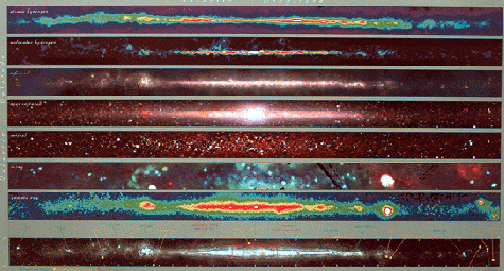
The illustration below demonstrates
the power and versatility of multispectral measurements that continue to provide
important, often critical information pertinent to astronomy, and by extention,
to the higher levels that underlie cosmological thinking. Shown are composite
images of the Milky Way galaxy acquired over different parts of the spectrum using
satellite- mounted sensors. Because the labelling is likely be blurred on your
screen, from the top these spectral regions are: Light from the excitation of
atomic hydrogen; the same, for molecular hydrogen; infrared; near infrared; optical;
x-ray radiation; gamma rays; a "reference" or "finder" image.
These panels were assembled
at NASA Goddard Space Flight Center's Astrophysics Data Center using results from
satellites developed there and elsewhere. Enlarged versions of each of these,
and several more at different wavelengths appear near the beginning of page page 20-4.
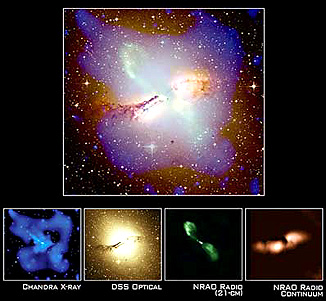
Astronomers have found
interpretive benefits in combining images made by sensing radiation at different
wavelengths collected by telescopes that are ground-based and/or on space observatories.
Of course, information in any of the input images is itself usually revelatory
and important in understanding stellar processes. Here is a composite of a Chandra
X-ray image, a visible image, and two images at different radio wavelengths
of the Galaxy Centaurus A that illustrates these points:
Cosmology is one of the writer's
(NMS) hobbies and special interests - has been since his high school days and
first acquaintance with the sciences. It was once a tentative choice as a career
until it became obvious that my mathematical abilities were too limited to allow
me to master the essential concepts of Physics to the degree needed to excel in
Astronomy and Cosmology. But, I have over the years "devoured" a number of texts
and popular accounts (starting with Isaac Azimov paperbacks) that deal with the
three main areas of Physics - Quantum Mechanics, which deals with the very
small; Newtonian Physics, which covers the physics of "everyday world"
scales, and Relativity/Astrophysics, which examines the very large (scales
at cosmological sizes), especially under relativistic conditions in which
measurements are made on objects traveling at speeds near that of light. This
has endowed me with enough elementary expertise to attempt this Section, which
is an condensed survey of current knowledge of the fundamentals of Cosmology presented
in a generalized descriptive narration rather than a rigorous, mathematically-developed
synopsis and supported by numerous illustrations. I have sought - but not yet
obtained - reviews by professional astro-scientists in hopes of validating and
improving its content (your critique, if you are so qualified, would be much appreciated
and changes made accordingly). But, for now, I accept full responsibility for
the errors of commission and omission that inevitably have made their way into
this write-up.
When I first began this Section,
I already knew that the majority of Astronomers/Cosmologists/Physicists had accepted
two fundamental ideas about the Universe: it was expanding and it seems
to have had a finite beginning involving the "explosion" of a very small primeval
particle (containing almost unimaginatively huge energy) referred to as the Big
Bang. My starting point in preparing the Section (back in early 1997) was
to re-read The Big Bang, by Joseph Silk, 2nd Ed., 1989, W.H. Freeman Co.,
which I outlined in toto. (note: the 3rd edition has been released in late
2000; this is the one book [in paperback] I would urge you to acquire if you wish
to delve in depth into Cosmology). As I proceeded to organize this survey of Cosmology,
I "discovered" a number of magnificent illustrations made through the Hubble Space
Telescope on the Space Telescope Science Institute's Home
Page on the Internet, Many of these I downloaded and incorporated into the
text of this Section, which has been expanded and repeatedly rewritten. In Fall
of 1997, I found The Whole Shebang: A State-of-the-Universe(s), by Timothy
Ferris, 1997, Simon & Schuster in a bookstore during a visit to the Washington,
D.C. area. After a full reading - it is a highly recommended account in layman's
language - more revisions were made.
Yet another trip there led
to finding a just published textbook Foundations of Modern Cosmology, by
J. Hawley and K. Holcomb, 1998, Oxford Press, scoped as a survey at the College
Senior-Graduate School level, which I went through at a cautious pace although
consistently fascinated. I judge it to be the one of the best science books of
any kind I have ever perused. It treats Cosmology in a proper way, from the viewpoint
of Einsteinian Special and General Relativity. (Special Relativity, which came
first, deals with spacetime in terms of the electrodynamics of moving systems;
General Relativity is a refinement that brings in the proper role of gravity.)
Rather than recasting the
entire Section 20 in terms of relativistic Cosmology - which would have greatly
enlarged its length - I have extracted some of the important ideas and information
from their book and incorporated these by splicing into the text. But, if you
have - or develop from this Section - an abiding curiosity about Cosmology in
its fullest scope and want to learn more using a treatise that contains rather
straightforward and manageable mathematics, I strongly urge you to order Foundations
of Modern Cosmology (it is not likely to be found at the usual bookstores) and
put aside the month or so that will be needed to investigate the "foundations"
of Cosmology (about 10 pages a day is the limit I advise, since you need to digest
and ponder its many significances). Or, if you want a rather rigorous (mathematical)
but quicker synopsis of Astronomy/Cosmology on the Internet, then try the lecture
notes, prepared by the University of Pennsylvania Physics Dept.; especially
helpful are Lectures 24-26.
I have deliberately avoided
detailed explanatory coverage in Section 20 of some of the more avant
garde aspects of Cosmology, such as: Theories of Everything (a unified model
including all physical aspects of the Universe's origin); Spontaneous Self Creation;
Hawking radiation (which draws upon quantum mechanics, thermodynamics, and relativity);
Hyperdimensional (greater than 3 and up to at least 10 dimensions) Space; Supersymmetry;
Superstrings (go to this site for a good summary of this
new, perhaps revolutionary field); Magnetic Monopoles; Wormholes and Time Travel.
However, some of these topics are touched upon briefly where pertinent to the
ideas being considered. Perhaps key answers will come from observations made by
the Planck Explorer spacecraft and the James Webb Space Telescope to be launched
in the early 21st Century. Meanwhile, a paperback that considers most of these
ideas is Hyperspace by Michio Kaku, Anchor Books. 1994 (Doubleday) treats
many of the above topics in a clear exposition and is another recommended read.
Another, more recent hardback that covers many of the above topics, with emphasis
on Superstrings, is Brian Greene's The Elegant Universe, W.W. Norton &
Co., 1999; this book has been summarized on the Internet by M.
McGoodwin..
Michio Kaku has revised his
Beyond Einstein: The Cosmic Quest for the Theory of the Universe, Anchor
Books, 1995, which includes an extended section on Superstrings. Also recommended
along these lines is God's Equation: Einstein, Relativity, and the Expanding
Universe, by Amir Anzel, Dell Publ., 1998.The role of Inflation in the early
Universe is presented as an odyssey of discovery by Alan Guth in The Inflationary
Universe, Perseus Books, 1997. An outstanding paperback that clearly illuminates
Cosmology from the quantum viewpoint is Other Worlds by Paul Davies, Penquin
Science, 1988.
Still another superb review
is The Cosmic Blueprint, also by Paul Davies, Touchstone Books, 1992; three
of his more philosophical tomes that attempt to reconcile the modern world of
science with metaphysical questions (including the role of God in creation) are
listed at the end of this Section. Two other excellent reviews, both published
by the Oxford Press, are The Left Hand of Creation by John Barrow and Joseph
Silk, updated edition, 1993, and The Life of the Cosmos by Lee Smolin,
1997. Another thorough treatise is Before the Beginning: Our Universe and Others
by Martin Rees, Addison-Wesley, 1997. A very recent paperback, The Accelerating
Universe: Infinite Expansion, the Cosmological Constant, and the Beauty of the
Cosmos, by Mario Livio, 2000, J. Wiley & Sons, is highly recommended for
its in-depth treatment of many basic cosmological concepts and its survey of the
idea strongly supported by observation that the Universe's expansion is now accelerating.
In addition to the U. Penn
site mentioned above, the Internet has a plethora of interesting sites that come
up when "Astronomy" and "Cosmology" are entered as the keywords in any of the
popular search engines. The best I have found (and strongly recommend visiting)
are the three courses taught by, and condensed on the Internet, Dr. James Schombert
of the Dept. of Physics at the University of Oregon. The links here are to Ast122
on stars, and Ast123 on galaxies
and expansion. Also quite informative is the Astronomy Notes web site prepared by
Nick Strobel.
Here are five more that I
found informative: (1),
prepared by Dr. E. Wright of UCLA, which has four key sections, a News of the
Universe section which updates these sections with major new discoveries or announcements,
and a very enlightening FAQ page at (2), (3),
an excellent synopsis by J. Hawley of parts of the book cited above on Cosmology
that he co-authored with K. Holcomb, (4), a good general summary
of some key ideas in Cosmology included in the Astronomy Today site, and (5),
a summary of a program on Cosmology shown on PBS. Two more sites, with a somewhat
advanced treatment of the subject are the Cosmology review prepared by the National Research Council
and by Cambridge University
astronomers. And I can also recommend a site prepared by Dr. Sten Oldenwald which
is in the form of numerous questions arranged in a FAC format; click on any of
the categories in the COSMOS group (note the other interesting space-related subjects).
Another informative Web Site that reviews some fundamentals of Cosmology: Goddard's MAP program.
In the remainder of this Preface,
I can't resist the temptation to touch upon (actually summarized in a bevy of
paragraphs) some of the most basic ideas that underlie Relativity and Quantum
Mechanics. Relativity is the concept that best describes the physics of "mega-space";
it is not deterministic in the sense of Newtonian mechanics. Instead it
is relativistic in that the values and meanings of such concepts as space
(three-dimensional), time, and gravity are relative to the conditions in which
movements associated with them occur. Thus, as treated by Special Relativity,
length of a body in motion, for example, is not absolute but varies according
to the speed of that body in relation a reference frame at rest or moving at a
different speed, with the length being assessed by the usual means of measurement
- namely, one that depends on visible light and other electromagnetic radiation
to obtain its values. For normal conditions, such as mobile activities in terrestrial
environments, the lengths as measured show no discernible variations. Relativity's
principal realm of applicability is under conditions in which a body under scrutiny
is traveling at speeds near that of light and in which gravity is so strong that
space itself becomes warped. Quantum Mechanics, on the other hand, concerns "micro-space",
at (sub)atomic levels; it is probabilistic in nature. In between, scalewise, is
the classical physics view of motion established by Newton, Galileo and others
in the 17th Century; this Newtonian physics, as it is often called, is what we
humans tend to use in our everyday lives.
What is treated in the
next sequence of paragraphs is a synoptic review of Relativity which the writer
(NMS) has developed by reading 4 textbooks on the subject (the best is the Hawley
and Holcomb "Fundamentals of Modern Cosmology", Chapters 6-9, cited above),
and by reading through a number of Web sites. Of these, the one to visit at
some stage of your understanding of Relativity is the famous book written in
1920 by Albert Einstein, now online in its entirety.
Prior to that, after reading through the material presented below, two Web sites
that give a nice overview are 1) Nick Strobel's treatment;
and 2) Ed Wright's
version.
Relativity is an outgrowth
of Einstein's thoughts, in the early 1900s, about motion and gravity in a non-Newtonian
framework. He was also trying to reconcile (or integrate) 1) some fundamental
concepts in the field of electromagnetic forces established earlier as Maxwell's
Laws with 2) the Newtonian mechanical Universe. Newton's physics - especially
in the realm of mechanics - works well in the dynamics of three dimensional space
(especially at the local scales for earth-sized bodies and smaller) and at velocities
common to everyday experience. Instead of the Absolute view of fundamental
parameters such as space and time envisioned in Newtonian physics, space, time,
energy and mass can vary in their perceived nature in a Relative sense,
depending on the inertia frame(s) of reference used to measure and monitor
them. Both the history of his discoveries and an excellent portrayal of how they
affect Cosmology is given in Amir Aczel's book God's Equation: Einstein, Relativity,
and the Expanding Universe, 1999, Dell Publishing. However, because of the
inherent "greatness" of Einstein as a scientist and humanitarian (selected by
Time Magazine as the "Man of the 20th Century), the writer strongly recommends
this splendid biography: Einstein: The Life and Times, by Ronald W. Clark,
1971, Avon Books. Two excellent Internet sites that include many Links to other
sources about him and his work are: (1)
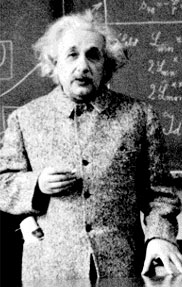
and (2). Here is a typical
photo of Albert Einstein in his later years:
Einstein's theory of Special
Relativity (SR) was first published in the Annalen der Physik in the summer
of 1905. In the same issue of that magazine, he also had significant papers on
Brownian motion and on the photoelectric effect (which helped confirm the dual
nature of light [exists simultaneously as waves and particles], for which he later
was awarded a Nobel Prize; ironically, it was a key early finding that led to
quantum indeterminancy which Einstein could never accept). Thus, three revolutionary
papers appear in one volume (copies of which now sell at high prices to collectors
who, like the scientists, recognize that this feat of triple masterpieces was
extraordinary and unique).
Einstein was not the first
to realize that physical properties should, theoretically, change significantly
when their measurements are made under conditions where the observer is traveling
at high speeds relative to that of light. In 1889, the Irish physicist George
FitzGerald suggested that objects moving very fast (at significant fractions of
light speed would appear to "shrink" in length according to the equation:
where L is length, v is
the speed of the object, and c is the speed of light. That notion was later picked
up by Henrik Lorenz and developed in more mathematical terms. (But it was Hermann
Minkowski, Einstein's math instructor at the Swiss Federal Polytechnic School
in Zurich, who is credited with placing the theory of Special Relativity on
a firm mathematical foundation.) Einstein was aware of the FitzGerald-Lorenz
ideas but during several years of deep thinking (independent of communications
with these other physicists) he explored the implications in much greater depth,
finally developing what has come to be called Special Relativity and demonstrating
its many consequences. He, in effect, showed the limitations of Newtonian physics
whenever motions involved move at high speeds.
Special Relativity is derived
from the premise that the speed of light is truly a constant - an absolute value
- which determines how one must approach the measurements of the physical phenomena
of the Universe. The principle from which many conclusions about the relative
aspects of time and motion in the physical universe are formulated springs from
this simple statement: "The speed of light * is the same when
measured from all moving (inertial) frames of reference, regardless of their (relative)
speeds."
In other words, the speed
of light is invariant, and will always have its precise value of 299,792 km/sec
(186,282 miles/sec; or expressed in terms more familiar to Earth's people, a speed
of 670,579,200 miles/hour [mph]) whether it is measured from a point on Earth
moving at its celestial velocity or from a spaceship traveling at hypervelocities.
Unlike a Newtonian description of relative motion (e.g. a person walking at a
velocity X on a train moving at velocity Y is seen by an external observer to
be moving at a speed of X + Y if walking forward in the direction of train motion,
or X - Y if walking opposite to train motion), Einstein showed that the additive
Newtonian case cannot apply when an object moving at a speed 'v' less than that
of light 'c' in a framework common to both (say, a person walking in a spacecraft
that has attained light speed); that is to say c + v is impossible and nothing
in the Universe can appear to move at speeds great than light. This constancy
of light speed (and its limiting value) is a cornerstone of Einstein's Special
Relativity. A corollary drawn from this principle is that, for any two systems
moving at different uniform velocities, all the laws of Mechanics (in Physics)
operate in the same way in both systems, i.e., are not influenced or moderated
by their relative speeds. However, Relativity is most relevant and applicable
for phenomena in which very high speeds are involved as well as aspects of Physics
involving the quantum state of matter and energy.
At the low speeds (compared
to light) that we travel in Earth life, we have all experienced the effects of
small differential speeds in our auto on an Interstate relative to a car traveling
at slightly lower speeds in the next lane (we actually sense that we are going
fast because our eyes are aware of features off the highway that are standing
still). But, relative to each other, the feeling of motion differences is minimal.
But, an observer (say, a pedestrian) off to the side notes both cars as going
fast. However, our sense of relative motions is accentuated when we compare our
forward motion with autos moving against our direction in opposing lanes.
Let's consider another aspect
of relative motion. This is referred to as the "Relativity of Simultaneity". Suppose
we are on a very long single car train with glass sides, and you are situated
at its middle lengthwise. Suppose also that the train is moving very rapidly.
Let a lamp encased in a container but with slits that outwardly direct two beams,
one forward and the other to the rear, be suddenly switched on. Two reference
photons of light (to simplify this thought experiment, we will ignore all the
other photons in the beam signal) leave in opposite directions from the middle
of the train simultaneously towards reflecting convex mirrors at both ends
of the train. You will see the light signal arrive at the front and back of the
train at the same time, since the frame of reference (you, the observer) is moving
at train speed. But, to someone off the train and at its side directly perpendicular
to the light source at the instant it passes, the photon from the back will arrive
earlier (the distance to the back mirror has shortened as the train moves forward)
whereas the simultaneous photon from the front mirror has traveled both the distance
from the center and the added distance covered during travel at the speed of light
represented by the distance the train has moved since the photon event began.
To the external observer, the photon from the front arrives after the photon from
the back of the fast-moving train and thus the dual mirror reflection events are
not simultaneous, i.e., seem to occur at slightly different times. (Of course,
in reality this experiment would not be feasible to conduct since trains move
much much slower than light speed.)
Now, looking at this with
another example, assume we occupy a spacecraft moving at extreme speeds (approaching
the speed of light), from which we send forth a light signal to an external observer.
If we somehow can measure that light as it moves outside the spacecraft, regardless
of our speed the light is found to be moving at its fixed value of almost 300,000
km/sec. From our frame of reference onboard, the relative motion of ourselves
within the spacecraft is that of standing still with respect to the spacecraft
itself but moving quite fast with respect to external objects and observers. For
the rapidly moving spacecraft passenger, clocks onboard seem to move normally
(no change in the length of a second) and lengths remain the same. For stationary
observers located elsewhere (say, on Earth) or alternatively observers in constant
motion at a speed lower than the spacecraft, clocks in the spacecraft appear to
tell time more slowly so that time dilates (interval between seconds increases)
(intense gravitational fields produce the same effects). Not only do the people
in the spacecraft as seen from the outside look as though they are slowing down
but they are dimensionally shortening in the direction of motion. To a distant
observer, our spacecraft will appear distorted owing to the differences in time
when light left different parts of the rapidly advancing vehicle. In effect, for
anyone moving at high relativistic speeds, time stretches out (called time
dilation), space shrinks, and mass and inertia greatly increase
relative to external observers.
In a sense, these relativistic
effects will seem "illusory" to external observers. For instance, length as
a dimension does not really decrease (contract) in terms of the spacing of atoms
in a real meter stick moving near the speed of light. To the observer moving
in sync with the stick (as held by an astronaut on the fast-moving spacecraft),
its length would remain the same in appearance as it did before launch. The
high rate of speed does not force the atoms to crunch together in the direction
of motion. But, to an observer off to the side, the shortening of the length
occurs because light seems to have left one end of the meter stick before the
other owing to the great contrast in relative speeds. So, for both dimensions
and time, no actual changes take place; the apparent spatial contracts
and time dilations are the consequence of the modes of measurement.
To many, the time effects
owing to relativity seem even weirder than those associated with spatial dimension
shifts. If the above-mentioned spacecraft's occupants were to return to Earth
after 20 years of high speed travel, they will have aged only at some shorter
time compared with the 20 years that the observer left behind has added to his
life from the beginning of our journey. The best example of this is found in Einstein's
Twin Paradox. Start with two brothers born on the same day. Now, as young
adults they separate in this manner: The ground twin remains on Earth; the space
twin takes a journey such as described in the last paragraph. Upon return, the
space twin finds his brother to have aged beyond that of himself according to
the record of time (the calendar), 20 years, elapsed since the space trip began.
The Earth twin is thus 20 years older. But, time has shortened for the space twin
and his bodily functions (in aging) have proceeded more slowly, so that he upon
return appears to have aged just a few years (say, 3). (Two obvious questions
might be: 1) does the space traveler see his return as a step into the future;
2) can the shortening of time go negative so that a traveler can somehow move
backward in time from "now" to the past? Both prospects have been subjects of
science-fiction movies.)
Let's carry this spacecraft
motion a step further. In the October 2002 issue of Scientific American
which features a single topic - Time, Paul Davies discusses this mode of travel
in his article That Mysterious Flow (referring to concepts and perceptions
of time, in which he demonstrates that the steady flow of time is an illusion).
In a box on Simultaneity entitled "It's All Relative", he reviews the case of
a spacecraft traveling at 80% light speed towards Earth and then continues on
a direct line to and past Mars. I shall summarize his scenarios in the following
4 paragraphs:
To people on the spacecraft,
at any time interval they feel as though they are standing still while both
Earth and Mars move toward them. In the two reference-frame examples Davies
develops, he cites actual calculated times for different events as measured
on Earth and in the rocket. In the scenario, the starting point is high Noon,
which has been sychronized accurately to be simultaneous for both Earth and
Moon observers; at the beginning of the experiment, the clock on the spacecraft
was also set at Noon. At precisely that time, the Mars observer sends a light
signal directed at the Earth observer. Its transit time is given as 20 light-minutes,
as predetermined by the actual (known) distance to Mars. First, from the frame of
reference set as the Earth station, at Noon, the Earthling assumes the Martian
has just sent a light pulse to Earth at the prearranged time also of Noon. Sure
enough, that signal arrives on Earth at 12:20 PM. At just this time, the rocket
passes by the Earth, but some distance away, at 80% light speed. Using calculations,
the Earthling determines that the rocket sees the Mars signal at 12:11 PM -
earlier than Earth because the spaceship is moving so fast. But, because time
slows down from the Earthlings perspective, he records the arrival of the space
ship just past the zeneth point above Mars to be at 12:25 PM.
Now, from the rocket's perspective,
these events unfold. First, at the Earth approach, the spaceship personnel measure
the distance between Earth and Mars, find this to be 12 light-minutes (owing to
length contraction as a high speed object looks externally at apparently moving
targets). After the rocketpeople pass above the Earth at precisely noontime, knowing
that the Martians were scheduled to signal Earth at Noon, they now look for that
signal as they enter the space between the two planets. They expect to see it
at 12:12 (the transit time they deduce from the distance measurement they made.
But, because of time dilation, the rocket clock runs at a different rate from
Earth and Mars clocks. Oddly (but valid) the Earth and Mars people determine that
the spacecraft's clock is running slower than their clocks even as the rocketpeople
in turn think their spaceship time runs slower. The Mars noontime signal arrives
at the spacecraft at 12:07 PM on its clock, and without thinking in Relativity
terms they wonder if it had been sent prematurely. At 12:15 spaceship time, Mars
"appears" as though it has arrived at the spacecraft above it (when actually the
spaceship has done the traveling). It signals both Mars (below) and Earth (behind
it) at this arrival point. That signal reaches Earth at 12:35 PM.
The "moral" of this story
is that the same instantaneous events appear to observers located at different
places at different times, thus confirming Einstein's deduction that there is
no measuring system that can register an event as happening at the same time everywhere
- the same motions seem relative with respect to "when" at different locales,
each with its own observation conditions, for multiple, separate, and moving observers,
and thus time is not an absolute as once affirmed by Newton and others. For a
person onboard a spaceship traveling at high relativistic speeds, on contacting
Earth he/she would learn that the clocks back there appear as though they would
be running faster, i.e., have speeded up. Conversely, the passage of time on the
spaceship relative to those on Earth would seem to have slowed down. Likewise
dimensionality in space is not absolute.
Thus, from such reasoning,
Einstein concluded that the proper number of dimensions needed to explain the
unusual phenomena that result from relativistic motions must be four rather than
the traditional three (space: length, width, and depth or height). The Universe
is fundamentally in a 4-D state. The fourth dimension, that of time, is considered
independent of spatial dimensions in Newtonian mechanics but is closely interrelated
in the Einsteinian system. (Note: the time used in Newtonian physics to measure
velocities, accelerations, momentum, etc. is of the ordinary or fixed variety.)
Under relativistic conditions, the role of time becomes paramount in measuring
the positions of objects in motion: time enters in because locations are changing
even as time is consumed as the light travels from source to observer and hence
when the signal reaches the observing device the object has now changed position.
In one of his thought experiments,
Einstein envisioned what would happen to a beam of light moving beyond the interior
of a space vehicle accelerating at relativistic speeds. Applying Special Relativity
concepts, to the onboard observer the light is transmitted along a straight line,
since both the light source and the vehicle are traveling at the same speeds.
But to an outside observer at rest, the light beam would appear to curve, inasmuch
as the paths of its photons are shifted progressively as they travel out from
the high speeding vehicle. Thus, under the influence of gravity-acceleration,
the light which must travel the shortest distance between two points (A, source;
B, target) will be subject to A's having moved a finite distance during the transit
time relative to the observer at B - thus the light traces a curved line, from
which it follows that space itself is curved in the sense that light traveling
across it follows a curved path that still represents the shortest distance between
points. (Any segment of a longitudinal line on a sphere is curved but nevertheless
remains the shortest distance between the points at each end of the segment.)
One corollary drawn from this
aspect of Special Relativity is that the huge dimensions of the Universe require
that we always consider time in measuring distances. We see any distant galaxy
as it was then, not as it really is now (it may in fact by now have greatly evolved
and has lost and gained many stars). Likewise, its position then relative to us
is not the same as now.
Let us expand upon this last
paragraph. This distribution of objects throughout the vastness of space, which
gives information as we observe them today that represents different times and
locales in the past, embodies the concept of Spacetime. At cosmic
levels, all event actions (along what are termed "worldlines"), together with
relative changes in sizes and distances, are embedded in spacetime. Thus, as we
shall see later in the Cosmology Section, this is one consequence of Spacetime:
light from a source (e.g., a galaxy) located at this time 5 billion light years
away (or, approximately at a distance of 47 x 1021 kilometers) left
the galaxy that many years ago and shows the appearance or state of evolution
reached by that galaxy then. What is actually happening at (and to) that galaxy
today will be received (perceived) as an event or state transmitted at this moment
only at some distant future time, during which the galaxy has since moved farther
from Earth (actually, both galaxy and Earth are drawing apart) and has evolved
beyond what is described for it during early 21st Century cosmological observations.
To get a mental picture of
what it means to visualize in Spacetime on a cosmic scale: Imagine you are somewhere
inside (for convenience, say, near the middle) of a huge sphere in which are randomly
distributed a huge number of points (for the Universe Model, these would be galaxies
that contain inhabited planets as observation points); you now gaze outward to
see various galaxies at different distances from your local observation site);
if this were actually just a real world model of finite dimensions, e.g., a few
hundred feet, then every other point would send you light at essentially the same
instant, so the view is static and just three-dimensional; but if you are really
looking out at all the detectable galaxies in a 3-D Universe, at any given moment,
the light received from any one would have taken a finite (long by comparison
to your local framework) time to get there, and different points (galaxies) at
different distances sent their light received now at different times in the past;
thus you see a three-dimensional array of points in cosmic space that represent
objects whose ages vary (farthest are oldest, since light had to travel longer
to get to you and hence had to leave earlier; nearest are youngest). This is a
spacetime panorama, in that the 3-D assemblage of points at different distances
actually consist also of points that differ in age and time of transmission. In
such an array, another characteristic is that NOW (the present moment)
those points are different (in distance, in stage of evolution, etc.) than they
were as you now observe them, i.e., they have moved on with expansion and have
changed to new states, the extent of which depends on their distance from your
observation point.
One of the paradoxical
spinoffs of Special Relativity as applied to Cosmology concerns the perception
of past and future. If a burst of photons leaves a distant galaxy
at some particular time and then arrives at our observation point, we have indeed
seen "into the past" to specify that moment in time. This is refered to as the
Lookback Time - the time required for photons from a source to reach
and be received at an observation point (as from a star to an Earth telescope).
But, for an observer in a galaxy "beyond" us in a direction that the light would
travel if it had not been intercepted by Earth, that moment has not yet happened.
It belongs to some time in the "future" (measured for our framework in terms
of Earth time) for that observer but when he/she eventually sees it, it will
be represented as the same moment that we have witnessed in the "now" time of
reception on Earth. Nevertheless, for any pair of events separated in time but
causally connected (light signals can mutually pass between them) the order
of reception of evidence for these two events will always follow the before-after
sequence.
Another of Einstein's conclusions
then was that mass and energy obey the Principle of Equivalence, such that under
certain conditions, energy can "condense" to mass and, conversely, that mass is
convertible to energy (hence the famed equation: E = mc2, with
c being the speed of light]). From this equation, one can deduce that as an object
moves faster up to speeds approaching that of light its energy (and the mass equivalent)
will begin to increase notably. In principle then, the maximum energy a given
amount of mass can release is determined by c2. This mass-energy equivalence
ranks with the space-time equivalence at the top of the list of his achievements.
It also forms the basis for schemes to recover huge amounts of energy from "tapping"
into the nuclei of atoms; the energy released from the explosion of an atomic
bomb derives from this relationship (nuclear explosions produce only a fraction
of this total energy).
This principle of relativistic
mass increase is used in the particle accelerators that physicists have built
to "smash the atom", or more precisely, to penetrate the nucleus to learn its
nature and to determine the types of subatomic particles that can exist in nature.
As particles such as electrons, protons, neutrons, muons, etc. are accelerated
(by moving through magnetic fields) to near-maximum relativistic speeds, their
masses greatly increase (approach infinity), making them much more powerful
and effective "bullets" that impart sufficient energy upon colliding with a
nucleus to break it apart or otherwise modify it. To summarize the essence
of Special Relativity, simply remember that to a slow moving or fixed observer,
on a fast moving object (think of some futuristic spacecraft) time will appear
(to the slower observer) to slow down (clocks tick slower), three-dimensional
objects will appear to shorten, and mass will increase whereas
these metrics remain unchanged for anyone on or in the object. Various experiments
have repeatedly proved the validity of Special Relativity. Relativistic effects
are noted in objects moving at as slowly as 40% of the speed of light, and are
dramatic above 70% as they rise exponentially. To quote from Ronald Clark's
book on Einstein (op. cit. above), "Einstein had showed that time and space
were not the inelastic things which they were thought to be, but were relative
to the sum total of circumstances in which they were considered. Thus he changed
the meaning attached to the word "reality"." (p. 755).
The theory of General Relativity
(GR), of which the first elements were put forth by Einstein in 1913 and 1915
followed by his "Foundations" paper in 1916, after about a ten year gestation,
was his effort to fit gravity into the spacetime picture. Since 1905, Einstein
had grown more adept as a mathematician; he found that tensor calculus and Riemann
geometry were particularly suited to developing the quantitative relationships
in the theory.
General Relativity has more
direct relevance to Cosmology than the more esoteric Special Relativity. GR is
concerned with frames of reference that accelerate relative to some one
frame which itself can be moving or still. Special Relativity is applicable to
frames that are traveling at uniform velocities (or one may be at apparent
rest; apparent because if it is on Earth [say, a fixed telescope] it is actually
in motion because of the Earth's rotation, its orbit around the Sun, the Sun's
motion in its galactic arm, and the movement of the galaxy relative to the whole
expanding Universe). General Relativity is concerned with the effects of accelerating
velocities, and their relationships to a proper understanding of Gravity and
to a rethinking of the geometry of cosmic space (overthrowing the Euclidian framework
[three orthogonal axes] for one of a curved nature). General Relativity's concepts,
together with certain facets of Special Relativity, have allowed scientists to
predict such things as relativistic redshifts, cosmic expansion, quasars, neutron
stars, Black Holes, gravitational waves and the age recession of components in
expanding space (remember from above: objects near the edge show themselves as
they were early in Universe history; those closer to Earth are normally in an
advanced age).
Gravity, from our experience,
is strongly dependent on mass. Einstein recognized that gravity is also dependent
on motion and the geometry of space. He thus postulated still another equivalence:
that of acceleration and gravity. This is confirmed by the following thought experiment:
Place yourself in an elevator that is initially at rest in a building (or on the
ground). You drop a ball and it naturally falls to the floor (at an acceleration
of 9.8 meters/second2 or 32 ft/sec2. In this conventional
case, gravity is the "cause" of the ball's acceleration; the value of acceleration
is related to the Earth's total mass (remember the Newtonian equation F = ma).
Now, imagine this elevator and you inside are transported to some point in outer
space so far from large bodies that any gravitation effect due to the Earth or
other massive bodies is close to zero. Let some power source (such as a rocket
engine) act on the elevator to move it upwards at an acceleration rate of 9.8
m/sec. You will feel just like you did in the Earth-based elevator: you feet are
planted on the elevator floor and if you release the ball it will fall as it did
on Earth. Since no gravity is acting, you would conclude that the gravity-like
conditions you experience must be due to the imposed acceleration.
From this experiment Einstein
concluded that gravity and acceleration obey the Principle of Equivalence (i.e.,
are equivalent), being just two variants of the same fundamental physical effect.
Thus, anyone enclosed in a windowless box, such that this person cannot look
outside to see if the surroundings are either moving or not, will not be able
to distinguish whether the box is being acted upon by gravity or is instead
accelerating outward in space far from any mass source of a gravitational field.
This conclusion is the basis for further deductions about gravity and the gross
shape of space that led Einstein to the rvolutionary ideas that arise from General
Relativity.
Returning briefly to the falling
ball in the elevator scenario, we illustrate another aspect of the role of
gravity/acceleration. If the elevator is stopped and a ball is dropped, it will
move straight down at the acceleration appropriate to Earth's gravity. If, instead,
it is released in a fast dropping (thus accelerating) elevator, when the elevator's
rate of speed change just balances that of standard gravity, the ball will "hang"
suspended in the elevator rather than falling. (This is similar to the effect
of inducing weightlessness for a short period when an airplane accelerates into
a fast dive; this effect, evidenced by free floating, is also experienced by astronauts
in the Space Shuttle when it orbits at angular velocities that balance [offset]
Earth's gravity.)
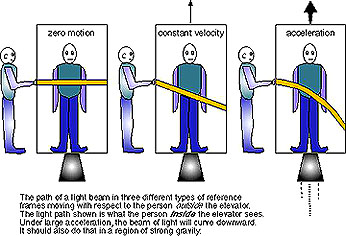
Still a third elevator example:
Start with this illustration.
Imagine the elevator to
have glass sides and to contain an observer inside. A person exterior to it
shines a light horizontally through the elevator. When at rest, both the internal
and the external observer see that the light beam maintains its direct horizontal
path. Then put the elevator into motion upward at a constant velocity and have
the exterior individual again aim the beam at it. The outside person sees no
change in beam direction but the inside person sees it bent down at some constant
angle (thus, stays straight but depressed). If instead, the elevator is accelerating,
the beam passing within becomes curved downward. (Such a sequence of beam path
behaviors is impossible at present to duplicate experimentally since the velocities
and accelerations must be greater than can be acquired by moving vehicles [i.e.,
"elevators"], although space probes orbit or recede fast enough to participate
in relativity experiments.) The third case, the accelerating elevator, which
by equivalence is a gravity-producing analog, demonstrates that a light beam
will follow a curved path when influenced by a powerful gravitation field.
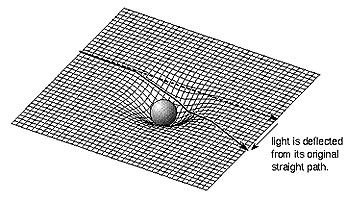
Gravity, on the grand scale
(stars and galaxies), can be conceived as a force field that influences geometry:
in other words, gravity bends or distorts the fabric of spacetime. Matter/energy
determines the curvature of spacetime and is said to "warp" space (this can be
visualized as follows: consider a fastened rubber sheet on which a grid pattern
is drawn; a heavy object, such as a round rock, if allowed to drop on the sheet,
will create a depression and distort the grid around that indentation). This can
be visualized in the drawing below:
One can use this diagram
to imagine how gravity affects an object that comes into its neighborhood. As
it approaches the high mass (pictured here as a sphere that could be a Giant
star), while moving along the grid representing the "fabric" of spacetime in
two dimensions, it will start to follow the distortion of that grid that produces
a depression. As its motion continues, the object (not shown in this diagram)
must eventually end up "trapped" as it reaches the sphere (this is just analogous
to being drawn to the sphere by ever-increasing gravity). In this Einsteinian
depiction it is the local curvature of space by mass rather than the Newtonian
force that delivers objects to the mass itself. (The incoming object can escape
this "trap" by exerting enough energy (force) to steer away from, or out of,
the depression.)
In a sense, gravity adds another
"spatial" dimension by inducing this curvature. Gravity then, in Einstein's view,
is just the effect of masses imposing curvature in the four-dimensional extension
of space, i.e., spacetime. The physicist John Wheeler summed the concept succinctly:
"Space tells matter [mass] how to move; matter tells space how to curve".
The "acid test" of the validity
of General Relativity is the actual observation of light from distant stars being
bent (slightly, but measurable) during a full solar eclipse, so that the stars
just beyond the edge of the Sun appear to shift in position relative their usual
position in the sky. This test (done by English astromers under Sir Arthur Eddington's
direction) was first successfully conducted during a May, 1919 solar eclipse,
resulting in a small but measured displacement of stars near the darkened Sun;
this now famous experiment marked the widespread acceptance of General Relativity
among physicists and astronomers. Afterwards, the test has been repeated many
time, always confirming to within experimental error the predicted amount of displacement
based on the mathematics of General Relativity. The test led to worldwide notoriety
for Einstein, so that his name became known to the "man in the street". Once his
fame was established, he was persuaded to become involved in Peace groups, and
as a promoter of the (ill-fated) League of Nations; his preeminence as a top scientist
also gave him leverage as a spokesman for the Zionist effort to gain a homeland
in Palestine (some years after Israel was established in 1947 by UN mandate, he
was offered the honorific position as its first President but had to decline because
of health).
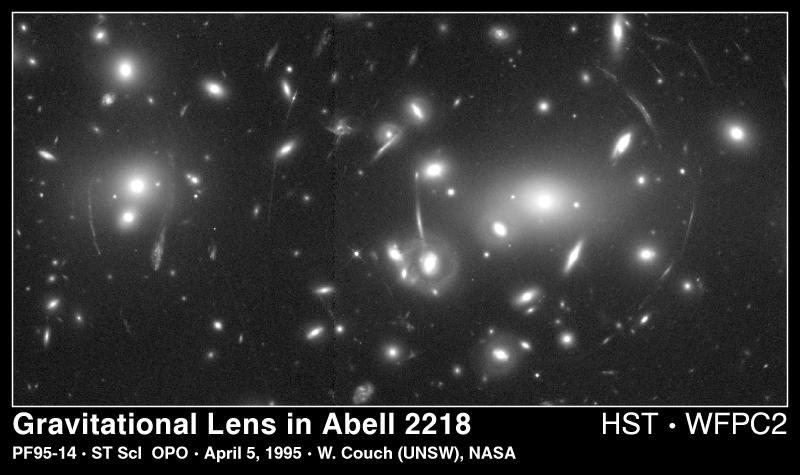
Now the principle is used
to explain the gravitational lens effect. Light from, for example, a very distant
quasar that passes a massive galaxy closer to Earth can be bent to produce double
(rarely triple) images.In other words, gravitational attraction causes a slight
but measurable curvature of the path of a light beam wherever the beam passes
near a massive object. Sometimes the distant object's lensed image is spread out
in an arc pattern. This Hubble Space Telescope image shows an example of this
effect.
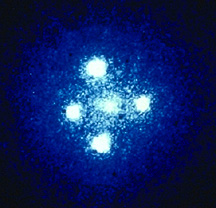
Perhaps the most "spectacular"
display of gravitational lensing is the Einstein Cross, in which a quasar
image (G2237-0305, as seen by the HST)is repeated 4 times owing to intervening
objects (probably galaxies) that bend its light:
Einstein also showed that
gravity can affect time as well as space. Experiments have proved that time
runs faster when the gravity field weakens as a clock is moved away from the
source of the gravitational pull. One specific test to verify this notion: When
a rocket was launched away from Earth following a straight vertical trajectory,
a maser signal was transmitted to Earth for a monitoring period of 100 minutes
during the experiment. A systematic shift in signal frequency (thus time-dependent)
occurred compared with the time units that this maser clock produced back on
Earth. Although the change to higher rates of time progression was small (at
a distance of 10000 kilometers it was 0.02% faster than on Earth), it exceeded
by fifty times the experimental error below which the real speeding up would
have been inconclusive. The observed change values enroute agreed closely with
predicted ones based on relativity theory.
<>An early outgrowth
of the consequences of General Relativity is the model devised by Einstein and
others of the type of Universe that would be predicted from its tenets: Thus,
the so-called Einstein Universe is closed, finite, curved and unbounded. This
is covered in more detailed on page 20-9; suffice for now to say that the evidence
based on expansion rates and the amount of total matter/energy found or deduced
for the Universe we have studied argue against this type, and Einstein himself
abandoned this model after Hubble and others showed the Universe to be expanding.
Regardless, the concept of General Relativity still applies to the actual Universe
as we are coming to know and understand it. And, another consequence of Relativity
of interest to those seeking equations to define the Universe's behavior (type
of expansion, etc.) is that these must meet the conditions (or restrictions) that
Relativity imposes on any mathematical model they propose, i.e., the equations
must be compatible with (cannot violate) the precepts deduced from Relativity
as applied to cosmic scales.
These, then, are some rudiments
of Relativity, hopefully not expressed here so superficially in this condensation
that only a vague insight into its characteristics, properties, and influences
will be implanted. Consult any of the references cited above for more details.
Also, you may wish to work through another challenging review of this subject
placed on the Internet by J. Schombert.
Keep in mind also that much of relativity is unfamiliar in terms of everyday life
experiences, so that it is hard to picture the consequences of physical processes
taking place at high speeds. Gravity is weak on Earth and the motions we are subjected
to are quite slow by comparison. For us, Newtonian Physics works well for most
everyday activities on Earth; for the Universe as a whole Einsteinian Physics
and Quantum Mechanics are needed to gain a proper picture of its operations. Because
of Quantum Physics' importance in understanding the achievements of Science at
the small scales below the normal environments - on Earth and in Space - we deal
with in everyday life, some additional paragraphs on this vital subject are presented
below.
Quantum Mechanics (QM) or
Quantum Physics is complementary to Newtonian (Classical) Physics (NP); whereas
the latter applies to macroscopic and normally rigid bodies, QM operates in the
realm of atomic and subatomic particles and radiation (often called the microscosm).
Much of what we experience in NP fails to work in the same way in QM, in which
the behavior of matter and energy seemingly acts in "strange" ways. A hallmark
of QM is that the description of the action of particles that comprise matter
and radiation must be treated as probabilistic - that is, with some degree
of uncertainty which requires statistical analysis. Thus, knowledge of the nature
and behavior of atomic and subatomic particles falls (both physically and metaphysically)
in the category of indeterminancy, which implies that we can never know
precisely the real state and nature of the material "thing" being examined.
The foundation of QM was laid
near the beginning of the 20th century by two of Science’s greats: Max Planck
and Albert Einstein. (Ironically, in later life Einstein never could accept the
main ideas of Quantum Mechanics, in large part because he believed that indeterminancy
has no place in the natural order.) Planck was intrigued by the distribution of
radiant energy (light in the visible range and beyond) coming from a perfect radiatior
or blackbody, for which he derived the Planck Blackbody Law (page
9-1). For such a body at some temperature, it was known that the intensity
of radiation varied with wavelength, with measurable energy confined to a continuous
but finite range of emitted wavelengths. This can be plotted as a spectral curve,
as we observed in the Section on Thermal Remote Sensing (see page 9-2). The shape of
the curve and total energy involved shifts with temperature (Wien’s Displacement
Law; same page). In 1900, Planck provided an explanation for this energy distribution,
and also the discrete locations of discontinuous spectra observed in emission
spectroscopy (see page 13-6), by postulating
that radiant energy is quantized in the sense that it is corpuscular, consisting
of tiny packets of energy called quanta (a quantum is the smallest possible
unit of energy). From this concept, he deduced one of the fundamental formulae
in both remote sensing and, more generally, physics, which we first encountered
in the Introduction (page I-2): E = hf (where
h is the Planck constant [~ 10-27- erg sec]- and f is the frequency
of the quantum [treated as an oscillator, i.e., a particle that vibrates]). Thus,
an excited atom (e.g., heated in an electric arc, as is done in emission spectroscopy)
gives off radiation at different discrete energies that correspond to narrow,
discontinuous, specific wavelengths (inverse of frequency). Likewise, an object
heated to a certain temperature emits continuous radiation over some spectral
range. In each case, the radiation consists of a stream of quanta with particular
properties tied to an energy-wavelength relationship.
This Planck hypothesis languished
until 1905 when Einstein recognized its applicability to his attempt to explain
the previously discovered (by Heinrich Hertz in 1987) photoelectric effect - the
phenomenon in which light striking certain types of metals caused generation of
a stream of electrons (whose existence was verified by J.J. Thomson in 1897) that
could be extracted as an electric flow. The maximum kinetic energy released is
related to the frequency of light in a (monochromatic) beam but this frequency
must be at or above a characteristic (for the metal) frequency that represents
an energy value called the work function φ. The Planck equation for this
effect becomes: K.E. = hf - φ. Einstein deduced that the light consists of
"lumps" or "bundles", which he called photons and surmised were a manifestation
of what Plank had named quanta. These photons are capable of knocking off
electrons (in this use, photoelectrons) from their host atoms that could then
be collected as a current. A specific photon, which Einstein demonstrated to be
the physical entity that Maxwell had postulated earlier to make up electromagnetic
radiation that travels both as a wave and a particle, at a specific wavelength
&lamda; (or frequency) yields a corresponding finite energy (K.E.) value (usually
given in electron volts [eV]) for a released photoelectron. His explanation eventually
(in 1922) won the Nobel Prize in Physics for Einstein.
In 1913, Niels Bohr published
his "picture" of an atom, consisting of a nucleus (proposed earlier by Ernest
Rutherford) and a series of orbits at different (minute) distances from the center
within which electrons at particular energy states for each orbit moved at high
velocities. When some process, such as heating or electrical excitation, caused
an electron to move from one orbital energy level to another, and then the electron
moved back to its initial state, a photon of some specific wavelength was emitted,
according to the relation: E2 - E1= hf. Thus, this transition
from one energy level to another is quantized, i.e., has a discrete value. Bohr
also found that the levels could be assigned integer quantum numbers that account
for the angular momentum L of an electron such that L = n (h/2p) where n can form
a series 1,2,3,4,…. With this concept, the spectral lines for elements like
hydrogen could be explained.
However, the Bohr atom, elegant
though it be as a concept, had limitations when atoms of elements of higher atomic
number were investigated in terms of their spectral outputs when excited. In the
"golden age" of QM, these discoveries were made: 1) when x-rays (energetic photons
with much shorter wavelengths than visible light) acting as particles collide
with others (for example, electrons), some of their momentum is transferred to
the recoiling electrons, with both having new momentums (the Compton Effect) (1923);
this partition of momentum further established that radiation consists of particles;
2) Louis de Broglie (1924) determined that since radiation particles could be
described as also having wavelengths, they must travel as moving waves - thus,
photons have a dual nature, behaving under certain observational conditions
as particles and under other conditions functioning as waves (this wave-particle
duality is a fundamental concept in subatomic or quantum physics; although hinted
at by Planck, it was Einstein's photoelectric effect hypothesis that set the idea
on firm experimental and theoretical grounds); the so-called de Broglie wavelength
for a moving subatomic particle is given by l = h/p where p = the particle’s
momentum mv; 3) W. Pauli announced his Exclusion Principle (1925), that no two
electrons in the same atom can have the same 4 principal quantum numbers; 4) E.
Schroedinger in 1926 published his famed wave equation (see the parenthetical
next paragraph) which better described the movement of free electrons but applies
to other particles including photons, and includes an important term Ψ called
the wave function; 5) Werner Heisenberg in 1927 enunciated the famous Uncertainty
Principle which states that it is not possible to fix both the momentum and the
instantaneous position of a moving particle such as an electron simultaneously
with high precision for both; 6) also in 1927, several investigators conducted
experiments that found diffraction effects when electrons pass through 1 or 2
tiny slits onto a recording screen; the electrons are not directed to either slit
specifically but will pass through one or the other in a manner controlled by
probabilities (see 8 paragraphs below).
The Uncertainty Principle
brings into play the fact (mentioned in Discovery 6 above) that in the quantum
world every event or process cannot be specified exactly. The characterization
must be that of probabilities in the statistical sense. As an example,
the precise orbit and location of an electron around its nucleus can never be
known with certainty - one can only surmise its various possibilities in terms
of a range of probabilities. This means that the electron's position and velocity
are indeterminant. If this is valid, then we must conclude that a purely deterministic
Universe (an idea that goes back to the ancient Greek philosophers and was much
debated in philosophic schools even into the 20th Century) does not fit the
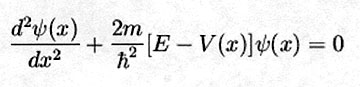
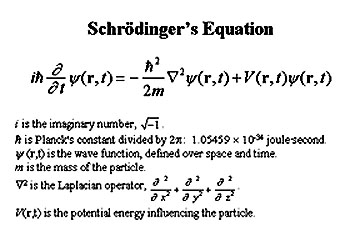
evidence, at least at the quantum level. The Schroedinger Equation
is inherently a probablistic one. We elect here just to show [without elaboration]
this Equation, one of the fundamental mathematical expressions that defines
the wave-particle duality at the heart of Quantum Physics. It can be written
in a variety of ways. First, it is shown in its differential equation form for
the basic case of one-dimensional time-independent functionality:
In this expression, m is the
mass of the particle (Schroedinger's original derivation was for the wave behavior
of the electron), h is the Planck constant, E is the total particle energy, V
is its potential energy, x is the one-dimensional position locator, and Ψ
is the wave function [analogous to amplitude measure for the classical wave equation].
For the three dimensional [using spherical geometry; hence radius r] time-dependent
case, the Schroedinger partial differential equation can be stated as:
We do not expect you to
"fully fathom" the meaning and use of this equation (unless you have had the
proper physics/math background) but simply wish to present it as an elegant
statement of how subatomic particles move in the reality of the micro-world.
Most of the essentials of
QM were thus formulated from 1900 into the decade of the 1920s but further insights
and applications have continued thereafter, including extrapolations to what is
often referred to as Quantum Cosmology. As quantum concepts are applied to Cosmology,
their principal application is tied to the first minute or so of the Universe
when 1) the singularity came into being and 2) the various particles relevant
to atoms were first generated. There are other application later in cosmic time
including formation of the elements within stars.
In the early 20th century,
much of the accruing knowledge came from the study of the electron, with emphasis
on its interaction with light. As a particle, initial concepts perceived it as
having a discrete shape and a sharp boundary and considered it to orbit in a plane
at a precise distance. Instead, it now is conceived to have an indistinct boundary
(its edges are "smeared" out) and to travel with its own electrical field; when
bound to an atom it moves in pathways having an average distance from the nucleus
that can follow any of the innumerable possible orbits along a sphere of reference.
When some apparatus attempts to locate it and determine its velocity, the measuring
method, say a beam of photons, interacts with the electron and in effect disturbs
its motion. Because of the Heisenberg uncertainty, if at any instant information
about its position is reliable (high precision), then corresponding information
about its movement has through the interaction become less well known. This translates
into some degree of unpredictability in any attempt to specify the state of particles
whether within or free of atoms with which they may associate; therefore, certitude
about the location and motion of a particle is denied because of this mutual incompatibility.
Thus, the electron cannot be made to behave as though static to fix a location
without influencing its actual motion. This is true for any particle or wave at
atomic scales. The uncertainty principle can be expressed as an inequality in
the form ΔxΔp is equal to or greater than h, where the product of the
Delta increments (uncertainty limits) for location (x) and momentum (p) is as
large or larger than the value of the Planck constant. A similar argument (ΔEΔt
is equal to or greater than h) concludes that as the time needed to measure the
energy of a moving particle increases, the uncertainty about the energy value
E also increases. One consequence of the Uncertainty Principle is that the behavior
of electrons surrounding the nucleus cannot be described by Newtonian Physics,
which depend on laws of mechanics that work on "rigid" bodies that follow precise
(planetlike) orbits around that nucleus. This requires modification of the Bohr
atom model which is just too simplistic to describe the microscopic realities
in the world of atoms.
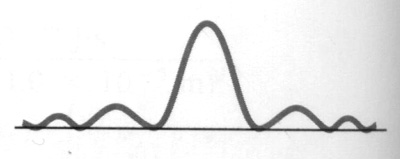
The wave-particle duality
of quanta is demonstrated by shooting a beam of electrons at a plate containing
a narrow slit and then recording the summed pathways over time of these electrons
after they are diffracted at the slit and then travel to a recording medium such
as a fluorescent screen. The result is a pattern typical of that predicted by
wave theory, with a buildup of screen "hits" (persistent light dots on the screen)
that resembles this figure:
Most hits are distributed
along the axis of line of sight of the electrons that got through the slit. But
there is a periodic and symmetric series of highs and lows on either side: these
are the summed numbers of hits from electrons diffracted at different angles.
The hit events result from a probability distribution that arises from the quantum
behavior of electrons (or photons, or other particles) subject to the wave aspect
of their movement (if the particles had not had a wave nature only those electrons
moving in a straight line through the narrow slit would have struck the screen,
reproducing the slit as a thin image.
A more puzzling behavior is
observed when the electron beam encounters two slits close to each other. A somewhat
different interference pattern of highs/lows (light/dark if film is used to record
the diffraction waves) is the outcome. Treating each electron passage as an individual
event, it is not possible to predict or deduce which slit accepted it - each electron
acts as though it is unaware of the other slit it did not pass through. The one
and two slit examples are controlled by different wave functions in the Schroedinger
equation. In either case, for each event the electron (or other particle) went
through only one of the slits but its surrounding field passed through both as
a manifestation of its wave nature.
There is, of course, much
more to QM than this brief summary of its salient features. Here are a few more
comments that may clarify some points.
1) The various forces associated
with the atom (Strong; Weak; Electromagnetic; see page 20-1) act on the particles
that they control by exchange of quanta. (There is at least one school of thought
in Nuclear Physics that speculates that the Strong Force is similar in some respects
to gravitational forces.) The protons and neutrons in the atomic nucleus are held
together through the Strong force by gluons which provide the binding force. Radioactivity
involves statistically random decay within the nucleus that depends on W bosons
to actuate the Weak force; individual nuclear particles (electrons, protons, others)
that cannot be predicted as to any specific atom will escape when that force is
overcome, causing any decayed atom either to become a different isotope of the
element involved or to change into one or more new element species. Electrons,
held around an atomic nucleus by the Electromagnetic force, upon changing energy
states as they are jumped into higher electron shell levels, upon decaying to
lower energy states exude photons that can interact with more electrons or other
particles. These several forces as they act and interact are alternately describable
by Field theory: specifically, at the quantum level, the Yang-Mills field (an
expansion or variant of the Maxwell field that pertains to electromagnetic waves)
describes the operative mode of force exchange at the nuclear level.
2) Quantum theory allows for
some truly strange activities by particles. One is the "tunneling" phenomenon
in which a particle, e.g., the electron, can move across a physical barrier within
which it is confined to appear outside that barrier; this happens probabilistically
and may occur only after a long time. Another activity is even more exotic: there
appears to exist in so-called empty space some form of energy (as yet undetected
and undefined) that allows intermittent "creation" of anti-particles and particles
that last for brief instants before mutually annihilating (see page
20-10).
3) Despite the imprecision
or probabilistic nature of matter and energy at the microscopic levels of space,
QM does not negate our approach to physical phenomena at the more traditional
macroscopic levels. It operates on things at the cosmic scale (atoms in galaxies
and starts) and on processes described in other than quantum terms, such as chemical
bonding, electrical conductivity, thermal properties, and nuclear power, Classical
physics, with its formulae that do not include quantum factors, provides valid
explanations which are functional and allow calculations that describe workable
and meaningful results in a world setting sensible to human scales.
4) QM, which was to mature
after Einstein’s theories of Special and General Relativity, seemed to conflict
with those ideas and for a while eclipsed the conclusions drawn from Relativity.
Einstein had at first conceived of a static, grossly unchanging Universe whose
physics was determined by its geometric properties. He extrapolated the rigidity
of macroscopic behavior according to NP to the atom itself but the evidence from
QM showed conclusively that in the microscopic world Newtonian Laws had to be
replaced by Probabilistic Laws. Despite his major contribution to QM from his
explanation of the Photoelectric effect, Einstein, who remained dubious about
aspects of QM throughout his life. He remained firmly convinced that the physical
world was deterministic (operating under Laws set forth by some external intelligence
- a Creator similar to the philosopher Spinoza's impersonal God). He refused to
accept the indeterminancy of a Quantum microworld (his most famous quote: "God
does not play dice with the World"). Einstein spent his last 35 years (without
success) trying to find equations that integrated gravity and electromagnetic
forces in a single Law that governs all of the physical Universe (physicists still
haven't reached that goal). Eventually, both QM and Relativity were accepted but
now the attention is focused on combining them in the Theory of Everything (written
as TOE), in which the gravitational force (in its relativistic form) is integrated
(reconciled) with quantum forces. Progress in this endeavor has been made but
a verified Theory of Everything remains elusive.
Assuming you have read
the above synopsis of Quantum Mechanics and still want more insight, try this
Web site
which is written to be user-friendly to the uninitiated. A good review of Quantum
Cosmology including the implications of the Instanton concept are examined at
this Cambridge University
site. To recapitulate the above
paragraphs about Special and General Relativity (SGR), Quantum Physics (QP),
and Newtonian Physics (NP) as they apply to Cosmology: QP is most relevant in
the first minutes after the birth of the Universe but continues to apply to
all matter and energy since then; SGR is pertinent to those initial minutes
but has its greatest role as space grows thereafter; NP functions most effectively
when applied and restricted to actions and movements in scales perceptible to
ordinary observations in human experience.
The treatment over the next
13 lengthy pages covers a wide scope and much relevant information but is still
only likely to give a broad-picture comprehension if you, like most, lack the
advanced knowledge and training so esoteric to cosmologists and astrophysicists.
The "worlds" of Quantum Physics and Relativity lie well beyond the experience
of ordinary living and can only be properly fathomed through their mathematical
precepts. The realms of the extremely small and the extremely large
are indeed bizarre. They are however interrelated (determining just how is a work
in progress) through the action of gravity. But one notable difference: for Relativity,
the gravitational fields are continuous; whereas for the subatomic realm, the
quantum fields are discontinuous.
As a parting thought, keep
in mind that Cosmology, like Astronomy and all Science, is still growing as it
solves old and discovers new problems and uncovers principles that will inevitably
modify the basic concepts already developed as working ideas. Thus, there are
today competing models for Universe expansion, precepts for the early moments
of "creation" are still being debated, and even the Big Bang itself is being questioned
both in its details and, by a few, in its essential correctness. Cosmology remains
a somewhat inexact science and is still a work in progress.
Here endeth the Preface. Press
the Back button on your browser or, if that doesn't work, press the Previous flag
or Next flag below (depending on how you accessed the Preface) now to return to
the first page of the Cosmology Section.
* The
speed of light was first estimated in 1678 by Christiaan Huygens. He started time
difference measurements made two years earlier by the astronomer Ole Roemer (credited
with establishing that light travels at a finite speed) of systematic variations
of the time intervals in which moons of Jupiter were eclipsed as the Earth moved
in its orbit from position 1 to position 2 six months later. The difference of
22 minutes was combined with the then estimated value of the mean Earth-Sun distance
to arrive at a speed of light value of 2.3 x 10⁸ m/sec, about 77% of
the currently accepted value. In 1849, Armand Fizeau (in Paris) used laboratory
apparatus to improve the measurement, obtaining a speed of 3.15 x 10⁸
m/sec. Later measurements closed in on the present value (2.998 x 10⁸
m/sec); this most precise value has been determined with timing based on use of
the cesium-beam atomic clock.