Water conservation potential-
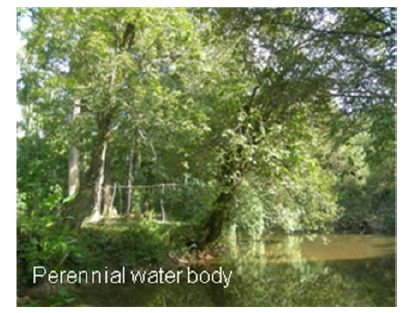
All these five groves are associated with water bodies
(either seasonal or perennial). The pond belongs to Jatti
bana or kereamma in Kalyanpur is a part of grove area
and is considered as sacred by local community. While
in Choudibana of Dugimane village, a perennial pond is
associated with the grove and the grove is seasonally
flooded with rainwater. Remaining three groves i.e.
Devarabatti kanu and Kadanmattibiralu bana of Mattigar
village and Kadkod Choudamma bana in Aralihonda
have seasonal water bodies. The ponds are perennial in
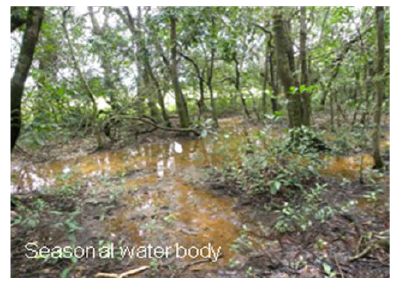
nature and are used at local level for domestic purpose. On the other hand, seasonal water
bodies have water for longer time period except extreme summer months i.e. April and May.
Although these seasonal water bodies have no direct use for local community it keeps the
temperature down inside the grove, provide necessary moisture for germination and
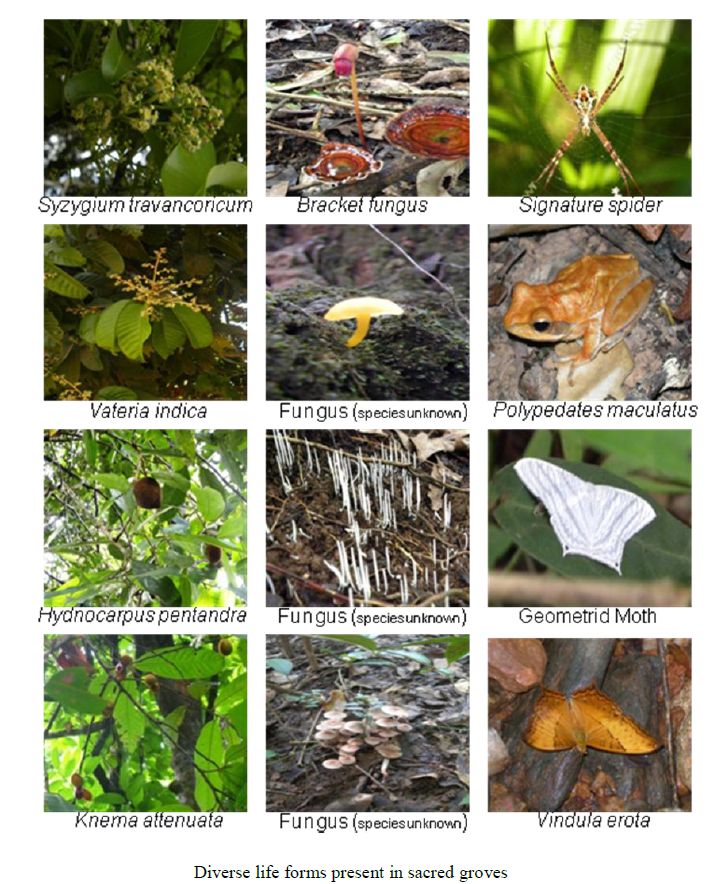
establishment of seedlings, support decomposition activities at grove floor and numerous life
forms (lower group of plants and animals) in the system. Presence of moisture sensitive
woody species in the grove indicates favourable microclimate in the area.
Threats to the groves
However, interactions with the villagers have revealed that, it is the changing religious
practices which effects grove maintenance and existence mostly. Although the studied groves
were fairly well protected but peoples inclination towards temple centric worship cannot be
overruled. It has been found that, once the focus of worship has shifted towards temple or
icon based practices, natural vegetation of the grove becomes irrelevant for further
management. Similarly, rapid land use changes in the surroundings often lead to
establishment of invasive species at grove border, change in microclimate, blockage of the
water sources and gradual reduction of the grove area. However, in studied groves these
effects are still at minimal level but active involvement of all stakeholders is very necessary
in this regard.
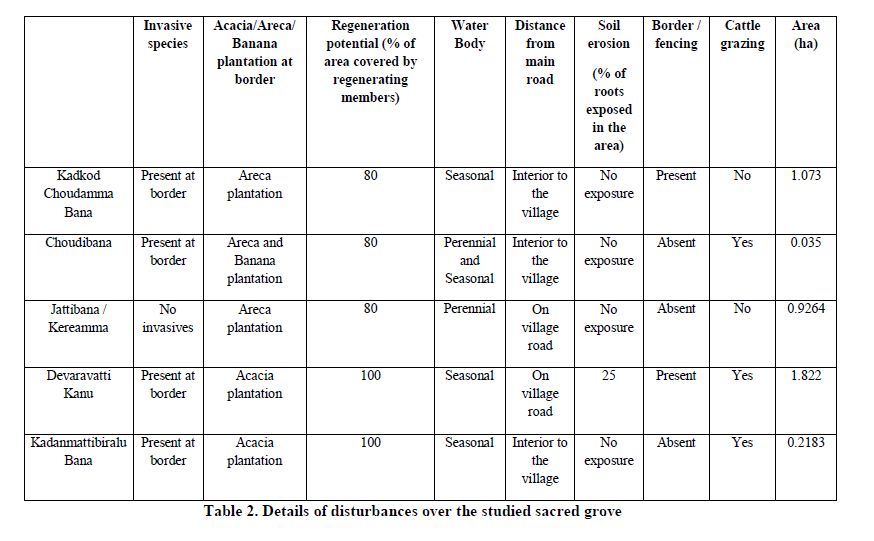
We have studied nine (9) disturbance factors for all five groves (Table 2). Based on the
relative disturbance scores groves have been categorised into highly disturbed (76-100%),
moderately disturbed (51-75%), disturbed (26-50%) and undisturbed (0-25%). All except one
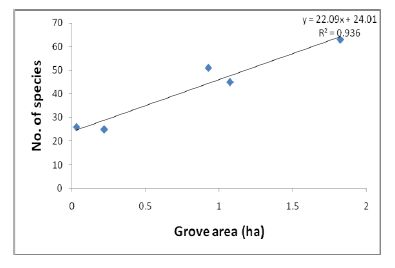
comes under less disturbed condition (i.e. 26-50% disturbed). Their area ranges from 0.2-1.8
ha and protection ensured by either boundary demarcation or existing social norms Moreover,
factors like proximity to water body, comparatively undisturbed interior provide suitable
microclimate for diverse members therefore provide ecological security. On the contrary,
Choudibana in Dugimane village find to be in moderately disturbed condition, principle
factors are small area (0.03 ha), lack of protection and maintenance
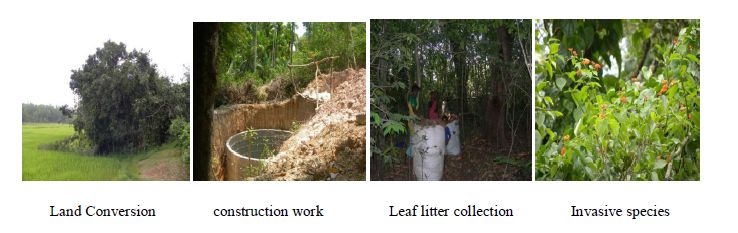
Apart from local community’s involvement, it is believed that forest department can play a major role in the protection of sacred grove. Being the legal owner of the land, it is expected that some minimal level of attention should be paid by them for management and maintenance of these groves. Groves can be maintained under community forestry / community reserve category. Innovative approaches like, carbon credit, restoration programs, incentive for conservation of rare, threatened and endemic species could be introduced to motivate the community people for grove management and conservation.
It is worthwhile to mention here, how simple protection measures at community level can boost up the entire grove system in terms of vegetation profile and water availability. The Devarabatti kanu of Mattigar village, had been studied by the researchers from Centre for Ecological Sciences, Indian Institute of Science (CES, IISc) in 1991 and based on their observation few protection measures were suggested to the local villagers. As a part of their current activity, very recently CES researchers have studied the same fragment to assess the impact of the conservation measures taken by the villagers. Comparative assessment of the vegetation profile has shown that all the characteristic features like tree density, basal area, endemism, species richness and others have increased over time. Natural disturbances like tree felling facilitates introduction of generalist species but forest species occupy a good percentage of the current vegetation. Regeneration study shows good potential for forest and endemic species. However, few recent disturbances (e.g. cattle grazing, leaf manure collection, uncontrolled entry etc.) have been noticed which require urgent attention from concerned authority. Overall, this study has pointed out that proper protection and maintenance of natural condition could be enough to protect sacred grove fragments from degradation.