| Theme: 7. Environment—Monitoring and Management, Environment education | Paper 1 | Paper 2 | Paper 3 | Paper 4 |
A Project approach to Conservation and Bio-diversity of lake-biota for understanding the concept of Environmental Education at School Level |
|||
| Presentation PDF | |||
| 1. Abstract |
In view of the supreme court's order to introduce environmental education in school syllabus in all classes, an attempt has been made to introduce a project based approach to inculcate the environment related values and scientific s prit of inquiry in them regarding lake biota of Mysore city.
A few model projects have been designed and worked out with school students to know the various immediate concerns related to conservation of bio-diversity.
2. Introduction |
Environmental education has been identified as an integral part of our education system for a longtime. The Supreme Court has directed all states and educational agencies in the country to introduce environmental education as a compulsory subject. National consultations on Environmental education in Schools were organized by NCERT which included scientists, Environmentalists, officials from state and center dealing with environment, departments of Environmental Science and Ecology, Teacher educators, NGOS, they identified mission and objectives for the implementation of Environmental education in Schools. The mission, could be stated as ,” To Prepare young minds to appreciate the importance of Environment in a holistic manner, not only for human survival but for all life forms on earth, to inoculate positive attitude towards environment, and to encourage proactive action for a sustainable future”.
3. Aim & Objectives |
The objectives listed one to develop in the children
• an awareness environment and its problems
• basic Knowledge and Understanding of environment and it inter relationships with man
• habits, values, attitudes and emotions to maintain and promote quality environment for human survival
• ability to assess environmental problems
• a sense of responsibility and urgency to ensure appropriate action to solve environmental problems.
Keeping these objectives in mind curriculum and syllabus are framed and suitable pedagogy and methodologies are identified. At primary stage, simple concepts of environmental education are covered; Knowledge about our body, food, air, water, clothing, immediate environmental etc… are covered. At higher Primary and Secondary levels, higher concepts are taken care. At higher secondary level all core subjects cover the concerns of environment the coverage of concepts includes the sustainable development, pollution, global warming, water-pollution, properties of water land pollution, ecology, protection of environment, understanding life on earth, ecosystem, conservation of natural resources etc….
Appropriate teaching strategies, methodologies lead to the learning process in children along with development of positive attitudes towards environment and its protection, Learning through active participation in activities by interacting with the real environment makes children understand better. Several strategies have been worked out. Presently a strategy called “Project Method” has been planned and worked out.
Project is a whole hearted, systematic approach to analyze the problem and come out with suitable solutions to the problem”. Through projects it is possible to develop skills, scientific, social, and educational, attitudes and values can be inculcated. Here water was taken as one of the natural resources of Environment that plays significant role for the survival of life on earth. It is chosen as theme and simple projects have been designed. XII Standard Students of Demonstration School and KendriyaVidyala, Mysore have tried out these projects. Certain guidelines are also given here to help children to taken up project work. Chemical Nature of water and Biological Properties of pond water system has been selected for present study.
Analysis of water sample:
( A ) Chemical properties of water
( B ) Physical Properties of Water
( C )Biological Properties:
For example certain planktons act as indicators of pollution of water and can be studied qualitatively and quantitatively. The details of biotic community is given below
4. BIOLOGICAL ANALYSIS |
EXPERIMENT
AIM: Collection and Preservation of Biological Water Sample for Biological analysis
To collect and preserve the water sample for Biological Studies
The methods for the collection of samples for Biological Studies vary greatly due to diversity of life forms (Plankton, macrophytes, etc).
Requirements:
1. 4% formation to be prepared from 40% formaldehyde in water.
2. Jerkins (small container made up of plastic, dropper).
Procedure:
5. EXPERIMENT |
AIM: Qualitative Composition of Phytoplankton
AIM: To observe and identify various phytoplanktons's in different water samples.
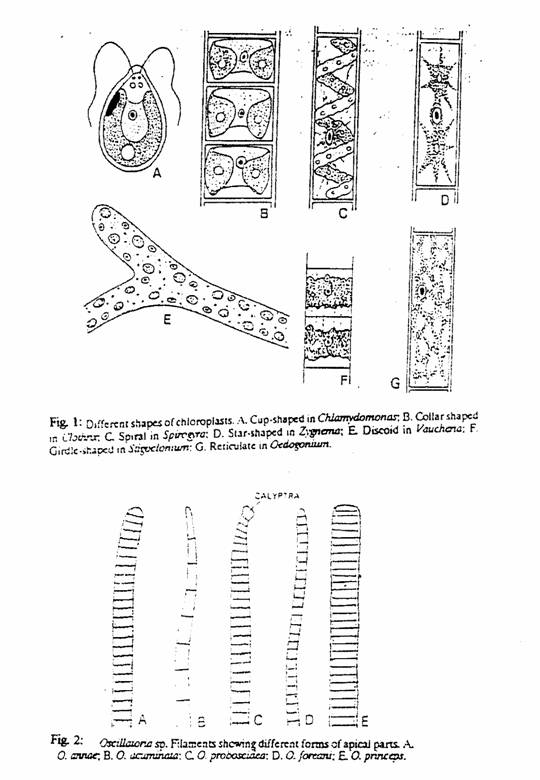
Phytoplanktons are the primary producers in the aquatic ecosystem and the entire aquatic life sustains on the quality and quantity of the phytoplankton. Hence it is imperative to identify the various phytoplanktons. In the following pages a list of common phytoplanktons is given.
CYNOPHYCEAE
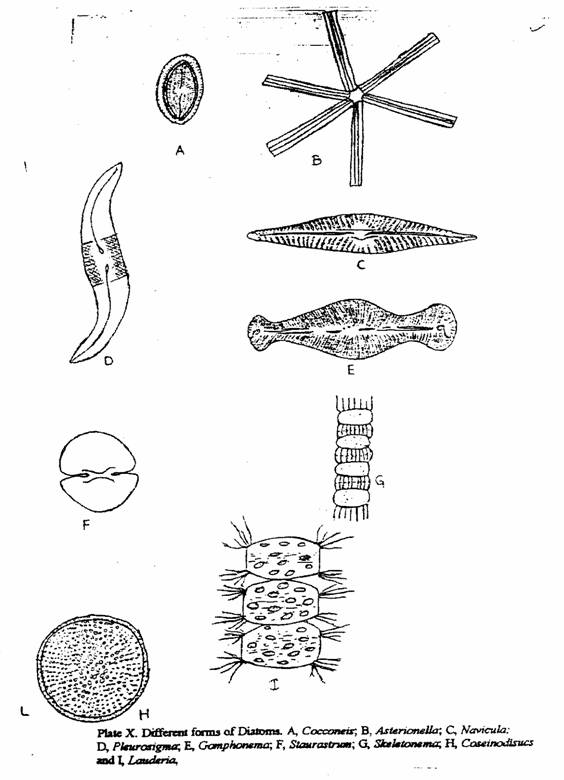
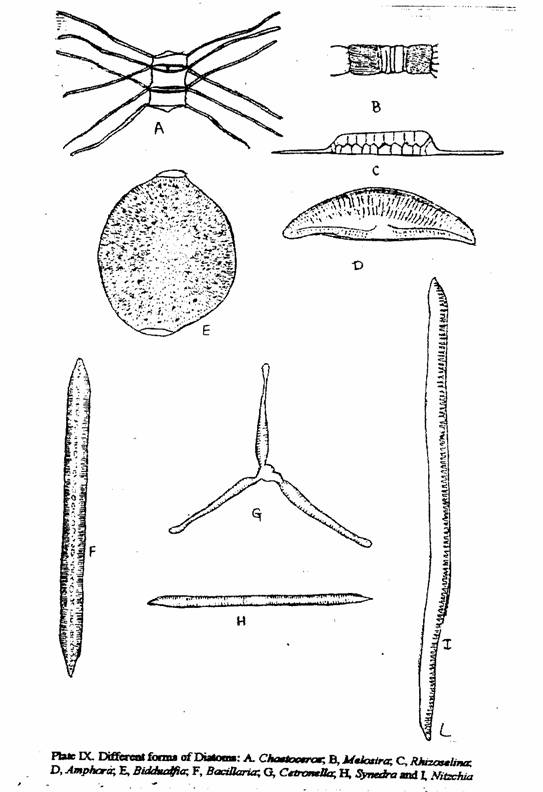
B. BACILLARIOPHYCEAE
EXPERIMENT
Aim: Collection, Preservation and analysis of zooplankton
Plankton as a term was first used by Victor Hansen (1887) for the aquatic communities of floating and drafting organisms that are carried primarily by movement of water rather than by their own swimming ability.
1.2 Type of Plankton
The plankton, which constitutes an association of plants, is termed as phytoplankton. The animal constituent of the plankton is known as zooplankton.
Role of Zooplankton
Zooplankton forms an important link in the food chain as secondary producers. They play an important role in the conversion of energy from primary to secondary level.
Ecological Classification of Zooplankton
Classification used as habitat
A. Marine plankton
B. Fresh water plankton (Limnoplankton)
Classification used as depth distribution
i) Pleuston: Those living at the surface of the water, part of whose bodies project in the air.
ii) Neuston: Living in the uppermost part (few to 10mm) of the surfaces micro layer.
iii) Epipelagic: Living between about 200 and 1000 m in daytime.
iv) Bathypelagic: Living below 1000 m.
Classification by length of planktonic life
i) Holoplankton (Permanent plankton): Those living as plankton during their entire life.
ii) Mero plankton (Temporary plankton): Those living as plankton during only a part of their life.
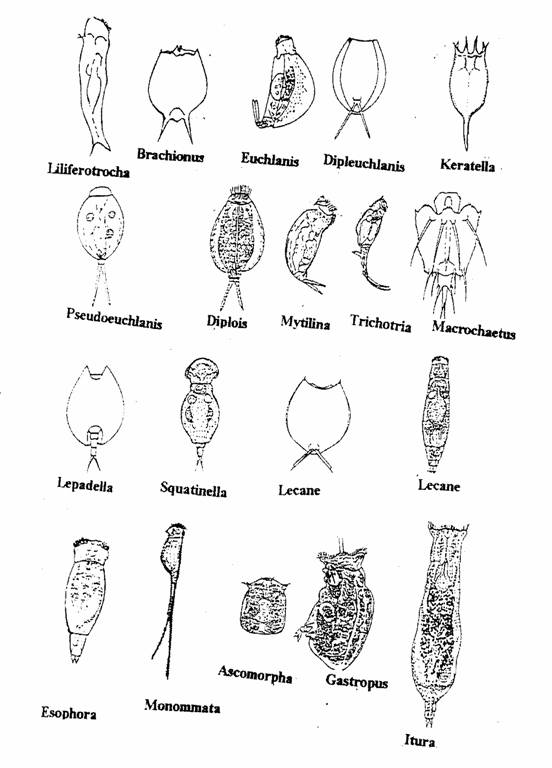
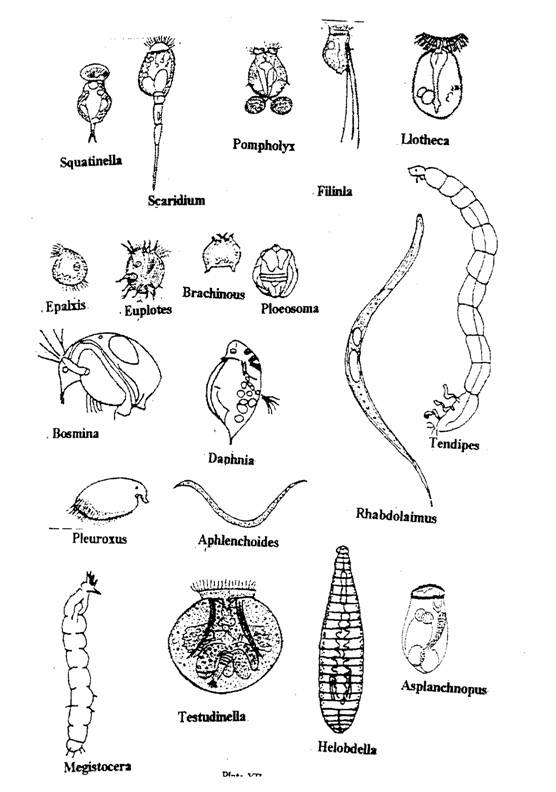
List of common zooplanktons is given below
6. Conclusion |
The following experiments were tested by XII class students of D.M.S and K.V.S schools and they found the manual is very useful in identification phytoplankton & zooplankton and other lake parameters of both physico-chemical in nature. We have planed this project method to give a feel for the students to hand on experience, and away from class learning and rote learning of most of the school children is discouraged and children have developed a critical thinking the school children is discouraged and children have developed a critical thinking about the data and the problem, which is truly the nerve center of science learning thus this project aimed at independent abilities and capabilities for school child to learn more about quality of water, environmental pollution, ecological management, biological conservation, bio-diversity and many more complex problems like salinity of water, reproductive nature of animals with a specific pH of water some of the crucial things, which they can learn through this method.
7.Acknowledgements |
We extend our sincere thanks to Prof.G.T.Bhandage, Head D.E.S.M for encouragement in taking up the study. Our thanks are due to Principal R.I.E, Mysore for giving financial support and guidance.
• A Manual of Zooplankton, Unit of Reproductive Biology and Live Feed Culture Department of Zoology. The New College of Chennai , India . Edited by K. Altaff
• Ramachandra, T.V., Kiran, R. and Ahalya, N. Satus , 2002. Conservation and Management of Wetlands. Allied Pubnlishers (P) Limited.
• Shankar. P. Hosmani. 2002. Phtoplankton – Zooplankton relationship in four freshwater bodies of Darwar. Indian Journal of Environment and Ecoplan. 6(1): 23-28.
• H.N.Srivastava, 1999. Algae.Publised by Pradeep Jain for Pradeep Publications, Jalandhar.
• Lake , 2002. Symposium on Conservation, Restoration and Management of Aquatic Ecosystems. entre for Ecological Sciences, IISc, Bangalore Karnataka Environment Research Foundation Bangalore. Commonwealth of Learning, Canada .
• Puttaiah E T, Distribution pattern of planktonic forms in the lakes of Mysore , 2002.
• Jagannatha V, Urban Waste Water Contributions as Source of Eutrophications, 1982
• International Lake Environment Committee, Data Book on the World Lake-Environs, Oceania and Asia , Oct 1995
• Field-cum-laboratory Manual in Environmental Biology for Secondary and Higher Secondary Levels of the Formal School System of Eastern Zone, 1992. D.G. Rao, Regional college of education, Bhubaneshwar, NCERT
Regional Institute of Education
Mysore - 6
|
