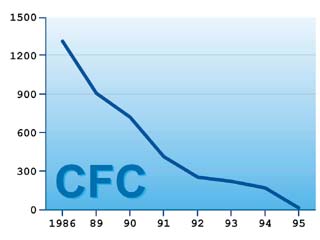
Raw material import of CFCs (tons of Ozone Depletion Potential). Source: SFT, Norwegian Pollution Control Authority .
The Ozone Depletion Potential; ODP, is described as a potential relative to that of CFC-11. The various ozone-depleting substances vary in the degree to which they contribute to the reduction of the ozone layer. Halons, for example, are more efficient than CFCs in depleting ozone, and therefore have a higher ODP.Chlorofluorocarbons (CFCs), halons, methyl chloroform, methyl bromide, carbontetrachloride and several other chemicals are ozone-depleting substances.
When CFCs and halons are released into the atmosphere, they rise slowly, taking up to seven years to reach the stratosphere. But once they are there, under the influence of the sun's ultraviolet light, chlorine is released and react with ozone, with a depletion of the ozone layer as a consequence. This allows harmful solar UV radiation to pass through to the earth's surface. Because it takes so long for the CFCs and halons to reach the stratosphere, any reduction in their use on earth does not have an immediate effect on the concentration in the stratosphere. Some of the ozone depleting substances are persistent, remaining active in the atmosphere for up to 50 years.
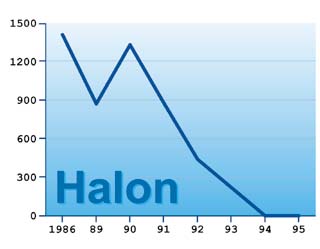
Raw material import of halons (ODP tons). Source: SFT
Most of the CFCs imported to Norway are eventually emitted into the atmosphere. A minor part is degraded and some is recycled. Imports of CFCs, halon and carbontetrachloride to Norway have been stopped. CFC is only allowed used in certain refrigerating systems.Halons are only allowed in existing fire extinction plants, but refillment of halons is prohibited.