| Theme: 13. Need for Environmental Education in Schools and Colleges | Paper 1 | Paper 2 | Paper3 | Paper4 | Paper5 |
| Ahmad Khan | No Abstract | PDF |
The Pakistan Wetlands Programme Executive Summary |
|
What is a wetland? Pakistan is a signatory to the international Ramsar Wetlands Convention and has adopted the comprehensive wetlands definition used by the parties to this Agreement: “ Areas of marsh, fen, peatland or water, whether natural or artificial, permanent or temporary, with water that is static, flowing, fresh, brackish or salt, including areas of marine water, the depth of which at low tide does not exceed six metres ."
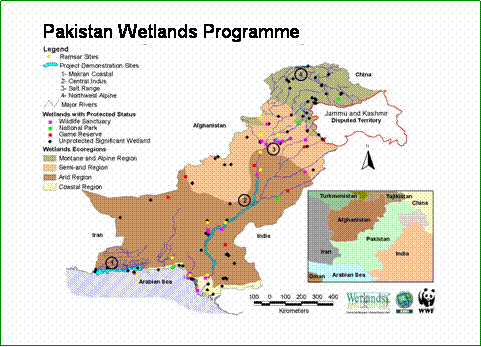
Where do wetlands occur in Pakistan ? Pakistan is blessed with about 225 significant man-made and natural wetlands spread over approximately 10% of the country. Lakes, canals, dams and lagoons formed as part of Pakistan 's extensive Indus Basin Irrigation System are classified as man-made wetlands. Natural wetlands, whether permanent or seasonal, exist as peatlands, rivers, streams, lakes, marshes, estuaries, mudflats and inter-tidal areas. Pakistan 's wetlands occur in a broad variety of ecological zones including arid, semi-arid, alpine and coastal areas.
How do we benefit from wetlands?
• Sustenance for agriculture, grazing and fisheries;
• Provision of vital habitat for wildlife, especially waterfowl;
• Maintenance of water quality and abatement of pollution;
• Flood and erosion control;
• Maintenance of both surface and underground water supplies;
• Tourism, outdoor education, sport and recreation; and
• Map prepared by the WWF-Pakistan GIS Laboratory
What is the socio-economic value of our wetlands? Wetlands and their resources make a significant, though largely unrecognised, contribution to Pakistan 's economy. Both freshwater and marine fish, for example, form a noteworthy portion of fish production and exports. Further, they provide livelihoods for several rural communities such as fisher folk, hunters, graziers and forest users living close to wetlands. Other people also use wetland products on a daily basis. Fish and fish products, baskets, blinds and reed mats and herbal medicines comprise just a few examples of these products. Rural people, especially poor households, also extract and process wetlands material for meeting daily needs. Thatched roofs - a common sight in rural areas - are made from emergent wetlands vegetation and fire wood is often gathered from forests found around wetlands. What is the biological value of our wetlands? Pakistan 's wetlands support a broad spectrum of important plant species and invertebrate and vertebrate animals. The latter includes a range of threatened, endemic and endangered species: five species of mammals, nine bird species, six forms of reptile, and about six freshwater, estuarine and marine fish types. Several of these animals are world famous such as the Indus Dolphin, Punjab Urial, Marsh Crocodile and Green and Olive Ridley Turtles. Many types of migratory birds including White-headed Duck, Siberian Cranes, Sarus Cranes, Greater Flamingos and Spot-billed Pelicans use Pakistan 's wetlands as wintering grounds. What are the threats to Pakistan 's wetlands? Our wetlands are generally degrading due to a whole range of human–induced threats including the following: • Conversion of wetlands and their immediate surroundings for agriculture and other purposes; • Damming of rivers and changes in water flow regimes; • Over harvesting of many forms of wetlands resources; • Felling of timber and deforestation of catchment areas; • Organic and inorganic pollution of wetlands; • Policy deficiencies and inadequate management. The Pakistan Wetlands Programme: Headquartered in Islamabad , t he Programme aims to promote the conservation of the country's freshwater and coastal wetlands and their associated biodiversity by means of two distinct sub-sets of interventions: • The creation of a positive, enabling national environment for wetlands conservation through policy development, training, capacity and awareness building; • The provision of replicable working examples in the form of community-based management plans for four wetlands complexes, each representing a specific eco-region.
Programme Approach: The Programme takes a broad participatory approach to promote increased public, institutional and policy support for wetlands conservation. It focuses on both Pakistani society at large and on key stakeholders to build awareness, improve capacity and elicit technical and financial support for wetlands conservation in Pakistan . Partner institutions will comprise of government agencies, non-governmental organisations, educational and research institutions, media and civil society organisations. Community involvement will be underpinned by supporting local institutions, user-rights agreements, participatory planning and management of wetlands complexes and alternative income generation initiatives. These measures, together with increased awareness, will enable rural communities to conserve wetlands resources and manage them for maximum sustainable benefit. |
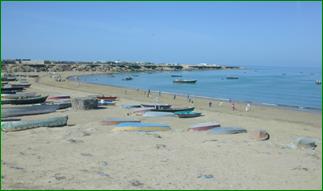
Jiwani: Makran Coastal Wetlands Complex |
|
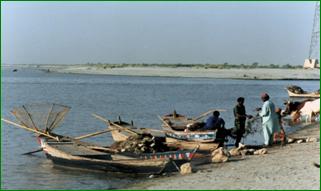
Taunsa: Central Indus Wetlands Complex |
||
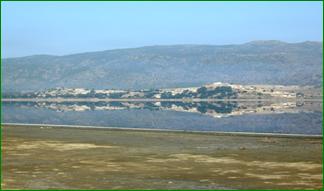
Ucchali Lake : Salt Range Wetlands Complex |
||
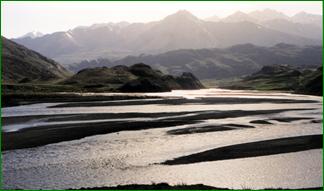
Yarkhun River : North-west Alpine Wetlands Complex |
Continued overleaf . . . .
Programme components:
1. Creation of a national enabling environment:
• Strengthening of appropriate institutions for the sustainable management and conservation of wetlands;
• Development and implementation of a comprehensive, inter-sectoral, National Wetlands Conservation Strategy;
• Enhancement of planning and management capacity for wetlands conservation by the introduction of decision-making tools such as Geographic Information Systems;
• Enhancement of technical capacity within key government agencies and communities to conserve wetlands;
• Improvement of public awareness and support for wetlands conservation; and
• Development of effective financial sustainability mechanisms for wetlands conservation.
2. Implementation of participatory wetlands management in four demonstration sites:
Makran Coastal Wetlands Complex : Extending westwards along Balochistan's Makran Coast from the Basol River to Jiwani on the border with Iran , this Complex supports a range of cetaceans such as Finless Porpoises and Hump-backed Whales as well as the endangered Marsh Crocodile. Local communities are dependent on fishing and port activities that have led to pressures on marine biodiversity through over-harvesting and pollution. A lack of alternate resources for fuel, fodder and timber has led to unsustainable utilisation of mangroves in the Dasht estuary.
Central Indus Wetlands Complex : Home to Pakistan 's endemic Indus Dolphin, this Complex presents a picture of intensive resource over use to meet subsistence needs. Over-fishing, harmful fishing techniques, agrochemical, industrial and urban pollution, hunting and extraction of wetlands vegetation pose the main threats to wetlands and their associated biodiversity in this Complex. Potential for alternative income generating ventures such as eco-tourism is high and can be encouraged to provide income for people who are acutely dependent on wetlands resources
Salt Range Wetlands Complex : Comprising of a series of adjacent lakes - Kallar Kahar, Khabbeki, Ucchali, Jhalar, and Namal - this Complex provides an important wintering ground for migratory birds and is core habitat for the endemic Punjab Urial. The lakes are degrading in quality and extent due to encroachment of agriculture, over-extraction and pollution of water and a range of other intensive resource-use practices. Fortunately, the local inhabitants are well organised in community-based organisations and recognise the dire need to conserve the wetlands biodiversity and other resources of the area.
North-west Alpine Wetlands Complex : Located in the upper Yarkhun River Valley at elevations from 3,000 to 4,200 m, this Complex includes some of the highest biologically active wetlands on earth. Its glacial lakes, braided stream beds and extensive peatlands provide a seasonal refuge to Palaearctic bird migrants and Marco Polo sheep. They also support a substantial local population composed essentially of hardy Wakhi people whose semi-permanent habitation is established well above the tree line. Emergent and peripheral wetlands vegetation is seasonally subjected to unsustainable use by Wakhi people and their livestock.
Key facts about the Pakistan Wetlands Programme
· GEF Implementing Agency: UNDP · Implementing Partner : Ministry of Environment · Programme Implementing Agent : WWF – Pakistan
· Duration: 7 years · Scope: Nation-wide · Total Programme Cost : US $12.134 million
· Principal Donors: The Royal Netherlands Embassy, The Global Environment Facility, Pakistan Poverty Alleviation Fund,
United Nations Development Programme and WWF Global Network
The Ministry of Environment's Pakistan Wetlands Programme

| Theme: 13. Need for Environmental Education in Schools and Colleges | Paper 1 | Paper 2 | Paper3 | Paper4 | Paper5 |
IMPORTANCE OF ENVIRONMENTAL EDUCATION FOR SUSTAINABLE DEVELOPMENT |
|
In the present scenario due to anthropogenic i.e. man made activities the environmental degradation is in an alarming rate and it results in various environmental issues such as Ozone layer depletion, green house effects, raise in sea water level, improper monsoon and acid rain. Science and Technology have brought immense benefits. However we are paying a high 'price' for it in terms of environmental degradation and this has serious implications for future generations. There is a wrong myth that economic development is based on only in industrialization. But in the international organizations such as World Bank and International Monetary Fund the environmental degradation is considered as the norm. The awareness among the public and industrial generators have to be created and motivated by the updated techniques and incorporating the innovative and implementable solutions to reform our economy which can be achieved through environmental education.
The Science and advanced Teclm01ogYGanhowever only help the process of global sustainable environment in a limited way but cannot deliver it. The success of the technology lies in its implementation part. The moral and ethical education is needed to achieve global environmental sustainability by changing people's attitude to nature and the environment. In spite of conducting more conferences, seminars and world summits towards the protection of environment for the past two decades, the present world is environmentally less sustainable than in the previous days.
The progress whatever the rich developed countries have made so far has largely been achieved through the relocation of their dirty manufacturing facilities to poor developing countries. However the relocation of the manufacturing facilities in this way cannot address the growing problem of anthropogenic pollution - it merely changes the jurisdiction of the pollution created from the 'rich' to the 'poor' world. Therefore in order to achieve the acceptable level of global nvironmental sustainability, the citizens must be empowered with essential knowledge and information especially in developing countries like India.
Thus, the environmental education has two essential components:
1. Alerting the public to the need to achieve global sustainable development and the likely consequences of failing to do so.
2. Focusing the educational curricula for global sustainable development by incorporating the know-how and skills and also the moral imperatives.
Our Central Government has also made it mandatory that from elementary level to college level environmental education need to be included. Since educational institutions are the places where the contact of the society is more it is possible to bring remarkable change in the mindset of the public. To protect children living in polluted regions, environmental education represents a relevant means of prevention because this type of education encourages learners awareness of their environment's ambient conditions, as well as their active participation in solving local problems. It is need for the hour to propose the environmental education with the essential elements of moral philosophy in Schools and Colleges. The younger generations, students are the ef(ective media to bring the enormous change in the
society and hence educating about the environment in these young minds is the right .m:pand aisu ihis is the right time for the same. The resource base is not nexhaustible and there must exist some limit beyond which the rate of exploitation of natural resources will comprise the ability of future generations to meet their own needs. Hence the focus must be on reducing consumption with a view to achieving sustainability.
Wherever possible, strategies for reducing consumption of energy and materials, and greater use of renewable resources, should be incorporated in design and construction. Conventional educational methods is no longer adequate for the real needs of tomorrow. Future engineers and also other specalised area students must acquire knowledge and skills in their own field and keep pace with rapid advances in practically in all branches of engineering as well as other area of specialization.. The communication perspective opens the door to another kind of tools that environmental educators can use in order to improve the educational practice. To this end a generic outline syllabus, including essential elements of moral phiolosphy has to be proposed for the environment education in schools and also undergraduate students in college level.
Key Words: Environmental Education, students, schools and colleges~sustainable development, ethics, morality.
DEPARTMENT OF CIVIL ENGINEERING,
K.S.RANGASAMY COLLEGE OF TECHNOLOGY, TIRUCHENGODE.
| Theme: 13. Need for Environmental Education in Schools and Colleges | Paper 1 | Paper 2 | Paper3 | Paper4 | Paper5 |
Environmintal Education in School- An Overall Perspective of NCF 2005 - A Resume |
|
The National Curriculum Framework is a document which provides guidelines for curriculum planners, textbook writers and The National Curriculum Framework is a document which provides guidelines for curriculum planners, textbook writers and teachers who are the actual implementing agencies and personnel. The present paper deals with overall treatment given to environmental education at different levels of school education and the intended objectives.
Regional Institute of Education, Mysore - 6
| Theme: 13. Need for Environmental Education in Schools and Colleges | Paper 1 | Paper 2 | Paper3 | Paper4 | Paper5 |
PRESERVATION OF MYSORE URBAN WATERBODIES |
|
Jagannatha V* & Sahana J ** |
|
Mysore urban development over a period of 100 years is unique from ecological planning and development. Shri Nalwadi Krishna Raja Wodeyar formed the City Improvement Trust Board (CITB) in 1903. Innovative planning combined with a humanitarian approach had been cited as the hallmark of CITB. Mysore development authority was constituted in 1988 .Now, environs of Mysore – Nanjungud local planning area cover about 495 sq km. Over 120 water bodies are now endangered in this area. The Mysore Urban Development Authority (MUDA) has the onus to carry the specific ecological features and to provide the city world-class infrastructure so that Mysore becomes a center of Tourism, education and industries.
Study on Mysore Urban development from the EIA and ESTs perspective reveals serious shortcoming leading to loss of valuable resources and irreversible economical and ecological damages. (V.Jagannatha, 1999). During 2002 under ADB support five lakes were earmarked for conservation with Rs 6 crores. However, for lack of pro-activeness only two lakes got conserved. First time, International Lake Environment Committee (ILEC,) format for lake status was prepared for all these five lakes. In these presentation socio technical aspects of over 120 water bodies in Mysore – Nanjungud planning area is proposed based on ILEC guidelines.
* Environmental Engineer/Training manager. /QMS-EMS Auditor ISRO Bangalore; Lake Management Expert, ADB/KUIDFC(2002)
** 1st Year Student, information science & Engg., SJCE, VTU MYSORE- 570006.